TRANSMISSION // 2611.07332v1
Could magnetic fields help explain gas rotation in the Sunflower Galaxy?
Source published
A preprint reconstructs the magnetic fields needed to account for a modelled portion of NGC 5055’s outer gas rotation. The required strengths are comparable to galactic magnetic fields, but depend on assumed gravity, gas thickness and boundary conditions. The study does not establish a magnetic explanation or a globally confined equilibrium.
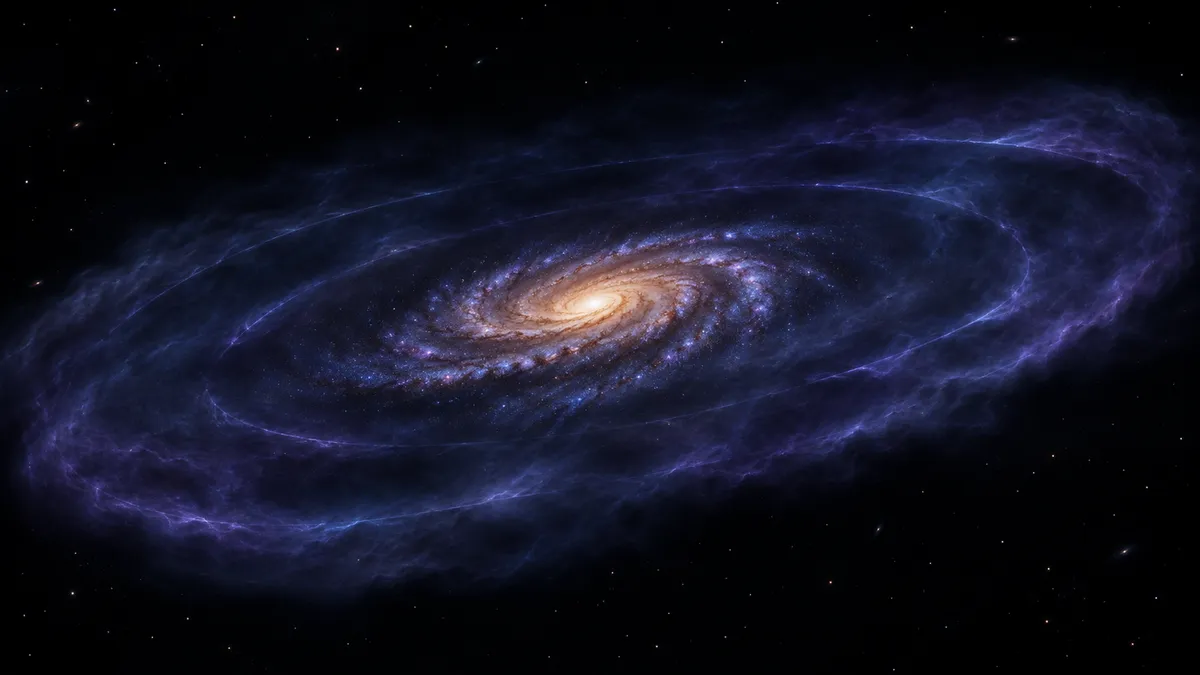
Gas in a galaxy responds to both gravity and magnetic stresses. A new modelling study of NGC 5055, the Sunflower Galaxy, asks whether plausible magnetic fields could account for some outer-disk rotation otherwise attributed to gravity—and shows why field strength alone cannot settle the question.
Reconstructing a possible magnetic contribution
In a preprint posted on November 5, 2026, Natalia Woźniak, Joanna Jałocha, Łukasz Bratek and Szymon Sikora investigate whether magnetic fields could increase the outer gas rotation of NGC 5055. Their calculation identifies fields that would produce a specified additional inward force under simplified conditions. It does not demonstrate that these fields exist in the galaxy’s outskirts.
NGC 5055, also called M63 or the Sunflower Galaxy, has a neutral-hydrogen disk extending well beyond its bright stellar disk. The authors adopt a distance of approximately 7.2 megaparsecs and use previously published rotation, gas-density and stellar-brightness measurements.
The central obstacle is that separate stellar and gas rotation curves are unavailable for this galaxy. Consequently, the study cannot directly measure a difference between gas motion and a stellar tracer of gravity. Instead, it constructs a gravitational reference and asks what magnetic field would account for the remaining rotation.
A deliberately constructed gravity model
The researchers first fit the observed gas rotation with a smooth curve. They then construct a lower outer rotation curve while approximately preserving the inner rotation. Using sums of analytic disk models, they obtain corresponding rotation curves and surface mass densities that are consistent within their adopted thin-disk framework.
Their final, blended reference is designed so that its outer surface density approaches the measured hydrogen-plus-helium profile. This represents a hypothesis in which magnetic forces account entirely for the prescribed outer rotation excess, rather than an independent measurement of the gravitating matter.
That distinction matters for interpreting the inferred mass reduction. The model’s lower outer density follows from its construction; it is not evidence that a dark halo has been observationally eliminated. The paper also notes that finite disk decompositions need not be unique and can depend on the chosen functions and their continuation beyond the fitted region.
How strong would the field need to be?
The magnetic calculation assumes circular motion, rotational symmetry and a purely toroidal field: field lines running in circles around the galaxy. In this geometry, magnetic tension and magnetic-pressure gradients compete. A field declining more slowly than the inverse of radius produces an inward force; a faster decline produces an outward force. Magnetism therefore does not automatically increase rotation.
With hydrogen providing the gas inertia, pressure neglected and a zero field prescribed at the reconstruction’s inner boundary, a constant exponential gas scale height of 1 kiloparsec gives a peak field of approximately 5.47 microgauss near 34.9 kiloparsecs from the centre. A microgauss is one-millionth of a gauss.
Thinner gas requires stronger fields because the same gas column is concentrated into a denser layer. A 250-parsec scale height gives a peak of about 10.95 microgauss, while 200 parsecs gives approximately 12.24 microgauss.
The authors also test layers that thicken outward. Their flaring exponential and Gaussian profiles give peaks of approximately 5.25 and 5.96 microgauss near 33.8 kiloparsecs. However, the thickness prescription is extrapolated beyond its published range of roughly 17 kiloparsecs and is not recalculated for the study’s adopted gravitational potential.
The boundary field introduces another freedom. Setting it to 8 microgauss gives flaring solutions that decline overall to approximately 5.73 and 6.30 microgauss near the last rotation measurement, at 39.7 kiloparsecs. This changes the field amplitude without changing the prescribed radial force difference.
Plausible strengths, substantial limitations
Earlier radio work inferred an average total field of approximately 9.5 microgauss across NGC 5055’s radio-emitting disk. The reconstructed strengths are therefore comparable to known galactic field strengths. But those radio estimates describe a different radial region and the total field, not the ordered circular component required here at 30–40 kiloparsecs.
Other assumptions affect the numbers. Including helium in the magnetically coupled inertia would raise the zero-boundary field amplitudes by approximately 15.5 per cent. The adopted illustrative pressure correction is subdominant in the outer region—about 6 per cent locally near the last rotation measurement for the constant-height fit—but can matter where the rotation excess is small. Changing thickness alters the magnetic calculation’s midplane density without refitting three-dimensional gravity.
The actual galaxy also has a warped, mildly lopsided gas disk and an observed spiral magnetic pattern with a substantial radial component, unlike the simplified geometry.
Most importantly, the authors report that their continued 1-kiloparsec, zero-boundary solution fails a necessary confinement condition for an isolated, pressure-free toroidal exterior. The reconstruction supplies a required stress over a finite interval, not a demonstrated global equilibrium.
Separate stellar and gas kinematics, together with measurements of outer-disk field strength, geometry and radial gradient, would test the interpretation. For now, the result is conditional feasibility within a chosen model, not a confirmed magnetic explanation.
- NGC 5055
- Sunflower Galaxy
- galactic magnetic fields
- rotation curves
- neutral hydrogen
- galaxy dynamics
- magnetohydrodynamics
- preprint
Related reading
Automatically matched by shared topic keywords. These links do not imply that the sources agree or establish a consensus.