TRANSMISSION // 2611.07284v1
A Nearby Galaxy Census Reveals a Few Giants, Flowing Filaments and One Unusual Dwarf
Source published
The preprint The 10 Mpc Volume combines Hubble distance measurements with infrared estimates of stellar mass to examine nearby galaxies. It finds a strong concentration of stars in a few dominant systems, environmental differences in star formation, and coherent galaxy motions associated with surrounding structures. Incomplete coverage and small-number statistics limit broader conclusions.
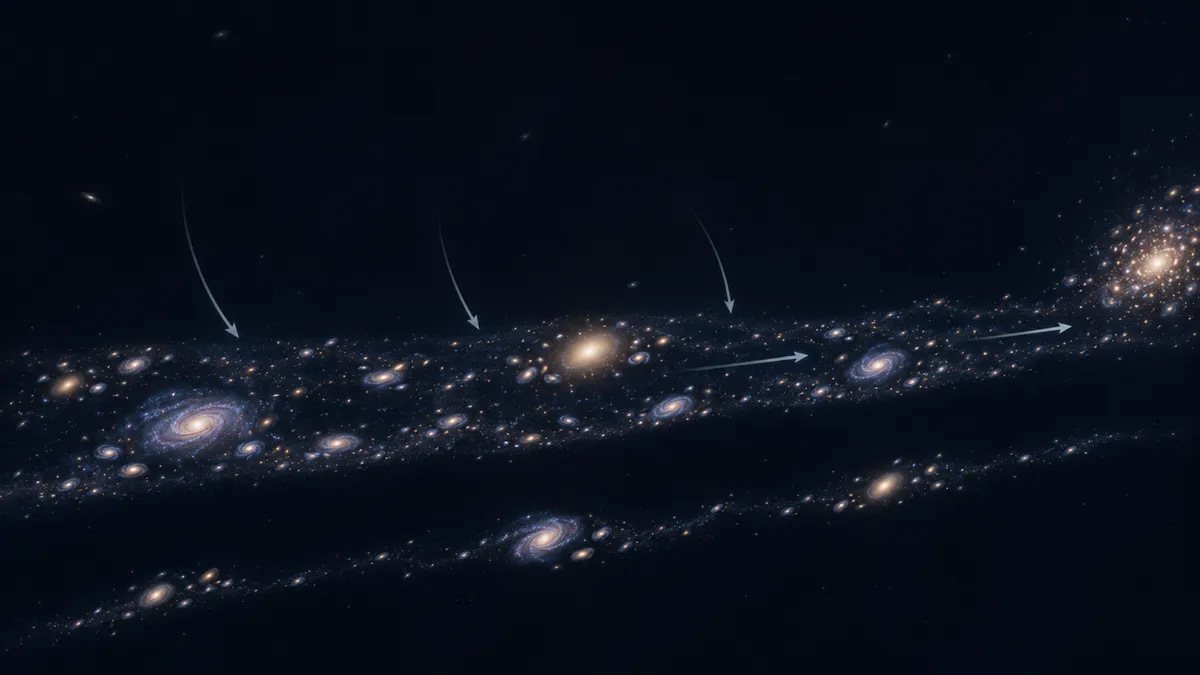
Our galactic neighborhood is neither evenly populated nor moving uniformly with cosmic expansion. In The 10 Mpc Volume, R. Brent Tully and colleagues assemble a detailed view of nearby galaxies, showing how their locations, stellar masses and star-forming activity connect to groups, filaments and the neighboring Local Void.
Measuring the neighborhood
The preprint examines galaxies within 10 megaparsecs, or Mpc, using observations that can distinguish individual bright stars. Hubble Space Telescope images supply distances and information about stellar populations, while mid-infrared measurements from the Wide-field Infrared Explorer, WISE, provide estimates of the mass held in stars.
Much of the distance work uses the tip of the red giant branch, a recognizable feature in diagrams of stellar brightness and color. The authors describe typical distance accuracy of about 5%, provided the observations contain enough suitable stars and avoid problems such as crowding. Confusing red giant stars with another stellar population can produce substantially incorrect distances.
The census is extensive, not complete. For galaxies brighter than an absolute blue magnitude of −13, precision-distance coverage is about 90% within 10 Mpc and 98% within 7 Mpc. Beyond 7 Mpc, uncertainties increase. The Milky Way also obscures some nearby systems, and galaxies fainter than the brightness threshold are incompletely sampled. Different analyses therefore use different distance and brightness cuts.
Sheets and filaments in motion
Most nearby galaxies occupy recognizable structures rather than filling space evenly. The dominant structure is the flattened Local Sheet, which contains our own neighborhood. Another structure, called the Leo Spur in this study, lies roughly parallel to it, about 6 Mpc away. The Pegasus Spur contributes a smaller part of the sample. Much of the region above the Local Sheet belongs to the sparsely populated Local Void.
Accurate distances let researchers separate expected cosmic expansion from additional motions, called peculiar velocities. Galaxies within a filament tend to move coherently, but neighboring structures can have distinctly different motions. The Local Sheet and Leo Spur are converging relative to uniform cosmic expansion at about 260 kilometers per second.
The authors interpret this pattern using larger-scale reconstructions of galaxy motions. Expansion of the Local Void contributes to the Local Sheet’s motion toward the Leo Spur, while attraction toward the Virgo Cluster produces another velocity gradient. Virgo itself lies outside the study volume, at about 16 Mpc. These interpretations draw on models extending well beyond the nearby census, rather than on local positions alone.
A small number of systems hold most stars
The stellar-mass distribution is strikingly uneven. In one sample of 370 galaxies between 1 and 10 Mpc, selected using infrared brightness and Galactic latitude, the estimated stellar mass totals 1.70 trillion solar masses. More than 80% lies in galaxies brighter than a WISE W1 absolute magnitude of −20.5.
Grouping galaxies by their gravitational halos makes the concentration stronger. In the analysis restricted to distances between 1 and 9 Mpc, five dominant halos contain half the stellar mass, and ten account for about three-quarters. These stellar masses should not be confused with total halo masses, which also account for dark matter.
The authors also identify a shortage of systems immediately below the dominant galaxies in brightness and mass. A corresponding feature appears in halo masses inferred from near-infrared luminosities, around a trillion solar masses. Its detailed interpretation depends on the assumed relationship between luminosity and halo mass.
The paper discusses possible tension with the standard cosmological model involving dark energy and cold dark matter. However, the authors emphasize the weak statistics available in this small volume and call for further tests. The gap is an observational feature to investigate, not a demonstrated failure of cosmology.
Environment and stellar history
Dominant galaxies generally retain gas and show ongoing or recent star formation. This pattern extends to dwarf galaxies occupying separate halos. Secondary galaxies sharing a more massive system’s halo are more often gas-poor and lack evidence of recent star formation.
The authors discuss several possible mechanisms, including loss of an incoming galaxy’s outer gas reservoir and removal of gas through interactions. The census establishes an environmental contrast; it does not identify one mechanism as the explanation for every galaxy.
Almost all sufficiently observed galaxies in the brightness-limited sample have prominent red giant branches, consistent with early star formation. KKR 18 stands out. This isolated dwarf in the Local Void has an estimated distance of 9.7 ± 0.8 Mpc and a weak red giant branch. Its stellar diagram suggests that most of its stars formed within the last few billion years.
That does not establish that KKR 18 contains no ancient stars. Its distance fit is tenuous, and an older population cannot be excluded. Alongside the mass gap and coherent motions, it illustrates the study’s central opportunity: nearby galaxies reveal detailed patterns whose interpretation still requires careful attention to measurement limits.
- nearby galaxies
- Local Sheet
- Local Void
- galaxy groups
- stellar mass
- peculiar velocities
- Hubble Space Telescope
- WISE
- KKR 18