TRANSMISSION // 2611.07253v1
DQ Tau’s molecular gas follows a slower rhythm than its accretion bursts
Source published
Coordinated infrared observations of the young binary DQ Tau reveal that hot molecular emission weakens and narrows across several stellar orbits rather than brightening with each accretion burst. A new preprint interprets the pattern as changes in the gas filling the disk’s inner cavity, while a proposed longer-term cycle remains unconfirmed.
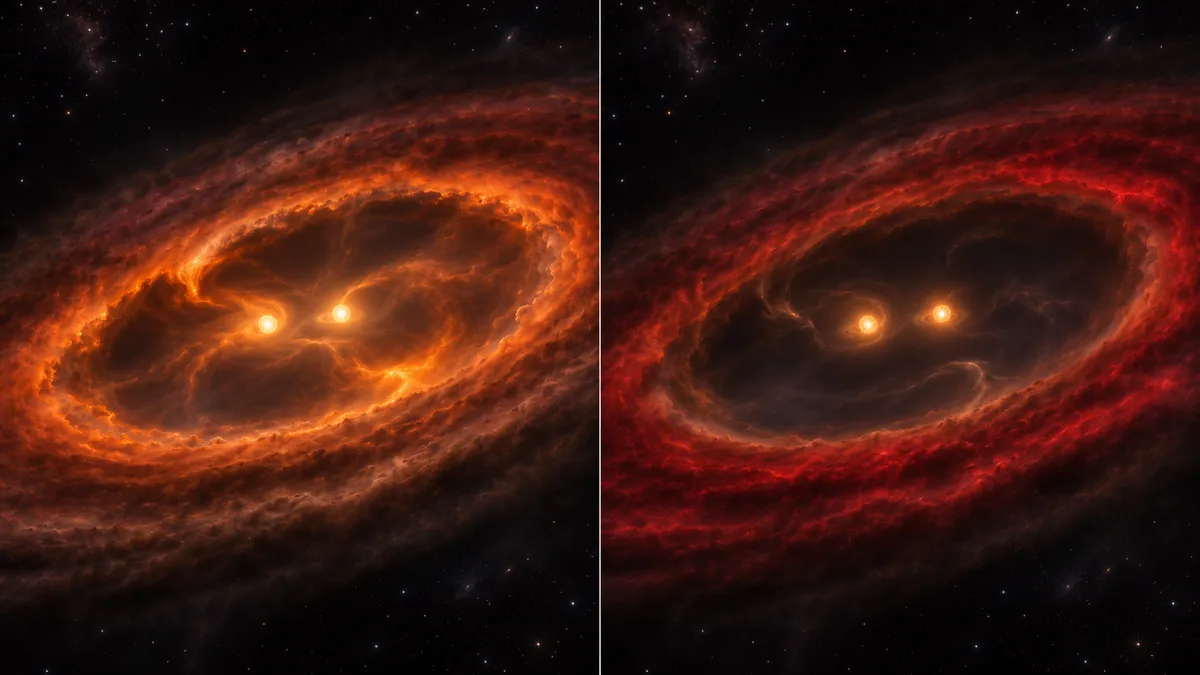
DQ Tau’s two young stars produce accretion bursts roughly every 16 days, offering a predictable experiment in how changing irradiation affects a protoplanetary disk. Observations with the James Webb Space Telescope and a ground-based infrared spectrograph suggest that its molecular gas responds mainly to a slower rearrangement of the inner disk, not to each burst individually.
Two rhythms in one disk
In a new preprint, Jacob Hyden and colleagues report coordinated observations of DQ Tau, a young binary whose elongated orbit helps regulate bursts of material accreting onto its stars. Across three successive bursts, the luminosity associated with accretion rose by factors of roughly nine to 80. Yet the disk’s hot molecular emission did not brighten in step.
Instead, emission from carbon monoxide, water, hydroxyl and hydrogen cyanide generally weakened across multiple orbits. The authors interpret this slower evolution as evidence that the distribution of molecular gas inside the disk changes over time, rather than simply responding chemically to each short increase in irradiation.
The distinction matters because a changing molecular spectrum need not mean a changing chemical composition. It can also reflect where the emitting gas is located, its temperature, density and emitting area.
Watching three bursts from space and Earth
The broader campaign involved seven instruments. This analysis centers on nine observing epochs with JWST’s Mid-Infrared Instrument, MIRI, and nine with iSHELL at NASA’s Infrared Telescope Facility, covering roughly 40 days in September and October 2024.
MIRI measured molecular emission across the mid-infrared spectrum, while iSHELL resolved the velocity structure of carbon monoxide lines. Photometry and other spectroscopy provided the accretion measurements needed to compare the molecular changes with the stellar bursts.
Different signals followed different patterns. Atomic hydrogen emission and the five-micrometer continuum, which traces hotter dust, closely followed accretion variability, although the first continuum epoch was an exception. Hot molecular tracers instead declined toward a minimum about 30–35 days after the first burst, then strengthened in the final observation. Longer-wavelength dust emission generally increased before declining at the end, while colder water emission varied less than its hotter counterpart.
What narrowing lines reveal
A central measurement is the changing width of molecular emission lines. The researchers combined water-line broadening from MIRI with fully velocity-resolved carbon monoxide profiles from iSHELL.
Assuming that orbital motion around both stars dominates the broadening, wider lines indicate emission from smaller characteristic radii. Narrowing lines imply that the emission becomes dominated by gas farther out.
Under this interpretation, the hottest water emission initially reached characteristic radii near 0.1 astronomical units, then receded toward roughly 0.3 astronomical units. Carbon monoxide showed a broadly similar outward trend, with some temporary inward modulation near the stars’ closest approaches.
These are indirect radius estimates, not resolved images. The authors caution that asymmetric streams and other complex motions near the binary could affect the line profiles. Some later high-energy water lines were unresolved, providing only lower limits on their emitting radii.
Independent fits to the water spectrum support the same general picture. Models with hot, warm and cold components indicate declining temperatures in the hot and warm reservoirs. The hot component generally shrank in emitting area, while the warm component expanded overall. These fitted areas describe equivalent emitting surfaces; they do not independently locate the gas within the disk.
Dynamics rather than immediate chemistry
Together, the measurements are consistent with an inner cavity initially rich in hot molecular gas, followed by a reduction in its innermost molecular reservoir. Accretion onto the stars and redistribution by the binary could contribute, leaving cooler gas at larger radii to dominate the spectrum.
The observations favor this dynamical explanation over rapid chemical adjustment to each burst. They are consistent with models in which chemical relaxation in the infrared-emitting region takes roughly 0.1–10 years, much longer than DQ Tau’s bursts, which last less than a week. They do not directly measure those chemical timescales or rule out all chemical effects.
The colder water reservoir also showed much smaller changes than those reported during a longer outburst in EX Lup. The authors suggest that burst duration, not just peak strength, helps determine whether enhanced irradiation produces substantial changes near the water snowline.
A possible longer cycle
The team proposes that gas accumulating near the disk’s inner edge could modulate both molecular emission and burst strength over roughly four to five binary orbits. Later archival MIRI observations, reanalyzed consistently, are compatible with that interpretation.
But a stable cycle has not been established. Historical photometry does not recover a persistent four-to-five-orbit period, and most simulations do not predict the proposed repeating gas accumulation for an eccentric binary like DQ Tau. The origin of the longer modulation remains unresolved. Longer monitoring and models that predict molecular gas distributions are needed to distinguish a recurring process from transient inner-disk dynamics.
- DQ Tau
- protoplanetary disks
- binary stars
- pulsed accretion
- JWST MIRI
- IRTF iSHELL
- molecular gas
- water emission
- disk dynamics
Related reading
Automatically matched by shared topic keywords. These links do not imply that the sources agree or establish a consensus.
Finding Hidden Patterns in the Motions of Planet-Forming Disks
Source published
Shared keywords: protoplanetary disks
Reanalysis Finds No Significant Spiral Rotation in IM Lup’s Planet-Forming Disk
Source published
Shared keywords: protoplanetary disks
Magnesium-rich dust could offer another route to formamide in space
Source published
Shared keywords: protoplanetary disks
Seven pulsar binaries sharpen measurements of stellar orbits and distances
Source published
Shared keywords: binary stars
A binary star in Sagittarius’s Teapot reveals its orbit—and a distance problem
Source published
Shared keywords: binary stars