TRANSMISSION // 2611.07092v1
Young stars hint at feedback-driven formation between two glowing gas regions
Source published
Infrared observations reveal young-star candidates arranged around molecular clouds between Sh2-140 and Sh2-145. Their distribution is consistent with massive stars helping trigger later star formation, but the preprint does not establish whether external compression, rather than the clouds’ own evolution, caused the activity.
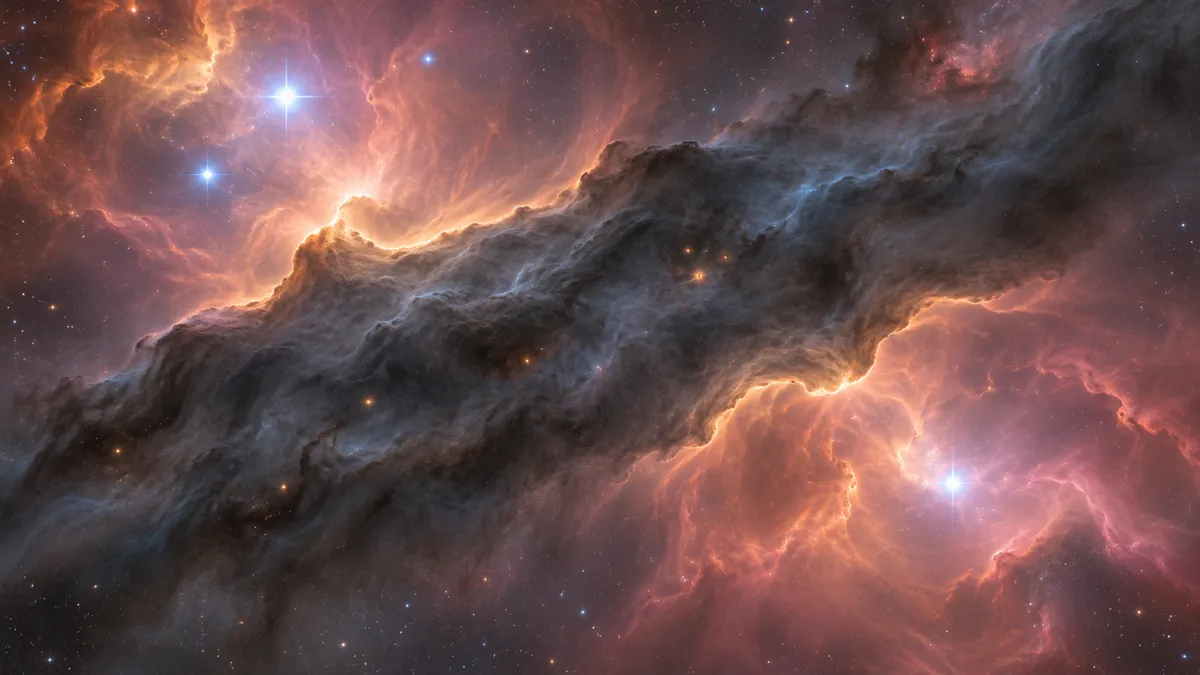
Massive stars can disrupt their birth clouds—or help nearby gas collapse into another generation of stars. A study of the clouds around Sh2-140 and Sh2-145 finds patterns that may reflect the second process, while leaving the crucial question of cause and effect open.
An infrared survey of a star-forming complex in the Cepheus OB2 association has found a suggestive arrangement: younger stellar candidates tend to lie inside molecular clouds, while more evolved candidates appear both within and outside them. The authors interpret this pattern, together with the clouds’ bright edges, as evidence consistent with massive stars influencing subsequent star formation.
The study, by C Rishi, Neelam Panwar and Ajay Kumar Singh, examines the bright-rimmed cloud BRC 44 and the dark cloud LDN 1204, in a region containing two glowing zones of ionized hydrogen, Sh2-140 and Sh2-145. The researchers adopt an approximate distance of 900 parsecs for the complex. Their manuscript is accepted for publication in the Bulletin de la Société Royale des Sciences de Liège, according to the arXiv record; the spatial patterns do not by themselves demonstrate that stellar feedback triggered the young stars’ formation.
A possible chain reaction
Massive stars emit ultraviolet radiation that heats and ionizes surrounding gas, producing what astronomers call H II regions. As these regions expand, they can drive fronts into nearby molecular material. The paper describes two possible consequences: compression that encourages gravitational collapse, or dispersal that inhibits further star formation.
The researchers ask whether the first process has helped shape this complex. Their earlier study of BRC 44 suggested that radiation from massive stars associated with Sh2-145 may have contributed to star formation inside its bright rim. The new work broadens the investigation to the surrounding clouds.
Three massive stars provide the local sources of ionizing radiation. HD 213023 and BD 62 2078 are associated with Sh2-145, while HD 211880 excites Sh2-140. Comparing the positions of these stars, cloud structures and young stellar candidates offers a way to look for a possible sequence of star formation.
Finding young stars through dust
The team used archival observations from the Spitzer Space Telescope and the Wide-field Infrared Survey Explorer, or WISE. Dust makes embedded young stars difficult to identify in visible light, but their surrounding disks and envelopes absorb stellar radiation and re-emit it at infrared wavelengths.
The researchers selected candidates using infrared colors—the differences in brightness measured at different wavelengths. They applied published criteria to remove sources that can resemble young stars, including galaxies, active galactic nuclei and emission features associated with shocks or interstellar material.
Using Spitzer measurements, the authors identified approximately 460 young stellar object candidates. That number refers to the Spitzer selection, not a stated combined total from both telescopes. Spitzer covered only part of the study region, whereas WISE supplied the wider view needed to trace the population across the complex.
The color criteria also separated candidates into Class I and Class II sources. In the paper’s interpretation, Class I objects represent an earlier, more embedded evolutionary stage, while Class II objects are relatively more evolved. These categories provide clues to evolutionary ordering, rather than individual measurements of stellar ages.
Patterns along the clouds
The young-star candidates are unevenly distributed. Many lie northwest of HD 213023 rather than southeast of it. The authors suggest that a greater concentration of gas in that direction could have provided material for gravitational collapse.
They also report that younger Class I candidates preferentially occupy cloud interiors, while Class II candidates occur inside and outside the molecular material. Around BRC 44, candidates follow the bright rim and the layer the authors interpret as compressed gas. This arrangement supports their proposed picture of radiation-driven compression followed by star formation.
An arc-like emission feature extends along one side of the cloud, with BRC 44 at one end and LDN 1204 at the other. The researchers interpret the asymmetric structure as a possible consequence of massive stars forming near a cloud edge and ionized gas expanding through an uneven surrounding medium.
Compression remains a hypothesis
Near Sh2-140, numerous Class I and Class II candidates suggest recent or continuing star formation. Molecular material also appears to sit between the two H II regions, raising the possibility that it is being compressed from both sides.
But an apparent arrangement on the sky does not establish the gas motions or demonstrate what initiated collapse. The paper explicitly calls for molecular-line observations to test whether the cloud dynamics show feedback-driven compression or instead reflect the cloud’s intrinsic evolution. Additional age and motion information would also help assess a sequential history.
The authors say they are conducting a detailed study using millimeter carbon monoxide data. For now, the infrared observations identify a plausible feedback-shaped pattern—not a confirmed causal chain linking the massive stars to a later generation.
- star formation
- stellar feedback
- young stellar objects
- Sh2-140
- Sh2-145
- BRC 44
- LDN 1204
- infrared astronomy
- Spitzer
- WISE
Related reading
Automatically matched by shared topic keywords. These links do not imply that the sources agree or establish a consensus.