TRANSMISSION // 2611.07064v1
JWST Finds Turbulent Early Disks That Depart from Today’s Galaxy Mass–Speed Relation
Source published
In a preprint analyzing 18 galaxies at redshifts 4–6, D. A. Gómez-Espinoza and colleagues identify five isolated disk-like systems. Their inferred masses and circular velocities suggest that the relationship between galaxy mass and internal motion differed from today’s, even after accounting for substantial gas reservoirs. The result remains tentative because the disk sample is small and the velocities require large, model-dependent pressure-support corrections.
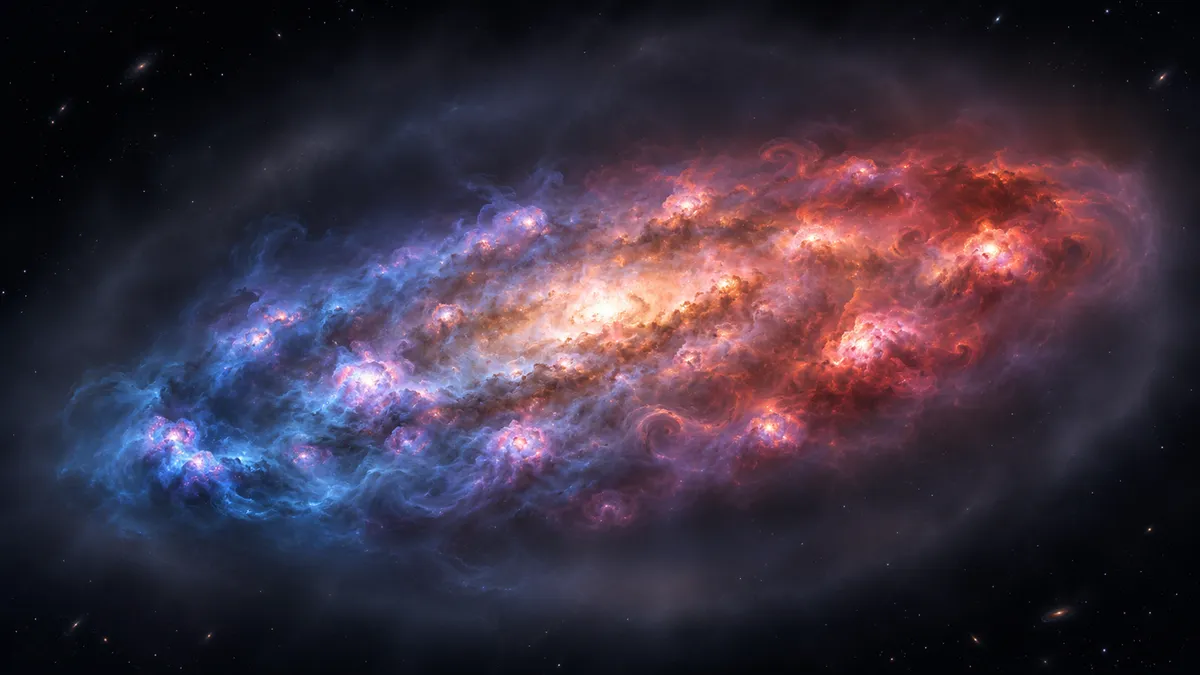
A galaxy can rotate coherently without being a calm, settled disk. Using JWST observations, researchers have identified five early galaxies whose gas shows ordered rotation alongside strong random motions. These turbulent systems offer a tentative glimpse of how the connection between galaxy mass and gravity evolved as disks assembled.
Reading the motion of young galaxies
The Tully–Fisher relation connects a galaxy’s mass with a characteristic speed associated with its gravitational pull. Astronomers study it using either stellar mass alone or baryonic mass: stars plus gas. Comparing the relation across cosmic history can reveal how galaxies assembled matter within their surrounding dark matter halos.
In the ALPINE-CRISTAL-JWST survey preprint, D. A. Gómez-Espinoza and colleagues investigate this connection in 18 star-forming galaxies at redshifts 4–6. Their analysis combines JWST’s NIRSpec integral-field spectroscopy, which provides spectra across a galaxy, with imaging and existing ALMA observations. The authors use the hydrogen Hα emission line to map ionized-gas velocities, while near-infrared images characterize the stellar structure.
Five galaxies meet their criteria for isolated disk-like systems. These criteria assess coherent velocity gradients, alignment between structure and motion, and agreement between the locations of the kinematic and light centers. The five represent 28% of the survey sample, with an uncertainty of 11 percentage points. Nine other systems show disturbed kinematics, and four are classified as galaxy pairs. This fraction describes the selected sample, not necessarily all galaxies at these redshifts.
Rotation with substantial random motion
The five disks are not quiet counterparts of present-day, dynamically cold disks. The authors infer intrinsic rotation speeds of 91–127 kilometers per second and velocity dispersions of 66–129 kilometers per second. Dispersion measures the spread of gas velocities beyond ordered rotation. With rotation-to-dispersion ratios of about 0.9–1.9, random motions remain dynamically important.
That distinction matters for the mass–speed comparison. Gas pressure helps support a turbulent disk against gravity, reducing the rotation needed to maintain it. The researchers therefore correct the measured rotation for pressure support to estimate circular velocity: the speed associated with the gravitational potential rather than the gas’s actual rotation alone.
Their preferred modeling also accounts for inclination, spatial blurring and instrumental line broadening. After these corrections, inferred circular velocities span 186–315 kilometers per second. These are model-derived gravitational speed estimates, not directly observed rotation speeds.
A shifted mass–speed relationship
Gómez-Espinoza and colleagues find that the five disks lie below the nearby-universe stellar-mass Tully–Fisher relation. At a given inferred circular velocity, they contain less stellar mass than the local relation predicts.
Because five galaxies cannot reliably determine the relation’s slope, the team fixes it to the local value and measures its vertical displacement. They obtain a stellar-mass offset of −0.96 ± 0.18 dex relative to nearby galaxies. A dex is a base-ten logarithmic unit; this offset corresponds to roughly nine times less stellar mass at fixed circular velocity. Compared with the relation at redshift 2.3, an epoch known as cosmic noon, the offset is −0.50 ± 0.18 dex.
Adding gas reduces, but does not remove, the discrepancy. Using ionized-carbon emission measured by ALMA to estimate cold-gas masses, the authors infer an average gas fraction of 68% ± 10%. The baryonic relation sits −0.57 ± 0.20 dex below the local relation, equivalent to roughly four times less baryonic mass at fixed circular velocity. Its offset from cosmic noon is smaller and less secure: −0.30 ± 0.20 dex. Three of the five galaxies are broadly consistent with that earlier comparison relation.
An interpretation with important limits
The authors interpret these offsets using an empirical model that combines evolving halo properties, gas fractions and the dark matter contribution inside galaxies. Their measurements are consistent with halo evolution driving the changing relation, moderated by a smaller dark matter contribution within early galaxies’ inner regions. This is a model-based explanation, not direct proof that dark matter is absent or that its fundamental properties changed.
Several limitations affect the result. Pressure-support corrections are large and depend on assumptions about gas density, disk structure and turbulence. Alternative prescriptions give less negative stellar-mass offsets, although their results agree within the uncertainties. Gas masses also rely on a conversion with approximately 0.3 dex scatter; alternative estimates do not substantially change the conclusion within the reported errors.
One disk candidate could instead be an unresolved interaction, and two have previously been identified as possible active-galactic-nucleus hosts. Removing the ambiguous candidate changes the fitted offsets only slightly. Nevertheless, the small sample, limited resolution and uncertain inner dark matter evolution leave the exact size and explanation of the shift tentative. The preprint supports a picture of rotating but turbulent early disks; larger resolved samples are needed to establish how representative they are.
- galaxy evolution
- Tully–Fisher relation
- James Webb Space Telescope
- ALPINE-CRISTAL-JWST
- high-redshift galaxies
- galaxy kinematics
- turbulent disks
- dark matter
Related reading
Automatically matched by shared topic keywords. These links do not imply that the sources agree or establish a consensus.
Early Galaxies Put New Limits on Hidden Neutrino Interactions
Source published
Shared keywords: james webb space telescope
Astronomers propose a 1,000-hour JWST survey to read galaxies’ stellar histories
Source published
Shared keywords: galaxy evolution, high redshift galaxies
How JWST Could Trace the Seeds of the First Massive Black Holes
Source published
Shared keywords: galaxy evolution, james webb space telescope
Hyperion’s Densest Regions Show More X-ray-Active Black Holes
Source published
Shared keywords: high redshift galaxies
Euclid simulations expose the galaxies a bright-line survey can miss
Source published
Shared keywords: galaxy evolution