TRANSMISSION // 2611.07060v1
Why the Timing of Atmospheric Heating Matters for Planetary Spin
Source published
An analytical study connects atmospheric heating, global pressure waves and the torques that change rocky planets’ rotation. The authors reproduce key features of earlier climate simulations and show why large atmospheric tides do not necessarily produce a strong rotational boost: the timing of the heating matters as much as the pressure response.
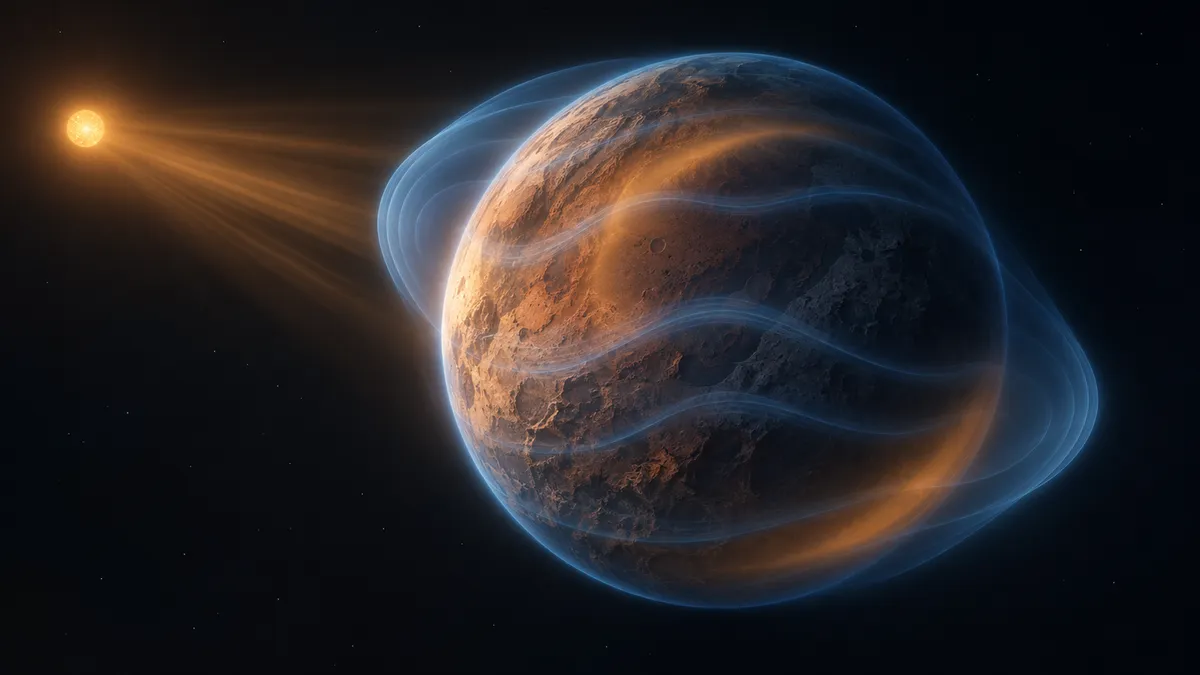
Sunlight can influence a planet’s rotation through more than temperature. By rearranging atmospheric mass, periodic heating creates pressure bulges on which stellar gravity can pull. A manuscript accepted for publication in Astronomy & Astrophysics explores how that mechanism depends on atmospheric structure, resonance and delayed heat release—with implications for the debated history of Earth’s day length.
An atmosphere that can twist a planet
A planet’s atmosphere responds to the moving pattern of daylight. Periodic heating drives global pressure oscillations, redistributing atmospheric mass into a thermal tide. If that mass distribution is offset from the direction of the star, stellar gravity exerts a torque—a twisting influence that can change the planet’s rotation.
In their accepted manuscript, Pierre Auclair-Desrotour, Jacques Laskar, Mohammad Farhat and Gwenaël Boué develop analytical expressions for this torque. They focus on the semidiurnal tide, which has two cycles per solar day. Their study compares mathematical predictions with existing barometric measurements and previously published general circulation model simulations; it does not report new planetary observations.
The central finding is that a large pressure oscillation does not automatically mean a large rotational acceleration. The timing and orientation of the atmospheric bulge are essential.
Two simplified atmospheres
The authors examine two idealised atmospheric structures. An isentropic atmosphere has uniform potential temperature and neutral stratification, making it a useful approximation for convective regions. An isothermal atmosphere has uniform temperature and stable stratification, allowing internal waves to propagate vertically.
Both models predict enhanced responses when periodic heating approaches a natural atmospheric oscillation frequency. The relevant global compressibility modes are called Lamb waves. Like other resonances, this matching can amplify the response, while damping limits its strength.
Despite their different mathematical forms, the two atmospheric models reproduce similar broad features: a torque maximum near synchronous rotation, where the spin matches the orbital motion, and resonant amplification at faster rotation rates. Their predicted amplitudes can differ substantially, however. Atmospheric structure therefore matters even when the overall pattern looks similar.
Checking against Earth’s pressure tide
For present-day Earth, the authors use earlier global barometric estimates of a semidiurnal pressure amplitude of 123.4 pascals at the equator, with a daytime maximum at 09:45 local solar time. These are observational constraints, not measurements made for this study.
Assuming direct atmospheric absorption of sunlight, their isentropic model predicts 119.6 pascals and a maximum at 09:46 for a selected damping strength. The agreement supports this simplified description under those conditions. The equivalent isothermal model performs less well, predicting an amplitude of about 79 pascals.
The authors caution that empirical estimates themselves differ by roughly 10–15%. Their close match should therefore not be read as minute-level or pascal-level validation of every model assumption.
Delayed heating changes the torque
A different picture emerges from comparisons with earlier climate simulations. Near Lamb-wave resonance, some simulated atmospheres produce a braking torque larger than the accelerating torque. Direct absorption alone does not reproduce that asymmetry in the analytical models.
The authors recover it by allowing atmospheric heating to lag behind sunlight. Possible mechanisms include delayed latent heat release associated with clouds and precipitation, or heat exchange involving the surface. These are physical interpretations of the fitted response, not uniquely identified causes.
In the prescribed constant-delay model, shifting the heating changes the phase of the pressure oscillation without changing its amplitude. That moves the atmospheric bulge relative to the star, altering the torque. Increasing the delay can weaken, or even eliminate, the accelerating peak while strengthening the braking peak.
Fits to an earlier ancient-Earth simulation reproduce both the torque-related pressure component and the pressure amplitude, although only the former was used to adjust the parameters. Both atmospheric structures fit well, so that comparison cannot distinguish between them.
What this means for ancient day lengths
The work bears on the hypothesis that atmospheric acceleration once balanced gravitational tidal braking, holding Earth’s day length nearly constant. Such a balance would not mean that Earth rotated synchronously with the Sun.
The authors infer resonant day lengths near 22 hours from the Earth simulation datasets they analyse. They emphasise that resonance, a change in torque sign and maximum accelerating torque need not occur at the same day length. In one benchmark, the strongest acceleration occurs near 23.9 hours rather than at the roughly 22-hour resonance.
Delayed heating makes a prolonged rotational stall less favourable in the scenarios examined. That challenges a proposed mechanism, but does not by itself settle the disputed geological history of Earth’s rotation.
Where the framework remains limited
The calculations use linear theory, simplified damping and idealised vertical heating. They neglect background winds, topography and deformation of the solid planet under atmospheric loading. Nonlinear dissipation could reduce strong resonances.
Several benchmark simulations cover only narrow frequency intervals or sample peaks coarsely. Formal fitting errors consequently understate broader modelling and sampling uncertainties. Applicability to near-synchronous planets in close-in systems also remains unestablished.
The preprint provides a tractable framework for interpreting atmospheric torques—not a complete reconstruction of planetary spin histories.
- atmospheric thermal tides
- planetary rotation
- semidiurnal tides
- Lamb waves
- thermotidal torque
- Earth day length
- rocky planets
- atmospheric modelling