TRANSMISSION // 2611.07047v1
Hyperion’s Densest Regions Show More X-ray-Active Black Holes
Source published
Ashlen Coburn and colleagues report that galaxies in the dense peaks of the Hyperion proto-supercluster are about 3.8 times as likely to host an X-ray-selected active galactic nucleus as galaxies in their comparison field. Their preprint finds no corresponding enhancement in Hyperion’s outskirts, but small samples and incomplete detection of obscured black holes limit the conclusions.
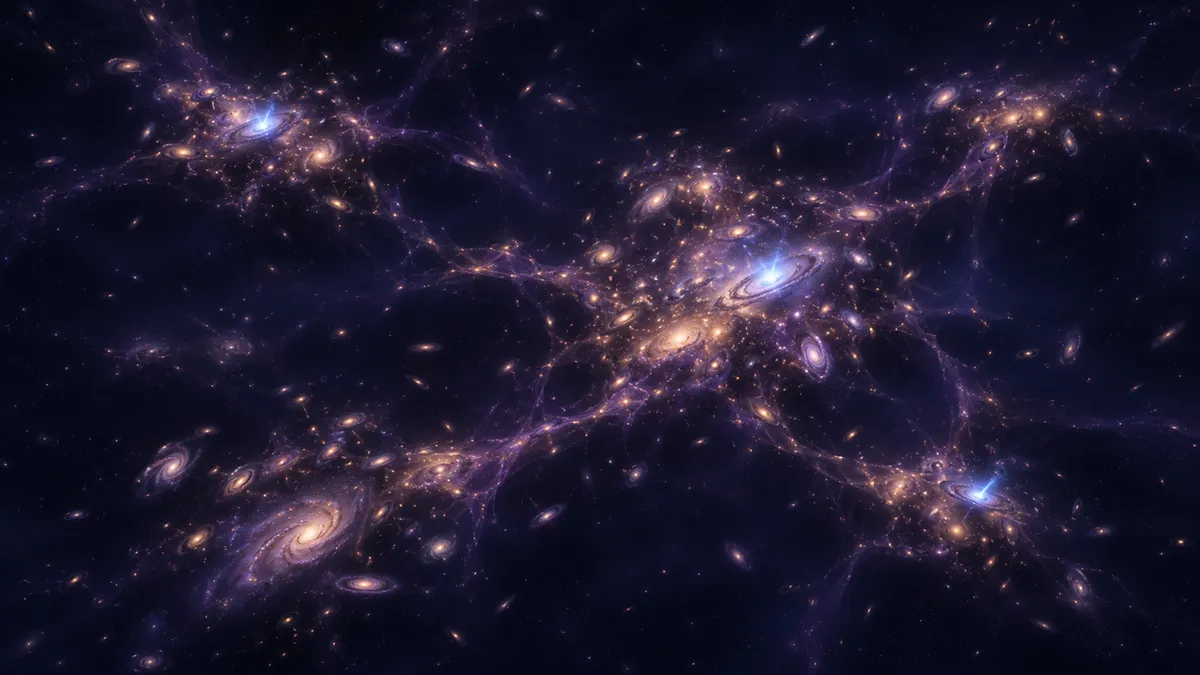
In a vast gathering of galaxies seen roughly 11.15 billion years in the past, actively feeding supermassive black holes appear especially common in the busiest neighborhoods. A new analysis of Hyperion suggests that the local conditions within an assembling cosmic structure may matter more than simply belonging to it.
A structure still taking shape
Hyperion is a proto-supercluster at a redshift of approximately 2.5: an enormous association of galaxies whose components are still assembling rather than an already settled galaxy cluster. It offers a way to investigate how dense surroundings relate to black hole activity near an epoch when cosmic star formation and active galactic nuclei were especially prevalent.
In their arXiv version 1 preprint, Ashlen Coburn and colleagues compare the incidence of X-ray-selected active galactic nuclei, or AGN, across Hyperion and a nearby-in-redshift comparison population. An AGN marks a galaxy center where material accreting onto a supermassive black hole produces powerful radiation. The study measures how frequently galaxies host detectable X-ray AGN, not how rapidly every black hole is growing.
Combining X-rays with galaxy distances
The authors identify X-ray sources using the Chandra COSMOS-Legacy Survey. They combine these observations with COSMOS2020 photometry, ground-based spectroscopy and Hubble Space Telescope grism measurements to estimate galaxy distances, stellar masses and environments.
Their environmental map distinguishes dense peaks from the connected, more moderately overdense outskirts. The comparison field occupies the same angular footprint but lies in redshift intervals in front of and behind Hyperion. This arrangement helps keep observational coverage similar while reducing the chance that distance uncertainties scatter galaxies between the structure and comparison samples.
Both populations are restricted to galaxies with stellar masses of at least ten billion solar masses. That matters because AGN incidence depends strongly on host-galaxy mass: comparing populations with different masses could otherwise imitate an environmental effect.
Most galaxies in the parent catalog have photometric rather than spectroscopic redshifts. To propagate distance uncertainties, the researchers repeat their analysis across 100 Monte Carlo realizations, assigning redshifts according to the available measurements and their reliability. They recalculate galaxy properties and environmental membership in each realization, then combine this variation with uncertainty from the small numbers of AGN.
The excess is concentrated in dense peaks
Coburn and colleagues report an X-ray AGN fraction of 7.4% across Hyperion, compared with 3.2% in the comparison field. The respective uncertainties are +3.2/−1.8 and +0.6/−0.5 percentage points. This corresponds to an enhancement of about 2.3 times, with a reported difference of approximately 2.3 sigma.
The contrast becomes stronger when the authors separate Hyperion’s internal environments. In its dense peaks, the AGN fraction reaches 12.3%, with uncertainties of +5.5/−3.4 percentage points. That is approximately 3.8 times the field fraction, a reported 2.6-sigma difference. The outskirts instead have a fraction of 2.1%, with uncertainties of +3.6/−1.1 percentage points, consistent with the field.
These results provide suggestive rather than decisive statistical evidence. The median Hyperion sample contains about nine X-ray AGN among 121 galaxies across the realizations, so individual objects and uncertain memberships matter.
The three most massive peaks together have a measured AGN fraction of 15.0%, versus 6.2% in the less massive peaks. However, the uncertainties are too large to establish whether peak mass itself controls AGN incidence.
A possible role for galaxy encounters
The authors interpret the concentration of AGN in dense peaks as evidence that local conditions may favor black hole fueling during early cluster assembly. These peaks are not equivalent to the much denser environments of evolved clusters. Galaxy encounters and mergers could redistribute gas toward galaxy centers and help trigger activity.
That explanation remains a hypothesis, not a demonstrated mechanism in this analysis. The authors also discuss whether black hole growth could accompany declining star formation in some massive galaxies, but explicitly state that their observations do not establish that AGN cause the suppression.
What remains uncertain
The study finds no statistically significant differences between Hyperion and the field in galaxy stellar masses, AGN-host masses or detected X-ray luminosities. This weakens a simple mass-based explanation, but small AGN samples limit the power of those comparisons.
X-ray selection also misses some heavily obscured, faint or radiatively inefficient AGN. The luminosities are not corrected for internal absorption. Tests find no significant obscuration differences among detected sources, but cannot rule out differences in the hidden population.
The preprint therefore supports a focused conclusion: detectable X-ray AGN appear more common in Hyperion’s dense peaks, not throughout its outskirts. Studies of host-galaxy encounters, broader AGN selection and additional protostructures are needed to test why.
- Hyperion proto-supercluster
- active galactic nuclei
- supermassive black holes
- galaxy environment
- Chandra COSMOS-Legacy Survey
- high-redshift galaxies
- galaxy cluster assembly
Related reading
Automatically matched by shared topic keywords. These links do not imply that the sources agree or establish a consensus.
Galactic Light Echoes Reveal Candidates for Fading Black Hole Activity
Source published
Shared keywords: active galactic nuclei, supermassive black holes
Astronomers propose a 1,000-hour JWST survey to read galaxies’ stellar histories
Source published
Shared keywords: high redshift galaxies
Stellar Motions Put NGC 3227’s Black Hole at About 12 Million Suns
Source published
Shared keywords: supermassive black holes
Stellar motions sharpen the estimate of M87’s black hole mass
Source published
Shared keywords: supermassive black holes
JWST Finds Turbulent Early Disks That Depart from Today’s Galaxy Mass–Speed Relation
Source published
Shared keywords: high redshift galaxies