TRANSMISSION // 2611.07039v1
GRS 1915+105 fades to record radio lows, hinting at a long quiet phase
Source published
Deep MeerKAT observations have detected the microquasar GRS 1915+105 at its faintest recorded radio levels. In a preprint, S. E. Motta and colleagues argue that the system may be ending the outburst that began in 1992, although obscured X-rays and uncertainty over the remaining radio emission complicate the diagnosis.
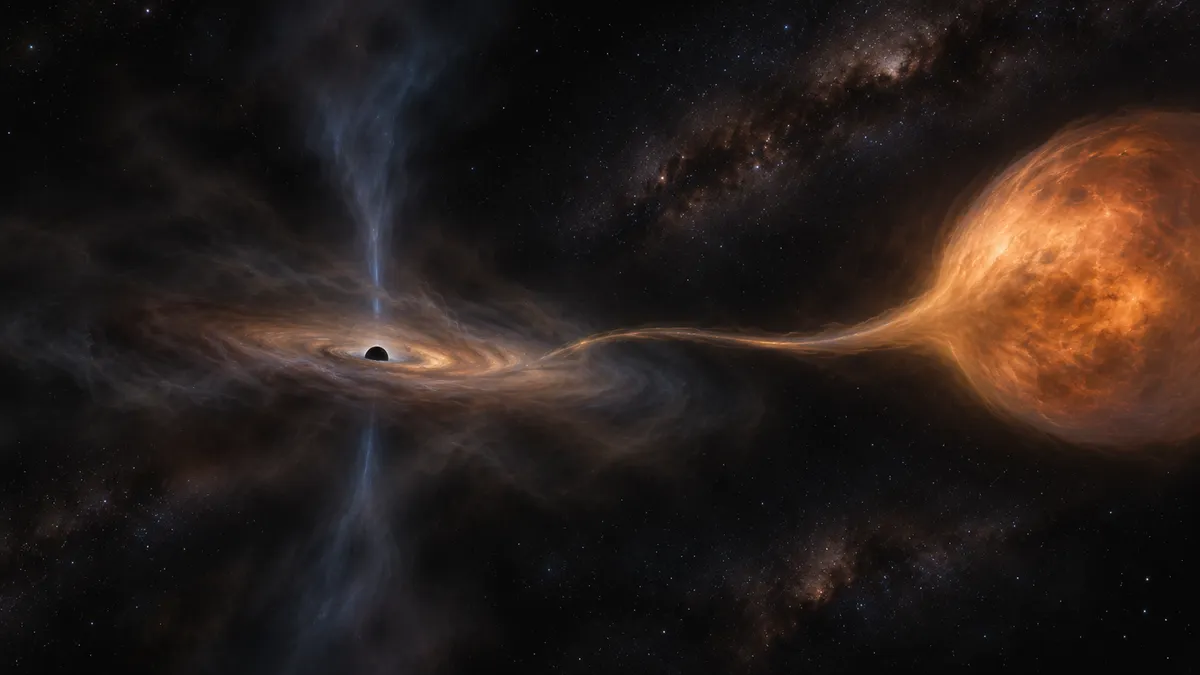
For more than three decades, GRS 1915+105 has sustained an extraordinary episode of black-hole feeding and jet activity. Now its dwindling radio signal suggests that the activity itself is subsiding—not simply disappearing behind a thicker veil of gas.
A decades-long outburst winds down
GRS 1915+105 is a microquasar: a binary system in which a stellar-mass black hole draws gas from a companion star and launches jets. Its black hole has a mass of about 12 Suns, and the system lies roughly 9.4 kiloparsecs away. Since its discovery during an outburst in 1992, it has displayed unusually prolonged activity, including more than 25 years of accretion near the Eddington limit, where radiation pressure becomes important in regulating inflowing material.
In their November 2026 preprint, S. E. Motta and colleagues report that the system has reached its lowest recorded radio brightness. They interpret the sustained decline as evidence that the outburst may be ending and the binary may be settling into quiescence—a low-activity state, not necessarily a complete halt to accretion or jet production.
Still present below the monitoring threshold
The team combined long-term MeerKAT and AMI-LA radio monitoring with deep MeerKAT observations and three Einstein Probe X-ray pointings. Following a major radio flare in early 2025 that exceeded one jansky, the measured signal at 1.28 gigahertz fell to about 1.1 millijanskys in October 2025 and roughly 0.55 millijanskys in January 2026.
By late February, measurements were generally around 0.2–0.4 millijanskys. After May 9, the source no longer met the team's detection threshold in routine ten-minute MeerKAT observations. That did not mean it had disappeared: near the sensitivity limit, changing image noise helped determine whether an individual observation counted as a detection.
Longer observations recovered the source in July. Combining approximately eight hours of observing time per band, the researchers measured 150 ± 34 microjanskys at 1.28 gigahertz and 93 ± 11 microjanskys at 2.62 gigahertz. The lower-frequency measurement corresponds to a radio luminosity of about 2 × 10^28 ergs per second. No significant variability was found across the six-day campaign.
Why radio matters more than missing X-rays
Since 2019, dense local material has heavily obscured the system's X-rays. Earlier X-ray dimming therefore did not necessarily signal weaker accretion: the radio jets remained bright, indicating continued activity behind the absorber.
Motta and colleagues argue that the new radio decline changes that picture. Unlike the monitored X-rays, the radio emission is unaffected by this local absorption, making it the best currently accessible tracer of the underlying activity. Its sustained fading supports an intrinsic decline in the central engine rather than increasing obscuration alone.
The Einstein Probe observations did not detect the source. Their combined limit corresponds to an observed 1–10 kiloelectronvolt luminosity below about 8.6 × 10^32 ergs per second. However, the amount of remaining absorption is unknown, so this is not a secure ceiling on the intrinsic luminosity. The authors explicitly caution that the soft-X-ray non-detection alone cannot distinguish a fading source from a hidden one.
An uncertain radio afterglow
The remaining radio signal also leaves room for interpretation. Its measured spectral index is −0.67 ± 0.41, meaning that the central estimate favours emission that weakens toward higher frequencies. Such a spectrum is consistent with relatively transparent, expanding material left over from earlier jet activity.
But the uncertainty is substantial: the usual flat spectrum of a compact jet is only mildly disfavoured, at about 1.6 standard deviations. A faint compact jet could coexist with residual ejecta, or the compact jet itself could have an unusually steep spectrum. The observations do not establish that the jet has vanished or cleanly separate these possibilities.
A quiet state that could last millennia
The authors find that the radio luminosity fits the level expected for a quiescent black-hole binary with this system's unusually long, 33.85-day orbit. That comparison supports their interpretation, but the radio relation rests on only five detections among seventeen comparison systems, with the remainder providing upper limits. Its scatter and uncertain normalization limit its diagnostic power.
Disc-instability models discussed in the paper predict outbursts lasting roughly 20–100 years, consistent with the 34 years elapsed here. If the observed decline truly marks the onset of quiescence, those models predict a quiet interval of order 10,000 years. That is a conditional theoretical expectation, not an observed duration.
For now, the strongest result is the record-low radio emission. Whether it represents a lasting transition rather than a temporary switch-off remains the central question.
- GRS 1915+105
- microquasar
- black-hole binary
- MeerKAT
- radio astronomy
- accretion
- astrophysical jets
- quiescence
Related reading
Automatically matched by shared topic keywords. These links do not imply that the sources agree or establish a consensus.