TRANSMISSION // 2611.07037v1
Reading the Ingredients of Planets in M-Dwarf Starlight
Source published
Infrared spectra of 40 planet-hosting M dwarfs reveal stellar abundances useful for studying rocky-planet interiors and Galactic stellar populations, while exposing important modeling uncertainties.
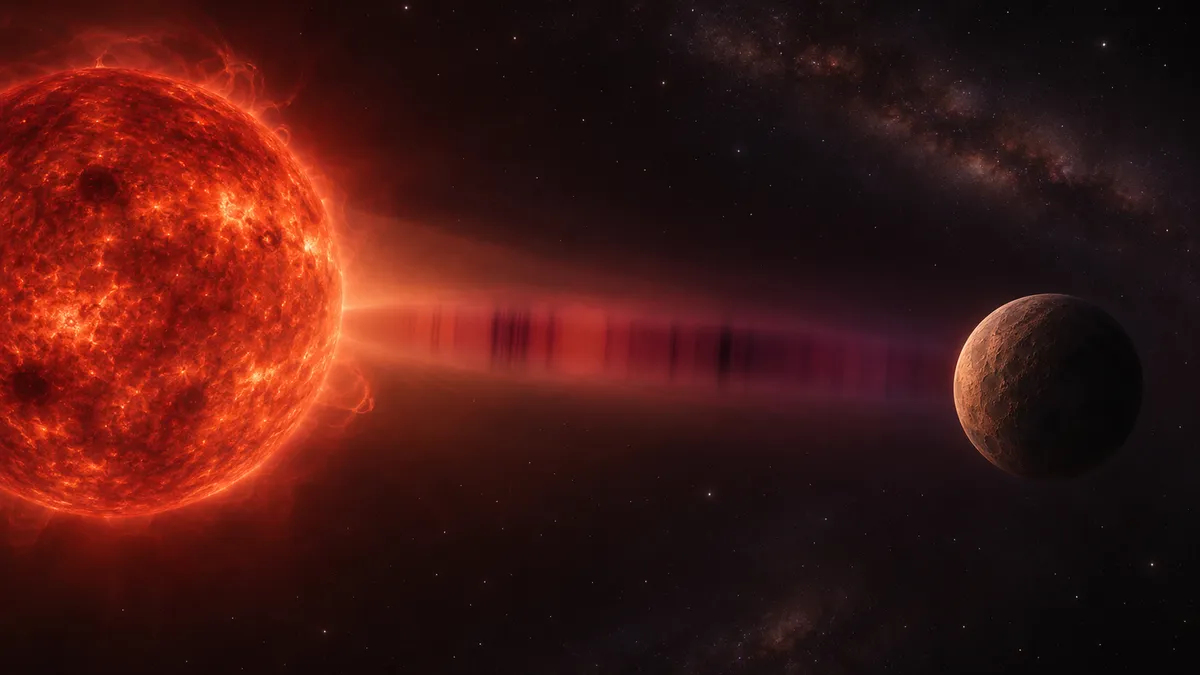
A planet’s host star offers a partial inventory of the material from which the planet formed. A new infrared spectroscopic study extends that inventory to 40 M-dwarf planet hosts, measuring oxygen and the rock-building elements iron, magnesium and silicon.
M dwarfs are the most common stars in the solar neighborhood and frequent hosts of small planets. Yet their chemical inventories remain less well charted than those of Sun-like stars. Their cool atmospheres produce crowded molecular absorption, making it difficult to locate the continuum and disentangle individual elemental signatures.
Zachary Maas and colleagues address that problem in an arXiv preprint, version 1, which the landing page reports has been accepted for publication in The Astrophysical Journal. The team analyzes high-resolution infrared spectra of 40 planet-hosting M dwarfs and two additional M dwarfs in wide binaries with FGK-type stars. Their measurements offer inputs for planetary-interior models and a way to investigate the stars’ Galactic origins—not direct observations of planetary interiors.
Finding abundances in a forest of lines
The team used H-band spectra from IGRINS at Gemini South and the McDonald Observatory 2.7-meter telescope, and NIRSPEC at Keck. The sample was initially selected for stars hosting at least one planet smaller than 1.5 Earth radii, favoring potentially rocky worlds. Expected temperatures below roughly 3,000 K and faint targets were excluded because their spectra are harder to model or observe at adequate signal-to-noise. The results therefore should not be assumed to represent all M dwarfs or all their planets.
To interpret the spectra, the researchers generated synthetic spectra with the MOOG code and MARCS model atmospheres. They exploited the different temperature responses of hydroxyl and water absorption: the effective temperature was chosen where the two sets of lines yielded consistent oxygen abundances. They then measured iron using atomic Fe I and molecular FeH features, and magnesium and silicon using atomic lines. Water is not just a diagnostic: many weak water lines collectively depress the apparent continuum, so modeling them matters for the other abundances too.
Spectroscopic temperatures were on average about 34 K lower than photometric estimates, with a scatter of roughly 94 K. The abundances were broadly consistent with previous studies, although comparisons with individual surveys showed systematic offsets. The two wide binaries provided an additional check: the warmer M dwarf agreed closely with its FGK companion, while the cooler one showed a larger magnesium discrepancy.
The limits of stellar chemistry
The coolest stars were especially difficult. Only one or two magnesium lines and one silicon line were reliably detectable in some cases, making continuum placement and blending consequential. Iron abundances inferred from Fe I and FeH also diverged more at lower temperatures. The authors report a possible temperature-dependent trend in magnesium relative to iron, at approximately the two-sigma level; it could reflect a measurement bias rather than an astrophysical trend.
Model atmospheres are another source of uncertainty. The analysis generally used the nearest available MARCS atmospheres rather than interpolating between them. Tests of different model choices suggest additional iron-abundance uncertainties of roughly 0.05–0.1 dex, while changing an assumed carbon-to-oxygen ratio also affected the derived oxygen abundance. Formal errors should therefore not be mistaken for a complete accounting of systematic effects.
Galactic history and planetary building blocks
The team combined Gaia astrometry and radial velocities with chemical abundances to assess membership in the Milky Way’s thin and thick disks. GJ 1252 and L181-1 met both their kinematic and magnesium-based chemical criteria for thick-disk candidates; L181-1 had already been identified as a thick-disk planet host. GJ 1252 is less settled: a previous rotation-based age estimate suggested a younger star, and the authors call for additional alpha-element measurements. Kepler 42 has thick-disk-like kinematics and low iron abundance, but uncertain magnesium and silicon measurements complicate its classification.
For planetary applications, the authors converted stellar abundances into molar silicon-to-magnesium and iron-to-magnesium ratios. Much of the sample overlaps solar values, and the ratios are broadly consistent with those reported for FGK stars. Under the adopted interior-model relationships, the distribution spans contours corresponding to core mass fractions of about 20–40%. These are model-based implications of stellar compositions, not measured core fractions for individual planets.
A star’s refractory-element ratios can inform a planet model, especially when paired with planetary mass and radius, but formation and subsequent evolution need not preserve an exact stellar composition. The study supplies a larger, internally analyzed set of host-star measurements; improved cool-star spectroscopy and modeling will be needed to determine how precisely those measurements constrain individual worlds.
Source: Zachary G. Maas and collaborators, The Composition of M-dwarf Exoplanet Hosts: Atmospheric Parameters and O, Mg, Si, and Fe Abundances from IR Spectroscopy, arXiv:2611.07037v1 (2026), preprint accepted for publication in The Astrophysical Journal.
- M dwarfs
- exoplanet host stars
- stellar abundances
- infrared spectroscopy
- planetary interiors
- Galactic thick disk