TRANSMISSION // 2611.07034v1
A JWST planet search reveals a galaxy masquerading as a companion
Source published
A reanalysis of HIP 65426 coronagraphic images finds no additional confirmed planets, but shows how wavelength coverage and evolving calibration affect companion searches.
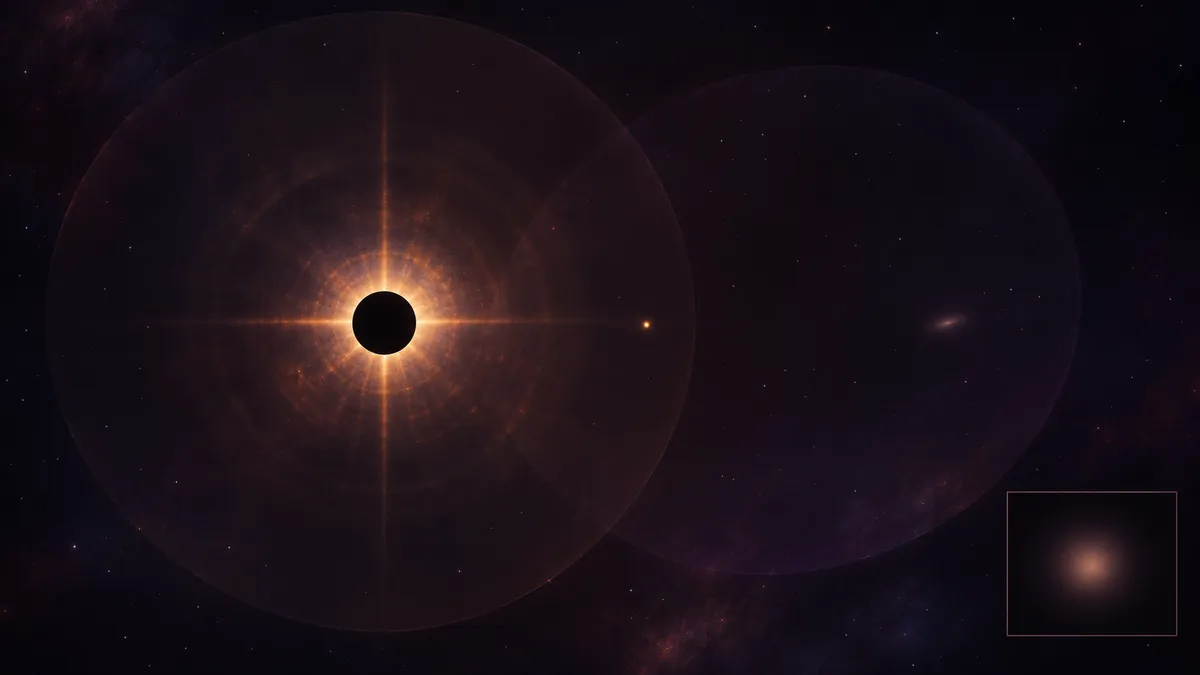
A faint point beside a bright star is only the start of an exoplanet discovery. In a new analysis of JWST images of HIP 65426, most credible sources turn out to resemble background stars or galaxies—and one likely galaxy illustrates how easily a mid-infrared image alone can mislead.
Evelyn Bruinsma and collaborators revisited the 2022 Early Release Science observations of HIP 65426, a young star approximately 107.5 parsecs away that hosts the directly imaged giant planet HIP 65426 b. Their study combines a search for additional companions with updated measurements of the known planet. The version examined here is an arXiv preprint; its landing page reports that it has been accepted for publication in The Astrophysical Journal Letters.
The team initially identified 21 possible companions besides the known planet. Thirteen survived image vetting: eight are classified as likely background stars, four as likely galaxies, and one remains of uncertain nature. No additional planet was confirmed. The other eight initial candidates were discarded as artifacts, noise, cosmic rays or insufficiently supported detections. These classifications do not rule out undetected planets elsewhere in the system.
Separating sources from stellar glare
HIP 65426 b is a compelling target for understanding giant-planet formation at large orbital distances. A previous analysis estimated its mass at about 7.1 Jupiter masses and its semimajor axis at roughly 86 astronomical units, albeit with substantial orbital uncertainty. Formation in place and outward scattering are among the scenarios discussed for such a wide orbit; either way, additional companions could inform the system's dynamical history.
The JWST observations used coronagraphs to suppress the host star's light. NIRCam supplied five near-infrared filters from about 2.5 to 4.4 micrometres, while MIRI contributed filters near 11.4 and 15.5 micrometres. The researchers reprocessed the observations with updated JWST and spaceKLIP software, using images of a reference star and observations at two telescope roll angles to help subtract the residual stellar pattern. They then fitted model point-spread functions to candidate sources and compared their colors and spectral energy distributions with stellar, planetary and galaxy models.
Candidates were initially found by visual inspection rather than a uniform automated search. The authors note that JWST's complex point-spread function makes automated detection challenging. Their vetting considered source shape and repeatability across filters, with exceptions for some objects seen only at wavelengths especially useful for finding cool companions. This approach is informative for the detected candidates, but does not establish a complete census of everything the images might contain.
A galaxy in planet's clothing
One object, called c20, is especially instructive. In the MIRI image it looks point-like, but in the shorter-wavelength NIRCam images it appears spatially extended. Its near-infrared signal is too weak for statistically significant flux measurements, so the authors use upper limits; its mid-infrared brightness and fits to galaxy templates favor an extragalactic interpretation, though confirmation requires further work.
Three other candidates also favor galaxy interpretations based on their colors, spectral fits and image profiles. The eight likely stars have spectral energy distributions and fitted temperatures broadly consistent with K–M dwarfs. Comparison with earlier ground-based observations suggests that one stellar candidate, c5, corresponds to a previously seen source; the JWST positions provide a first astrometric epoch for the other sources to support future proper-motion checks.
The remaining object, c18, lay outside the NIRCam field and has only two MIRI measurements. Those data do not establish its nature. If it were at the star's distance, its projected separation would be about 1,240 astronomical units—unusually wide, but not by itself a decisive exclusion of a bound companion.
The c20 example cautions against treating a point-like source in a single-epoch MIRI image as a planet without further evidence. Complementary near-infrared imaging can reveal extended structure or distinguish colors; follow-up astrometry or spectroscopy can supply additional tests. The authors also note that independent orbital evidence can sometimes support identification without a second imaging epoch.
The known planet, recalibrated
The reanalysis still finds HIP 65426 b consistent with a young, cloudy giant planet. A BT-Settl atmospheric fit gives an effective temperature of approximately 1,436 K, with a formal uncertainty of about 12–13 K. That precision is model-dependent: alternative atmospheric grids in the same study give temperatures of roughly 1,210 K and 1,376 K.
Compared with the 2023 analysis, the largest reported differences are about 2.2 sigma in separation, 1.5 sigma in position angle and 3.7 sigma in flux, depending on the filter. The largest flux discrepancy is in F300M. Changes to calibration files, software and reduction choices all complicate a direct attribution; the authors do not isolate a single cause. The result is a practical reminder that precision measurements from high-contrast images depend on the entire reduction chain, even when the broader interpretation of the known planet remains intact.
- HIP 65426
- JWST
- direct imaging
- exoplanets
- coronagraphy
- background galaxies
- atmospheric modeling