TRANSMISSION // 2611.07033v1
Galaxy Motions Help Untangle Models of Dynamical Dark Energy
Source published
A preprint finds that measurements of cosmic structure growth sharpen constraints on a dilatonic k-essence model, although the evidence does not establish an alternative to ΛCDM.
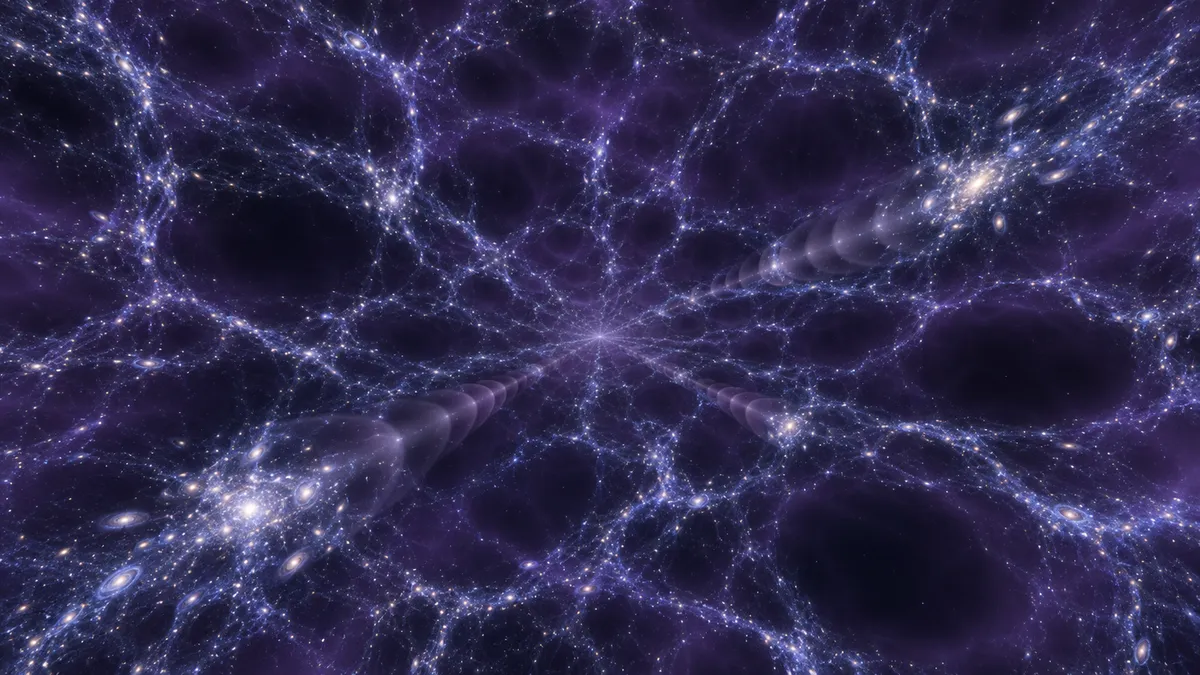
Two dark-energy models can mimic some of matter’s influence on cosmic expansion. A new analysis asks whether the motions of galaxies can tell the components apart.
Cosmic expansion measurements do not always reveal which ingredients are driving the expansion. A dark-energy field can sometimes evolve with an equation of state close to that of pressureless matter, allowing its contribution to the expansion history to be traded against the inferred matter density. Galaxy motions offer another way to investigate the ambiguity: they carry information about how structure grows, not just how the Universe expands.
In a preprint submitted to arXiv on 4 November 2026, Rebecca Briffa, Lehel Csillag and Erik Jensko examine two examples of this problem. They find that growth-rate measurements help constrain the present-day matter density, particularly in the more flexible of the two models. The work is a preliminary late-time analysis, not a demonstration that dynamical dark energy is preferred over the standard ΛCDM cosmology.
A field that can resemble matter
The study considers k-essence: a scalar-field description of dark energy in which the kinetic term has a non-standard form. The first model, the ghost condensate, has a pressure function P = −X + αX², where X represents the field’s kinetic energy. In the second, the dilatonic ghost condensate, the coefficient of X² depends exponentially on the field. Setting the exponential slope λ to zero recovers the first model.
Despite the name, the authors select solutions without ghost or gradient instabilities; the label does not mean that their accepted solutions contain unstable ghost degrees of freedom. Both models also include ordinary pressureless matter, including cold dark matter. A scalar field with matter-like pressure need not cluster like cold dark matter, so a background degeneracy need not persist in measurements of structure growth.
For the simpler model, stability at the starting point ensures stability throughout the evolution considered. For the dilatonic model, the researchers also check each sampled trajectory on a redshift grid from zero to 2.4 and reject unstable or otherwise invalid solutions. These theory restrictions shape the allowed parameter space alongside the observations.
Adding a view of growth
The team combines cosmic chronometer measurements with Pantheon+ Type Ia supernovae calibrated using SH0ES Cepheid anchors. They then add DESI’s second data-release baryon acoustic oscillation (BAO) measurements, a compilation of redshift-space distortion and peculiar-velocity measurements, or both. The BAO sound horizon is treated as a free parameter rather than fixed to a cosmic microwave background value.
Peculiar velocities distort the apparent distribution of galaxies along the line of sight. The resulting growth observable, fσ₈, combines the logarithmic growth rate with the amplitude of matter fluctuations on a scale of 8 h⁻¹ megaparsecs. It supplies information that distance and expansion-rate measurements alone do not.
The payoff differs between models. For the ghost condensate, BAO data already substantially narrow the matter-density degeneracy, and adding growth data has a modest further effect. For the dilatonic model, BAO leaves a long tail toward low matter density; adding growth data reduces the width of its 68% credible interval by roughly a factor of 2.2. With all four probes, the reported marginalized peak is Ωm,0 = 0.2791, with an equal-tailed 68% interval expressed as +0.0079 and −0.0711. The asymmetric range is important: the constraint is not a symmetric measurement around that peak.
BAO also shifts the preferred model parameters differently. It moves the simpler model closer to its ΛCDM-like background limit, while shifting the dilatonic model’s λ posterior toward larger values. That difference does not by itself establish a detection of evolving dark energy.
How strongly do the models compete?
For the full dataset, the dilatonic model improves the minimum χ² by about 4.1 relative to ΛCDM, at the cost of two additional model parameters. The Akaike information criterion, which penalizes extra parameters, is nearly tied between the two; the Bayesian information criterion favors ΛCDM. The simpler model offers essentially no improvement in raw fit. Best-fit growth curves for all three models are nearly indistinguishable compared with current measurement uncertainties.
The authors also derive S₈, a combination of fluctuation amplitude and matter density used in comparisons of lensing and cosmic microwave background results. Their k-essence estimates have slightly higher central values than their late-time ΛCDM estimate, but uncertainties are broad. The comparison is indicative, not evidence that either model resolves or worsens the S₈ discrepancy. Their high inferred Hubble rates are obtained using SH0ES-calibrated supernovae and should not be read as an independent resolution of the Hubble tension.
Limits of the shortcut
The growth calculation assumes a quasi-static, subhorizon regime in which scalar-field perturbations contribute negligibly to the gravitational potential; the field then affects the adopted matter-growth equation through the expansion history. Small scalar sound speeds make that assumption nontrivial. The authors check representative solutions and find support from sound-horizon and background-suppression estimates, but this is not a full perturbation calculation across all posterior samples. They also neglect an Alcock–Paczynski correction to the growth compilation.
Finally, σ₈ is sampled directly rather than evolved from primordial fluctuations, and the analysis does not fit cosmic microwave background data. A full Boltzmann treatment including early-time and complementary large-scale-structure observations is needed to test viability and assess clustering tensions more conclusively. The immediate result is narrower: growth measurements can expose parameter degeneracies that expansion data leave behind, but their leverage depends on the model and its assumptions.
- dark energy
- k-essence
- redshift-space distortions
- cosmic structure growth
- ghost condensate
- cosmology
Related reading
Automatically matched by shared topic keywords. These links do not imply that the sources agree or establish a consensus.