TRANSMISSION // 2611.07032v1
A Possible Polarization Swing Near the Black Hole in Cygnus X-1
Source published
A day-by-day analysis of balloon-borne hard X-ray observations suggests that Cygnus X-1 briefly became more strongly polarized while its fitted disk-reflection fraction increased. The evidence favors, but does not establish, a change in the geometry near the black hole.
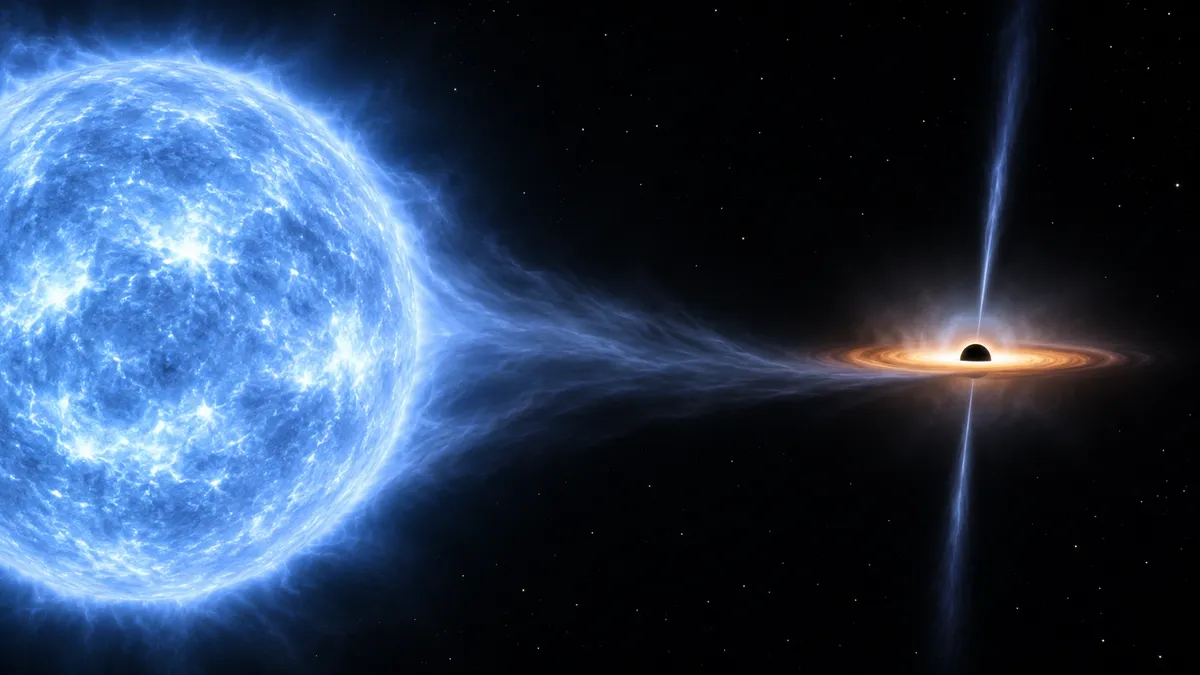
An apparent excursion in the hard X-ray polarization of Cygnus X-1 offers a new way to probe its elusive corona. The signal comes from one observing interval and remains subject to statistical and modeling uncertainties.
Cygnus X-1 is a laboratory for studying matter in extreme gravity: a stellar-mass black hole accretes from an O-type supergiant companion, producing a bright, variable X-ray source. In its hard spectral state, much of the high-energy emission is attributed to hot coronal plasma that boosts lower-energy photons through Compton scattering. The corona's shape and location, however, remain uncertain.
Polarization adds a geometric clue. Its degree describes how strongly the electric-field orientations of the radiation are aligned, while its angle specifies the preferred orientation on the sky. Both depend on how photons are emitted and scattered, so changes can reveal behavior that a spectrum alone might miss.
In the preprint Is the hard X-ray polarization of Cyg X-1 stable?, Matthew G. Baring and colleagues revisit observations made during the July 2024 flight of the balloon-borne XL-Calibur polarimeter. The arXiv landing page says the work has been accepted for publication in The Astrophysical Journal; the version discussed here is the preprint.
A conspicuous interval
XL-Calibur measures the angular distribution of Compton-scattered photons, with sensitivity over roughly 19–64 keV for this analysis. Earlier work combining its four Cygnus X-1 observing intervals found a polarization degree of 5.0%, with uncertainties of +2.7 and −3.0 percentage points, and an angle consistent with the radio jet axis.
The new day-by-day analysis finds a different result for July 12–13: a polarization degree of 16.8 ± 4.9% and an angle of approximately −52°, offset from the jet direction by about 25°. The other three intervals, combined, give 6.3%, with uncertainties of +3.2 and −3.6 percentage points. The paper quotes a roughly 3.4-sigma constraint on the July 12–13 polarization degree itself, but only about a 1.8-sigma difference between that degree and the combined degree from the other intervals. These are not interchangeable measures of variability.
The team also examined the normalized Stokes parameters, which retain information about both polarization degree and angle and avoid the positive-definiteness bias of polarization degree. For the joint change in these parameters, the reported local chance probability is 0.2%; accounting for trials raises it to 1.7%. A separate constant fit to the Stokes measurements gives a chance probability of 8%. Together, the analyses suggest an excursion, rather than an unambiguous characterization of its cause or recurrence.
Instrumental effects matter for such a comparison. The authors examined background rates and polarization, detector noise and pointing offsets, and used an alternative scattering-angle fit. They report no instrumental explanation for the excursion in those checks. Nevertheless, the dataset has gaps, unequal observing durations and limited precision when subdivided. It covers only about 70% of the binary orbit, preventing a systematic test of whether the signal repeats with orbital phase.
A simultaneous spectral clue
To put the polarization in context, the researchers combined observations from NICER, NuSTAR and Swift's Burst Alert Telescope. Their joint spectral fits span 1–195 keV and use four time segments chosen around the observed variability. Long-term monitoring and the fitted spectral slope indicate that Cygnus X-1 remained in the hard state.
The model includes direct Comptonized emission and X-rays reflected from the accretion disk. The fitted relativistic reflection fraction rose from 0.11 ± 0.02 in the segment before the polarimetric excursion to 0.25, with a 90% confidence interval of −0.03 to +0.04, in the segment overlapping it. The paper reports that the increase persists when the poorly constrained coronal electron temperature is fixed. The reflection fraction is a model-dependent parameter, not a direct image of the disk, and instrument coverage in the later segments overlaps only partially. The polarization uncertainties quoted above instead represent approximately one-sigma probability content.
Corona or companion?
The authors argue that a change in coronal plasma or magnetic geometry near the black hole could affect both the polarization and the fraction of emission reflected by the disk. This is a physical interpretation, not a uniquely fitted geometry. In their simplified estimate, explaining the polarization increase solely through the reflected component would require that component to be polarized at roughly 50%, highlighting the difficulty of accounting for the excursion.
Scattering near the companion is another possibility, especially because the anomalous interval falls near an orbital phase where wind absorption can be enhanced. But the authors estimate that an illustrative wind clump would contribute far too little scattered flux; existing smooth-wind calculations also produce smaller polarization changes in the softer IXPE band. Neither comparison excludes every possible clumpy-wind configuration, particularly at XL-Calibur energies.
The result therefore points to a useful constraint rather than a settled picture: any successful model must account for a possible day-scale change in polarization alongside the spectral behavior. More sensitive, overlapping polarimetric and broadband observations could test whether such excursions recur and distinguish evolving coronal geometry from scattering elsewhere in the binary.
- Cygnus X-1
- X-ray polarimetry
- black hole binaries
- XL-Calibur
- accretion corona
- disk reflection