TRANSMISSION // 2611.07029v1
Radio galaxies masquerade as tiny gravitational lenses
Source published
A detailed radio study identifies eight of nine surviving candidates from a milli-lensing pilot search as compact radio galaxies, while one remains unresolved. The results offer a practical way to distinguish such impostors from potential probes of dark matter.
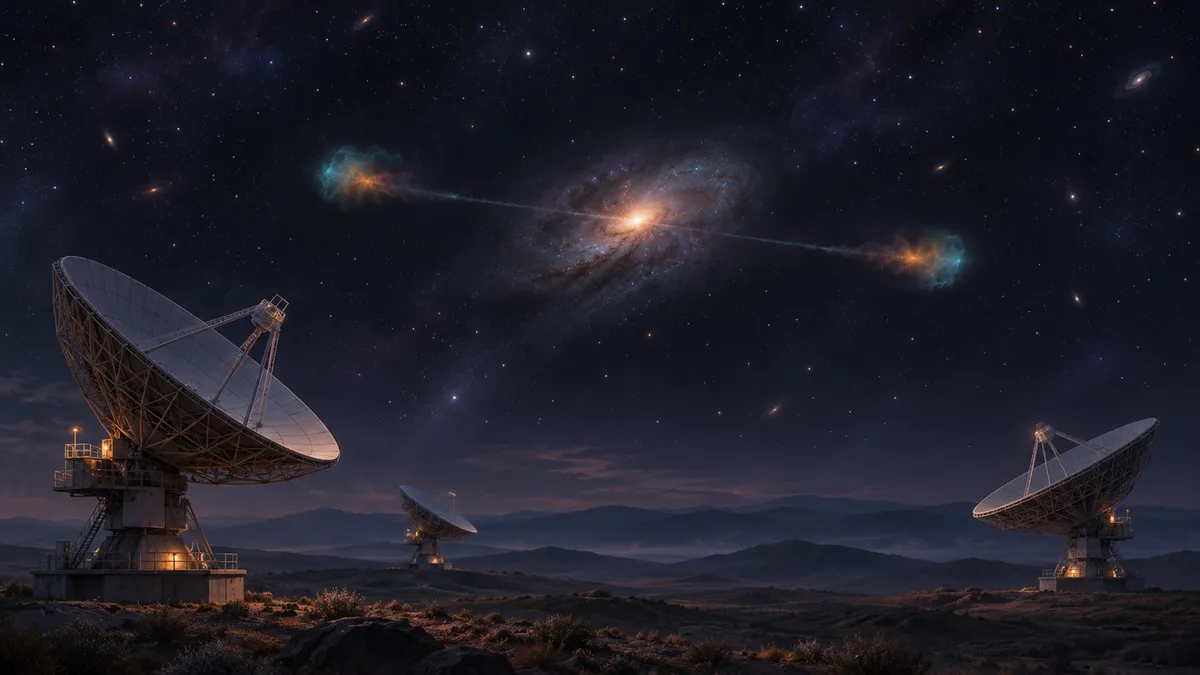
Two bright spots in a radio image can be copies of one distant source, split by gravity—or opposite sides of a single active galaxy. A new study uses sharper images and radio spectra to tell those possibilities apart.
The search for dark matter can begin with a deceptively simple picture: two tiny points of radio light, close together on the sky. A compact concentration of mass between Earth and a distant radio source could bend the source’s radiation into multiple images. If the intervening mass is roughly a million to a billion times the mass of the Sun, those images can be separated by just milliarcseconds—thousandths of an arcsecond.
Such milli-lensing could help astronomers test how many small dark matter halos exist, regardless of whether those halos shine. But similar-looking pairs can arise without any lens at all. In a compact symmetric object, or CSO, a galaxy’s active central engine produces radio-emitting structures on both sides, often resembling two separate images.
Diego Álvarez-Ortega, Felix M. Pötzl and Carolina Casadio examined the nine candidates left after earlier screening in the Search for MIlli-LEnses (SMILE) pilot project. In their paper, submitted to Astronomy & Astrophysics and posted as arXiv:2611.07029v1, they classify eight as CSOs rather than milli-lenses. Four receive a CSO classification for the first time. The ninth, J0923-3435, remains ambiguous; the study reports no confirmed milli-lens among these nine.
Looking beyond a double image
The researchers combined archival radio observations with new measurements from the High Sensitivity Array at 5 and 8 gigahertz and the European VLBI Network at 22 gigahertz. Both use very long baseline interferometry (VLBI), a technique that combines widely separated radio telescopes to resolve extremely fine detail. Single-dish and connected-array measurements supplied additional information about the total radio emission.
The team modeled compact components in the VLBI data and compared their shapes, brightnesses, separations and behavior at different epochs and frequencies. For spatially resolved spectral maps, it matched the observations’ angular resolution and used frequency pairs observed within 24 hours. The spectral index describes how brightness changes with frequency; markedly different indices can indicate that two bright regions are physically different parts of a source rather than copies of the same region.
Deeper images revealed connecting emission or central structures in J0210-2213, J1143+1834, J1218-2159 and J2347-1856. In J1218-2159, for example, a flatter-spectrum central feature lies between the outer emission regions, supporting a radio core and two lobes. For J1653+3503, the two components have sharply different fitted spectral indices, about −1.07 and −3.03. That mismatch argues against their being lensed copies.
Not every classification rests on the same evidence. J0024-4202 formally satisfies the original lens-selection criteria, but the authors favor a CSO interpretation based on the differing component morphologies and other properties. Most candidates also satisfy the earlier tests involving flux ratios and surface brightness; all have measured component separation speeds consistent with zero within the stated uncertainties. Those tests alone therefore do not settle the nature of the surviving sources.
A remaining candidate—and a different kind of physics
J0923-3435 still satisfies the empirical lensing criteria with the available data. A possible third component in an archival image is too uncertain to establish its nature. The paper describes awarded deeper High Sensitivity Array and Long Baseline Array observations intended to test that feature; these are planned follow-up, not a reported detection.
The apparent impostors are scientifically valuable in their own right. For sources with known redshifts, the authors estimate projected lobe separations of roughly 60–240 parsecs. Their magnetic-field estimates are generally about 20–320 milligauss under an equipartition assumption, in which magnetic fields and energetic particles carry comparable energy. One exceptionally steep-spectrum component has a higher estimate that the authors regard as unreliable. These are model-dependent estimates, not direct field measurements.
To investigate why the total radio spectra turn over at low frequencies, the team compared models in which synchrotron-emitting plasma absorbs its own radiation with models involving free-free absorption by ionized gas. For J0210-2213 and J2347-1856, an uneven external absorbing screen was favored over both a single uniform synchrotron absorber and a two-component synchrotron model. That supports, but does not independently prove, a clumpy ionized environment. The authors call for denser low-frequency coverage and independent observations, including hydrogen absorption or X-rays, to test the gas interpretation.
What the survey can and cannot conclude
No significant expansion was measured. For sources with redshifts, the derived speed limits imply lower limits on kinematic ages of approximately 54–951 years, assuming constant expansion. These are not measured ages: the speed limits are loose, so the data cannot decide whether the compact sources are young and growing or constrained by their surroundings. Changes in calibration and the use of observations taken years apart can also complicate variability and spectral fits.
The pilot drew on heterogeneous archival images and was not selected uniformly. Its outcome cannot simply be turned into a detection rate or dark matter abundance for the main SMILE survey, which uses a different, flux-limited sample. The authors instead recommend prioritizing deep, multi-frequency VLBI follow-up: resolving faint bridges and comparing spectra may eliminate convincing lookalikes before a rare genuine lens can be claimed.
- gravitational lensing
- dark matter
- compact symmetric objects
- radio astronomy
- very long baseline interferometry
- active galaxies
- SMILE survey
Related reading
Automatically matched by shared topic keywords. These links do not imply that the sources agree or establish a consensus.
Tracing cosmic arcs: HLA-Net uses geometry to shortlist gravitational lens candidates
Source published
Shared keywords: gravitational lensing
Webb finds a faint oxygen signal inside a nearly pristine galaxy
Source published
Shared keywords: gravitational lensing
How Decaying Dark Matter Could Puff Up a Galactic Halo
Source published
Shared keywords: dark matter
Reading the Hidden Histories of Faint Galaxies Through Their Star Clusters
Source published
Shared keywords: dark matter
A Sharper View of the Milky Way’s Hidden History
Source published
Shared keywords: dark matter