TRANSMISSION // 2611.07028v1
Galactic Light Echoes Reveal Candidates for Fading Black Hole Activity
Source published
A search of nearby galaxies finds 34 candidates whose outskirts retain signs of black hole activity stronger than those in their centers. The result offers a way to study AGN flickering, though viewing angle and other sources of ionization complicate the interpretation.
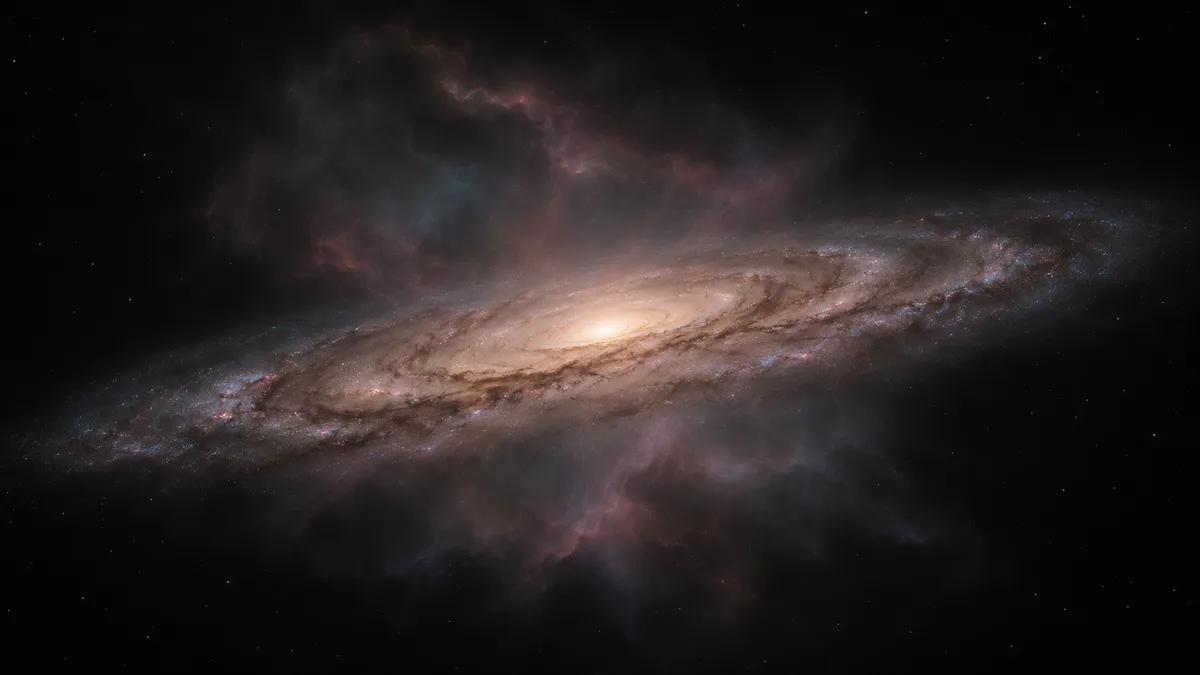
A galaxy’s central black hole can grow quiet while distant gas still carries evidence of a brighter past. A new survey uses those delayed signatures to look for such fading episodes—and to estimate how long an active phase may last.
When a supermassive black hole feeds, the infalling material can produce an intensely bright active galactic nucleus, or AGN. If that supply drops, the nucleus can dim before its surroundings have caught up: radiation emitted earlier continues to reach distant gas, leaving a possible light echo of the brighter phase.
Quinn O. Casey and colleagues searched for that contrast in the Mapping Nearby Galaxies at Apache Point Observatory survey, known as MaNGA. They identified 34 candidate fading AGN: galaxies whose outer regions show a stronger inferred AGN contribution than their centers. Their paper, AGN Archaeology: A Systematic Search for Fading AGN in MaNGA, has been accepted for publication in The Astrophysical Journal.
Reading a galaxy in pieces
MaNGA used integral-field spectroscopy to collect a spectrum at each position across a galaxy, rather than measuring only its central light. The team analyzed the survey’s final data release, containing observations of roughly 10,000 unique galaxies. Each spatial element, or spaxel, provides emission lines from glowing gas.
The researchers used four lines—two from hydrogen, one from nitrogen and one from oxygen—in a diagnostic known as the BPT diagram. Their empirical model mixes observed star-forming and AGN-like spectra along roughly 25,000 tracks to estimate the AGN fraction of the oxygen-line emission. Because tracks overlap and other processes can generate similar line ratios, the fraction is a model-dependent estimate, not a direct measurement of black hole power.
For each galaxy, the team compared the inferred contribution within one kiloparsec of the center with that in AGN-like spaxels beyond 1.5 kiloparsecs. A candidate needed a higher outer contribution even after allowing for the spread in the inner and outer estimates. The search initially found 131 unique candidates; it then required adequate spatial coverage and removed objects with independent evidence of a currently active nucleus, among other possible interlopers.
Evolved stars can also produce line ratios resembling low-ionization AGN emission. An additional diagnostic combining a line ratio with hydrogen-line strength removed 33 remaining candidates, leaving 34. The authors also compared line ratios and gas velocities with shock models: no system was judged shock-dominated, although some individual spaxels could still be affected.
A record written in gas
The resulting galaxies generally show the reverse of a familiar AGN pattern: their centers look more like star-forming or mixed regions, while farther-out gas looks more AGN-like. Among 29 candidates with usable central single-fiber nitrogen-based classifications, 11 appeared star-forming and the rest appeared composite. Spatially resolved spectra expose the outer signatures that a central observation can miss.
The team estimated that the mean projected distance to the AGN-like gas corresponds to a light-travel time of about 11,000 years. This is an approximate historical baseline, not a precisely measured shutoff date: the three-dimensional positions of the gas and its response to changing radiation matter, and faint emission may extend beyond the survey’s field or detection threshold.
The researchers also compared the candidates with a catalog of 387 MaNGA AGN. Treating 34 fading candidates over the estimated visibility time as a turnoff rate, they derived a characteristic active-phase lifetime of about 130,000 years and interpreted it as a lower limit, because both the measured extent of the emission and the cataloged AGN count may be incomplete. This is a population-level inference, not a clock measured for each black hole. It is consistent with episodes of intermittent accretion, but depends on the candidates and comparison population being representative.
The importance of perspective
The host galaxies offer clues and cautions. Twenty-four of the 34 candidates are classified as edge-on. Of the 29 with merger-catalog classifications, 22 are labeled mergers: 17 minor and five major. These are classifications within a selected sample, not proof that minor mergers caused the activity; extended gas can also be easier to find in interacting galaxies.
To investigate the viewing-angle bias, the authors built simplified three-dimensional models of a star-forming disk and two cones of AGN-illuminated gas. For the fading model, they removed the inner part of the cones. When projected at different angles, a genuine fading system could resemble an ordinary AGN, while a normal nucleus viewed nearly edge-on could be diluted by light from the disk and mistaken for a fading candidate. The model does not capture every possible geometry or dust effect.
The authors therefore regard some edge-on objects as possible contaminants and expect some face-on fading systems to be missed. Infrared evidence supports relatively weak nuclear activity in the selected sample, but obscuration and star formation can hide an active nucleus there too. Follow-up spectroscopy, including observations beyond MaNGA’s footprint, and other high-resolution or multiwavelength measurements could test individual candidates and better trace the full extent of their ionized gas.
- active galactic nuclei
- supermassive black holes
- galaxy evolution
- light echoes
- MaNGA
- integral-field spectroscopy
Related reading
Automatically matched by shared topic keywords. These links do not imply that the sources agree or establish a consensus.
How JWST Could Trace the Seeds of the First Massive Black Holes
Source published
Shared keywords: galaxy evolution
Stellar Motions Put NGC 3227’s Black Hole at About 12 Million Suns
Source published
Shared keywords: supermassive black holes
Stellar motions sharpen the estimate of M87’s black hole mass
Source published
Shared keywords: supermassive black holes
Euclid forecast points to millions of galaxy spectra, with oxygen-line counts less certain
Source published
Shared keywords: galaxy evolution
Euclid simulations expose the galaxies a bright-line survey can miss
Source published
Shared keywords: galaxy evolution