A Call for a Bigger JWST Survey of the First Galaxies
Source published
A community white paper argues that coordinated, multi-cycle JWST surveys could turn surprising early-universe discoveries into a clearer statistical picture of galaxy and black-hole growth.
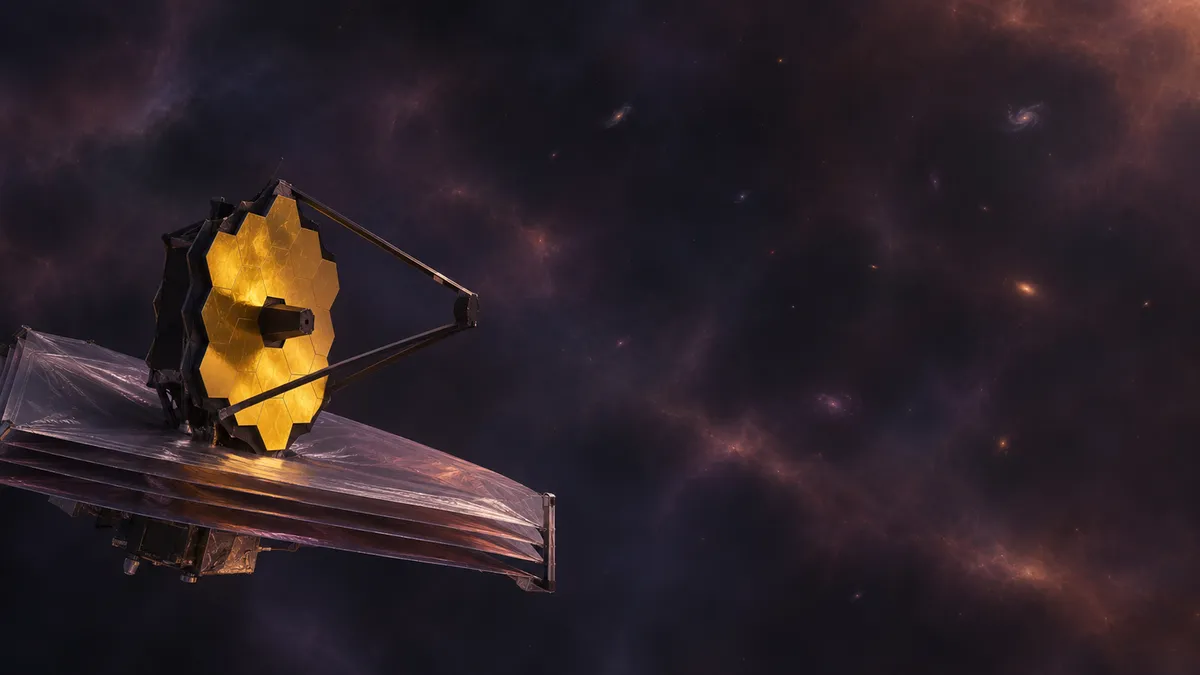
AI-generated conceptual illustration; not documentary evidence.
JWST has found unexpectedly bright galaxies in the young universe, but their origins remain difficult to explain. The Genesis Initiative is asking for a new way to organize the telescope time needed to study them as a population.
The James Webb Space Telescope has shown astronomers a young universe crowded with surprises: luminous galaxies appeared earlier than many models anticipated, and compact red objects have challenged ideas about how the first massive black holes grew. A community white paper argues that the next step is not simply to find more remarkable objects, but to observe enough of them consistently to understand how representative they are.
The Genesis Community, including Alice Shapley, Steven Finkelstein and Rachel Somerville, submitted the framing paper to the Space Telescope Science Institute in response to its Multi-Cycle Treasury concept call. It advocates coordinated galaxy-formation surveys of roughly 1,000–2,000 hours. This is an argument for future observing programs, not a report of a newly approved survey or its results.
What JWST has already seen
The paper synthesizes published observations rather than presenting a new data analysis. Before JWST, many models anticipated few ultraviolet-bright galaxies beyond redshift 10 in the initial small surveys. Redshift measures how much cosmic expansion has stretched light; for distant galaxies, larger redshifts generally mean a view farther back in time. Instead, JWST found galaxies whose brightness and inferred masses suggested rapid early growth.
Spectroscopy, which spreads light into its component wavelengths, has confirmed galaxies at approximately redshift 14. Still more distant candidates have been identified from imaging in different filters, but those estimates need spectroscopic confirmation. Spectra also suggest that some early galaxies already contained substantial quantities of elements heavier than helium, the products of previous stellar generations.
Other puzzles remain open. Many compact sources known as Little Red Dots show broad emission lines consistent with rapidly moving gas around accreting black holes. Yet they are generally undetected in X-rays and radio, and those non-detections and other properties complicate that interpretation; stellar explanations are also under discussion. The authors describe possible hints of primordial Population III stars—the first generation, formed from nearly pristine gas—but say no such system has been confirmed.
Why a uniform sample matters
The white paper draws on existing JWST imaging and spectroscopy, along with a comparison of approved Hubble and JWST observing-program sizes. Previous surveys have produced valuable public data, but their fields, depths and target-selection rules differ. That makes it difficult to distinguish an intrinsic population trend from a difference in what each survey was able or designed to detect.
The authors say current spectroscopy of low-mass galaxies at redshift 4 and above is incomplete and biased toward galaxies forming stars especially vigorously. Deep spectra capable of measuring several emission lines remain too sparse for robust comparisons across multiple periods. Those lines help estimate properties such as chemical composition and star-formation activity. Without a well-characterized selection function—a description of which objects a survey is likely to find and observe—comparisons with simulations can be misleading.
Imaging has a separate depth-versus-area problem. The authors cite some of the deepest existing images as reaching a limiting magnitude of about 31 over roughly one square arcminute, too small an area at that depth for a robust sample of candidates beyond redshift 15. A higher limiting magnitude means fainter sources can be detected.
The proposed observing strategy
The paper advocates one or more coordinated treasury-scale programs, rather than specifying a single finalized survey. For the search beyond redshift 15, it discusses near-infrared NIRCam imaging at least about one magnitude deeper than existing data: approximately 100–150 hours per filter in a deep blank or gravitationally lensed field to reach magnitude 32. Lensing uses a foreground mass as a natural magnifier, though reconstructing the background source introduces uncertainties. The paper also discusses a wider, shallower alternative reaching about magnitude 30.
For galaxy populations, the authors call for long-exposure spectroscopy of thousands of uniformly selected targets spanning a wide range of luminosities. JWST's NIRSpec can observe multiple targets using an array of tiny shutters. Deeper mid-infrared MIRI imaging across many pointings would help study evolved stars, obscured systems and early black holes. Repeated observations over multiple cycles could also capture changes over time. These are proposed capabilities and observing requirements, not guaranteed measurements.
The paper cites Hubble's 902-orbit CANDELS survey and other multi-cycle projects as precedents for large datasets that remain useful years later. Its comparison indicates that the largest extragalactic JWST general-observer programs in the first five cycles were hundreds, rather than thousands, of hours. Larger allocations would compete with other uses of limited telescope time; the white paper makes the scientific case for that tradeoff rather than resolving it.
What a larger survey cannot settle by itself
More uniform data could sharpen tests of how galaxies build their stars and chemical elements, how black holes begin growing, and how the first sources helped ionize intergalactic hydrogen. But a larger sample does not automatically remove uncertainties in stellar-population models, black-hole mass estimates or the interpretation of faint spectra. Nor does a non-detection of a metal line alone prove that stars are primordial: observations must be sensitive enough to rule out the relevant metal abundances.
The authors argue that the timing matters because some instrument modes face reduced efficiency, including long-wavelength MIRI observations and NIRSpec shutters that can become stuck. Their central claim is that coordinated depth, coverage and selection would give astronomers a stronger basis for deciding which early-universe explanations survive—not that those explanations are already settled.
Source: Genesis Community et al., “Why a Multi-Cycle Treasury Program is Essential to Maximize JWST's Scientific Contributions to Galaxy Formation,” arXiv:2611.07027v1, 2026.
James Webb Space Telescope
galaxy formation
cosmic dawn
Multi-Cycle Treasury
spectroscopy
Little Red Dots
Related reading
Automatically matched by shared topic keywords. These links do not imply that the sources agree or establish a consensus.