TRANSMISSION // 2611.07022v1
Magnetar Flare Simulations Find Little Heavy-Element Production
Source published
A study of a proposed crust-ejection mechanism finds that magnetar giant flares may expel matter too rapidly to make substantial amounts of heavy elements. Its idealized models also struggle to explain the mass inferred from a famous radio afterglow.
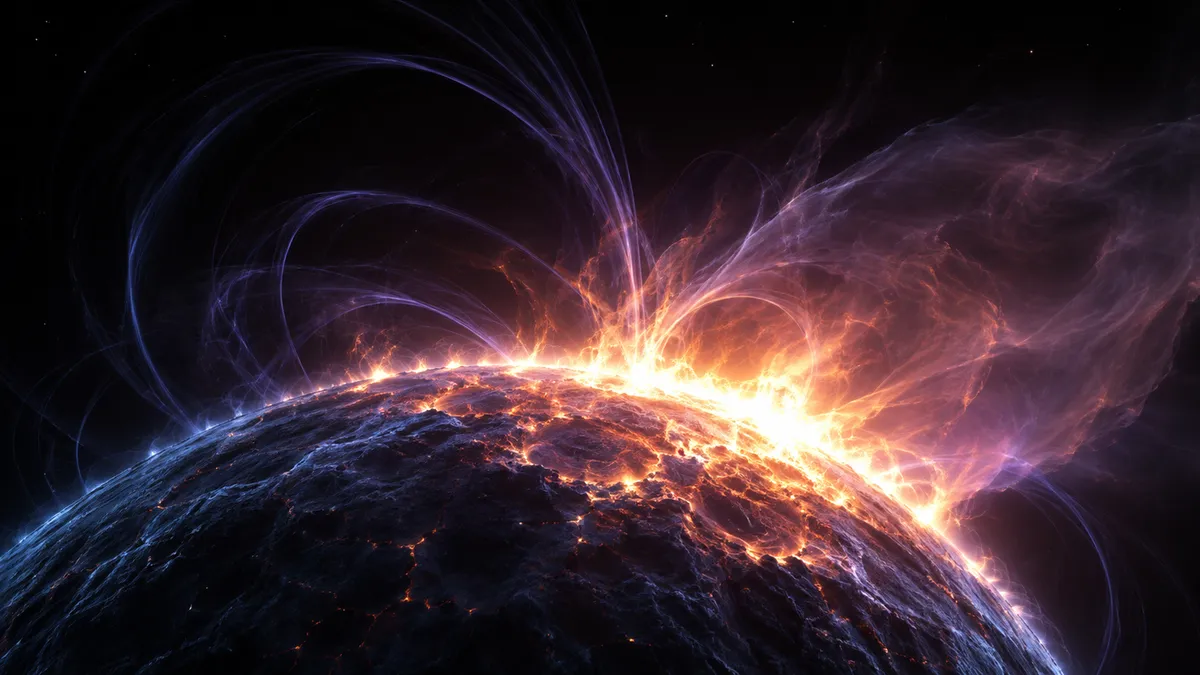
A magnetar's giant flare can briefly outshine almost anything in its neighborhood. Whether that violence also forges significant quantities of heavy elements depends on how much of the star's crust escapes—and what happens as it cools.
The giant flare of SGR 1806-20 in December 2004 was followed by a radio source. One interpretation of its later brightening is that matter thrown out by the flare slowed as it swept up surrounding gas. Under assumptions about distance and geometry, that interpretation implies at least 1.6 billionths of a solar mass in ejecta, potentially much more. This is an inference from the afterglow, not a direct measurement of escaping crust.
One proposed explanation puts a hot layer of photons and electron–positron pairs above the magnetar's surface. Its pressure drives a shock into the crust; as the layer expands, shocked outer material can rebound and escape. Such ejecta might make heavy elements through rapid neutron capture, or the r-process, and produce a brief radioactive transient called a nova brevis.
Tetyana Pitik, David Radice, Jacob Fields and Yi Qiu test this crust-shock picture in a study posted as arXiv:2611.07022v1. Their simulations find escaping material, but little heavy-element production. This is a calculation for an idealized mechanism, not an observation of a flare's chemical products.
Following a shock and its particles
The team modeled a neutron star of 1.4 solar masses and radius 13.24 kilometers. Using the AthenaK code, they evolved the crust and flare layer with general-relativistic hydrodynamics, a tabulated nuclear equation of state, and an approximate two-moment treatment of neutrino transport. Neutrinos and related weak interactions can change the electron fraction: roughly speaking, the number of protons per nucleon in electrically neutral matter. That fraction influences which nuclei can form.
The researchers varied the layer's peak pressure over values equivalent to magnetic pressures for field strengths from 10¹⁵ to 10¹⁶⋅⁵ gauss. This field strength labels the assumed pressure, not necessarily the star's dipole field; the simulations themselves contain no magnetic field. Each model was also run without neutrino transport, isolating its influence. The authors did not separately vary general relativity and the equation of state.
The main neutrino-transport runs followed the flow for one millisecond. The team estimated escaping mass from outward-moving material crossing a radius of 30 kilometers, using an energy-based escape criterion. For four flare strengths, they followed representative ejecta histories with the SkyNet nuclear reaction network. Beyond the simulated trajectories they extrapolated the expansion, comparing two prescriptions to assess the effect on yields.
Fast expansion, few heavy nuclei
Across the modeled pressure range, the calculated unbound mass rises from about 1.2 × 10⁻¹⁰ to 4.8 × 10⁻⁸ solar masses. Mass-weighted speeds estimated far from the star are about 44–52% of light speed. In the most extreme case, neutrino cooling drains energy from the hot layer while it drives the shock, reducing the ejected mass by roughly 46% relative to the run without neutrinos. In less extreme cases the mass changes little.
The ejecta largely retain the crust's electron fraction. Weak interactions alter it mainly in the hottest models, typically by only a few hundredths, although the balance between emission and absorption matters. Rapid expansion and high entropy have a more dramatic consequence: there is little time to assemble seed nuclei on which neutrons could be captured.
In the network calculations, roughly 90% of the mass becomes alpha particles, the nuclei of helium atoms, while about 7–10% remains as free neutrons before their decay. Stronger modeled flares produce some nuclei reaching the third r-process abundance peak, but nuclei with mass number 90 or greater account for at most about 0.08% of the ejecta, or 3.5 × 10⁻¹¹ solar masses per flare. At pressure labels of 10¹⁵⋅⁵ gauss or below, the heavy-nucleus fraction is less than 0.001%. These are model yields, not detected abundances.
The team attributes its much smaller heavy-element yields compared with an earlier analytic ejecta model largely to a difference in what escapes. That model included deeper, denser and cooler crust; in the new simulations, those layers mostly remain bound.
What the models leave open
The authors estimate that free-neutron decay, rather than heavy-element decay, would chiefly power a nova brevis from their ejecta. For one model, a simple estimate gives an optical and ultraviolet transient peaking after roughly 40–55 seconds. This prediction depends on assumptions about opacity and how decay energy heats the ejecta; it is not a detection.
The connection to the 2004 afterglow is difficult. Some full-surface models eject enough mass to meet its inferred lower bound, but their flare-layer energies are 60–600 times the energy estimated for the prompt gamma-ray spike. Scaling the model to the spike's energy yields substantially less mass than the afterglow interpretation requires. The authors conclude that the crust shock alone is unlikely to supply the inferred baryons unless the flare released much more energy than its gamma rays indicate or a realistic geometry ejects matter far more efficiently.
Important limitations remain. The models are spherical, deposit energy promptly over the entire surface and omit magnetic fields, even though real flares are likely localized and magnetic forces can restrain the crust. The authors regard their masses as upper limits at a given pressure, not precise forecasts for real events. The escape test at finite radius can overestimate unbound mass, and the barely escaping deepest layers dominate much of the heavy-element yield. Different extrapolations change that yield, with an estimated uncertainty of up to a factor of two for nuclei with mass number at least 90 and more for the heaviest products. Multidimensional magnetized simulations with localized energy release are needed to test the picture.
- magnetars
- giant flares
- neutron stars
- nucleosynthesis
- r-process
- neutrinos
- nova brevis
Related reading
Automatically matched by shared topic keywords. These links do not imply that the sources agree or establish a consensus.