TRANSMISSION // 2611.07018v1
A Timing Clue to the Slow Dimming of Red Giants
Source published
A study of 983 red giants finds a consistent timing offset between their long-term dimming and changes in radial velocity. The pattern constrains possible explanations but does not establish that the stars have dusty companions.
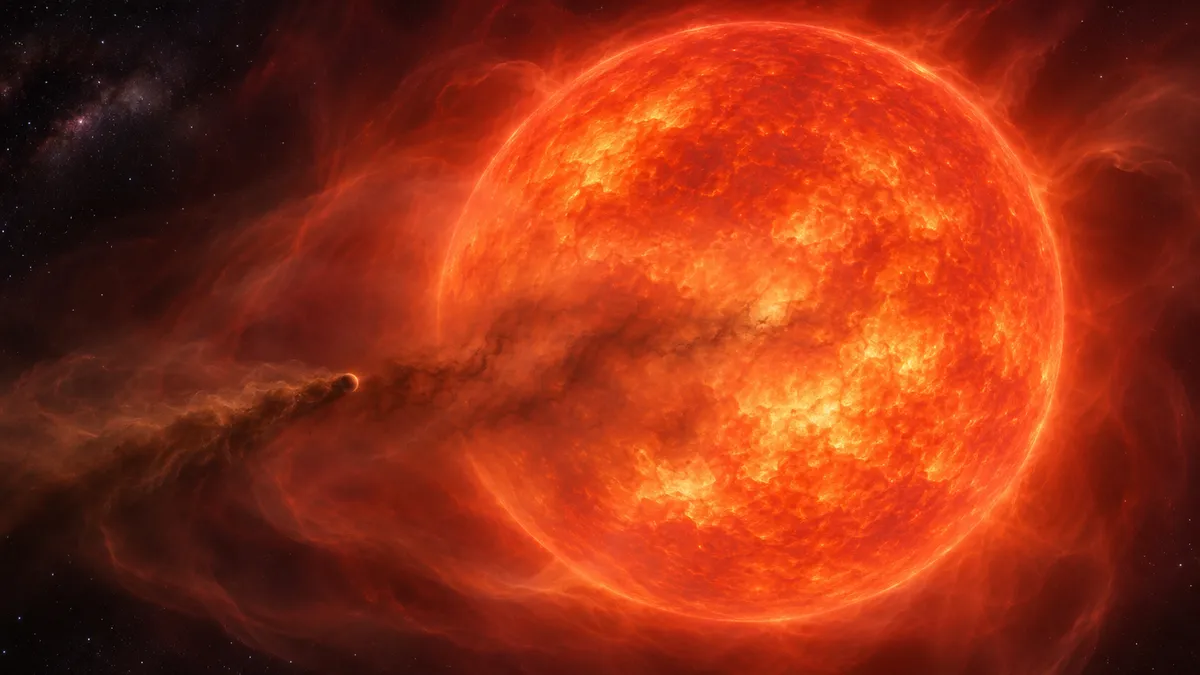
Many red giants fade and brighten over years as well as pulsating on shorter timescales. By comparing starlight with measurements of motion along our line of sight, astronomers have tested what makes those long cycles distinctive.
A second, slower rhythm
Roughly a third of pulsating red giants show a mysterious extra cycle known as a long secondary period, or LSP. These brightness variations last hundreds to thousands of days, typically about ten times longer than the stars’ primary pulsations. Their cause remains unsettled: proposed explanations range from processes within a single star to the effects of a low-mass companion and surrounding dust.
Dorota Skowron and colleagues examined how the timing of the slow dimming relates to a star’s radial velocity: its measured motion toward or away from us. Their study, arXiv:2611.07018v1, was submitted to The Astrophysical Journal; the available version is a preprint and does not report acceptance. The analysis draws on observations, while its physical interpretation remains a test of competing ideas rather than a direct detection of companions.
Comparing light and motion
The team matched Gaia’s catalog of 9,614 long-period variables with the ASAS-SN variable-star catalog, finding 7,960 counterparts. They searched ASAS-SN V-band brightness records for periods and visually classified stars with sufficiently clear light curves and reliable periods. Stars with inadequate coverage or substantial irregular changes in mean brightness were excluded. The resulting sample contained 4,130 stars, including 983 LSP variables, 201 Miras, 1,887 semiregular variables and 669 small-amplitude red giants called OSARGs. Eclipsing and spotted variables supplied further comparisons.
Gaia’s radial-velocity measurements used in the study were collected between July 2014 and May 2017, with 12 to 90 measurements per star and an average of 24. The researchers used each star’s brightness period to align its light and velocity measurements by position in the cycle. They fitted smooth periodic curves to estimate when light and radial velocity each reached their minimum. The velocity fits used two Fourier harmonics for LSP stars, Miras and semiregular variables, and one for OSARGs and the eclipsing and spotted classes.
For a cleaner comparison of curve shapes, the team also selected a “golden” subset with sufficiently well-sampled, high-quality velocity curves: 100 LSP stars, 40 Miras and 180 semiregular variables. They normalized and stacked these curves. Despite scatter in individual measurements, the LSP averages showed a coherent relationship and similar shapes across the subset.
The offset is real, but not unique
The authors defined the phase offset as the time of minimum radial velocity minus the time of minimum light, divided by the period. An offset of −0.15 therefore means that, on average, the velocity minimum falls about 15% of a cycle before the brightness minimum under their phase convention. For the 983 LSP stars, the mean was −0.15 ± 0.10 cycles, or −0.96 ± 0.64 radians. The quoted spreads are standard deviations across the sample, not uncertainties on the mean.
Miras, which pulsate in a fundamental radial mode, had a mean offset of −0.23 ± 0.13 cycles. Their distribution overlaps that of LSP stars, so the timing offset alone cannot distinguish the LSP phenomenon from pulsation. Semiregular variables averaged −0.29 ± 0.16 cycles, and OSARGs −0.37 ± 0.21. The authors note that noisier, lower-amplitude velocity curves make the minima harder to determine for these groups, especially OSARGs.
The measured value also depends on the fitted curve. Earlier work found LSP offsets clustered around −π/2 radians; this study’s two-harmonic velocity fit placed the center closer to −π/3. Using a single sinusoid instead, the team obtained −0.36π, closer to the earlier result. That sensitivity matters when comparing analyses.
A clue from the size of the motion
Period and velocity amplitude together offer a sharper distinction. Across OSARGs, semiregular variables and Miras, velocity amplitude generally increases with period. LSP stars instead cluster at long periods with amplitudes of only a few kilometers per second. Their median peak-to-peak amplitude was 3.9 km/s, compared with 11.1 km/s for Miras. The finding argues against treating LSPs as simply an extension of ordinary pulsation to longer periods, though the authors do not rule out every non-radial pulsation mechanism.
In one proposed binary picture, a low-mass companion interacts with the giant’s wind and creates a dusty wake that periodically obscures the star. The observed timing would require the obscuring material to be displaced in orbital phase from the companion, rather than sitting at its position. Earlier hydrodynamic simulations cited by the authors produced such a displaced wake. The observed range of offsets and the average curve shapes can help constrain which wake geometries and viewing angles work.
This is consistency with a model, not proof of it. Selection for identifiable periods and usable data limits the sample, and the high-quality stacked subset is smaller still. The common timing pattern is an observational constraint that any successful explanation must meet.
- red giants
- long secondary periods
- stellar variability
- radial velocity
- stellar pulsation
- dusty wakes
- Gaia
- ASAS-SN