TRANSMISSION // 2611.07006v1
How JWST Could Trace the Seeds of the First Massive Black Holes
Source published
A theory white paper proposes a coordinated, multi-cycle JWST program to distinguish early black hole birth from later growth and investigate the mysterious Little Red Dots. Its proposed tests build on existing observations but have not yet resolved the competing explanations.
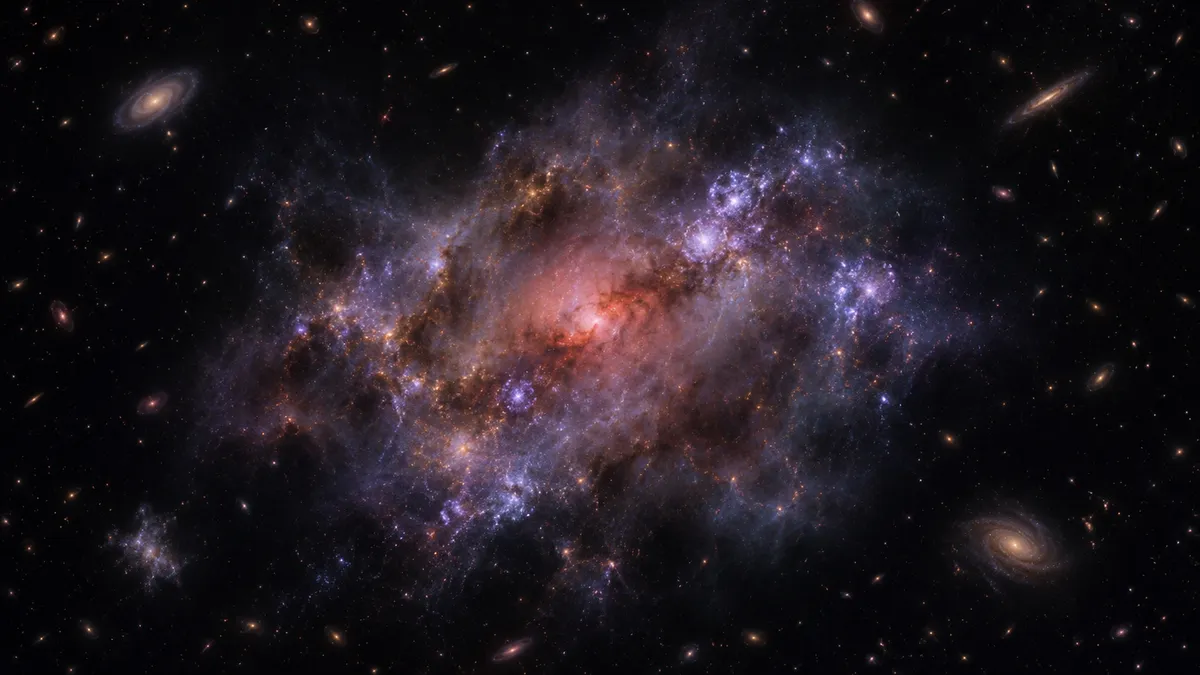
Some of the young universe’s black holes appear unexpectedly massive for their galaxies, while compact red sources raise questions about what is hiding inside them. Fabio Pacucci, Raffaella Schneider and colleagues argue that answering both puzzles requires following the same carefully selected population with several complementary JWST techniques.
The James Webb Space Telescope has found signs of black holes in galaxies seen when the universe was young. But a black hole’s present mass is not a birth certificate: both a large initial seed and a smaller seed that grew rapidly can produce a massive object later on.
In an arXiv white paper, Pacucci, Schneider and colleagues propose a JWST Multi-Cycle Treasury program to disentangle those histories. This is a research agenda, not a report of a newly completed survey. The version posted on 4 November 2026 was submitted to the Space Telescope Science Institute’s call for treasury concept white papers; the supplied record does not report acceptance of the program or journal publication.
Small seeds, large questions
One proposed route starts with remnants of the first generation of stars, producing seeds around 100 times the Sun’s mass. Other scenarios produce seeds of roughly 1,000–100,000 solar masses through stellar dynamics, runaway collisions or the collapse of supermassive stars formed in rapidly accreting gas clouds. Subsequent feeding and mergers can blur the differences.
The authors point to a possible test at redshifts 5–7, a period in the early universe. Some heavy-seed models predict a shortage of black holes below about one million solar masses; light-seed models instead predict a continuous distribution to lower masses. To investigate, the paper calls for a census reaching a total luminosity of roughly 3 × 10⁴³ erg per second, alongside measurements of the active fraction in galaxies of about 100 million solar masses in stars. The target luminosity corresponds, in the authors’ example, to a million-solar-mass black hole shining at one quarter of its Eddington rate.
The Eddington rate is a reference scale at which outward radiation pressure balances inward gravity under standard assumptions. At redshifts of 9 and above, the paper proposes counting the brighter million- to ten-million-solar-mass black holes. Their abundance could constrain seeds because light seeds growing continuously at the Eddington rate would struggle to reach those masses in the available time. Earlier episodes of faster-than-Eddington growth could, however, weaken that inference.
Growth leaves its own fingerprints
At an assumed radiative efficiency of 10%, a black hole growing at the Eddington rate increases its mass by a factor of about 2.7 every 50 million years. The authors estimate about 11 such growth periods between a seed formed at redshift 25 and a known quasar at redshift 7.64, whose black hole mass is estimated at 1.6 billion solar masses. That is enough for a 100,000-solar-mass starting seed, but not for a 100-solar-mass seed under the same continuous-growth assumptions.
Rapid accretion could help smaller seeds catch up, but keeping gas flowing is difficult: radiation and other feedback can restrict the supply. The team therefore proposes measuring both the distribution of black hole masses and the distribution of luminosities relative to the Eddington limit at redshifts 4–9. Together, these could constrain how often black holes are actively feeding. X-ray weakness and the incidence and speeds of outflows would provide complementary tests, rather than a unique proof of rapid accretion.
What are the Little Red Dots?
Little Red Dots are compact, distant sources with distinctive red spectral shapes. The paper reports that they outnumber ultraviolet-selected quasars of comparable luminosity by roughly 10–100 times. Many confirmed examples have broad hydrogen emission lines, suggestive of accreting black holes. Yet their X-ray weakness, limited or disputed hot-dust evidence and weak or undetected variability complicate that interpretation.
The competing possibilities include black holes embedded in dense gas or envelopes, very massive stars before black hole formation, and dense stellar clusters. The proposed program would combine medium-resolution spectroscopy, deep imaging with JWST’s mid-infrared instrument MIRI and repeat observations. Line shapes could reveal gas motions and scattering; infrared light could constrain dust and stellar or envelope emission; changes over time could probe the size and structure of the emitting region. None is a stand-alone verdict: for example, a cool photosphere could surround either an embedded black hole or a supermassive star.
Numbers matter too. The authors estimate that Little Red Dots occur in roughly 1% of galaxies over the relevant interval from redshift 8 to 4.5. If the phase lasts only about 3 million years, their illustrative calculation requires it to recur two or three times in every galaxy. A 20-million-year phase instead requires roughly one galaxy in three to experience it. These are conditional demographic estimates, not measured lifetimes.
Galaxies and selection effects
Some early black holes appear 10–100 times more massive relative to their hosts’ stars than the typical local relation would suggest. But bright-object selection can favor unusually massive black holes, host galaxies are often difficult to detect, and black hole masses inferred from broad lines have substantial systematic uncertainties. A large apparent offset alone does not prove a heavy seed.
The proposed remedy is to measure black hole properties and host galaxies for the same uniformly selected sources, using deep imaging and continuum spectroscopy, with integral-field spectroscopy for a subset. Comparing theoretical models after applying the same selection criteria would make the comparison fairer. Even then, the program’s conclusions would depend on reliable mass estimates, completeness and the ability to distinguish competing explanations.
- James Webb Space Telescope
- black hole seeds
- Little Red Dots
- early universe
- black hole accretion
- galaxy evolution
Related reading
Automatically matched by shared topic keywords. These links do not imply that the sources agree or establish a consensus.
A Call for a Bigger JWST Survey of the First Galaxies
Source published
Shared keywords: james webb space telescope, little red dots
Webb maps gas and stars moving differently around faint active black holes
Source published
Shared keywords: james webb space telescope
Early Galaxies Put New Limits on Hidden Neutrino Interactions
Source published
Shared keywords: james webb space telescope
Euclid forecast points to millions of galaxy spectra, with oxygen-line counts less certain
Source published
Shared keywords: galaxy evolution
Galactic Light Echoes Reveal Candidates for Fading Black Hole Activity
Source published
Shared keywords: galaxy evolution