TRANSMISSION // 2611.06966v1
Reading the Hidden Histories of Faint Galaxies Through Their Star Clusters
Source published
A proposed spectrograph for the Extremely Large Telescope could study star clusters in faint, extended galaxies much more efficiently. Exposure-time calculations suggest a way to test ideas about their dark matter and origins, but the instrument's performance and the galaxies' histories remain to be measured.
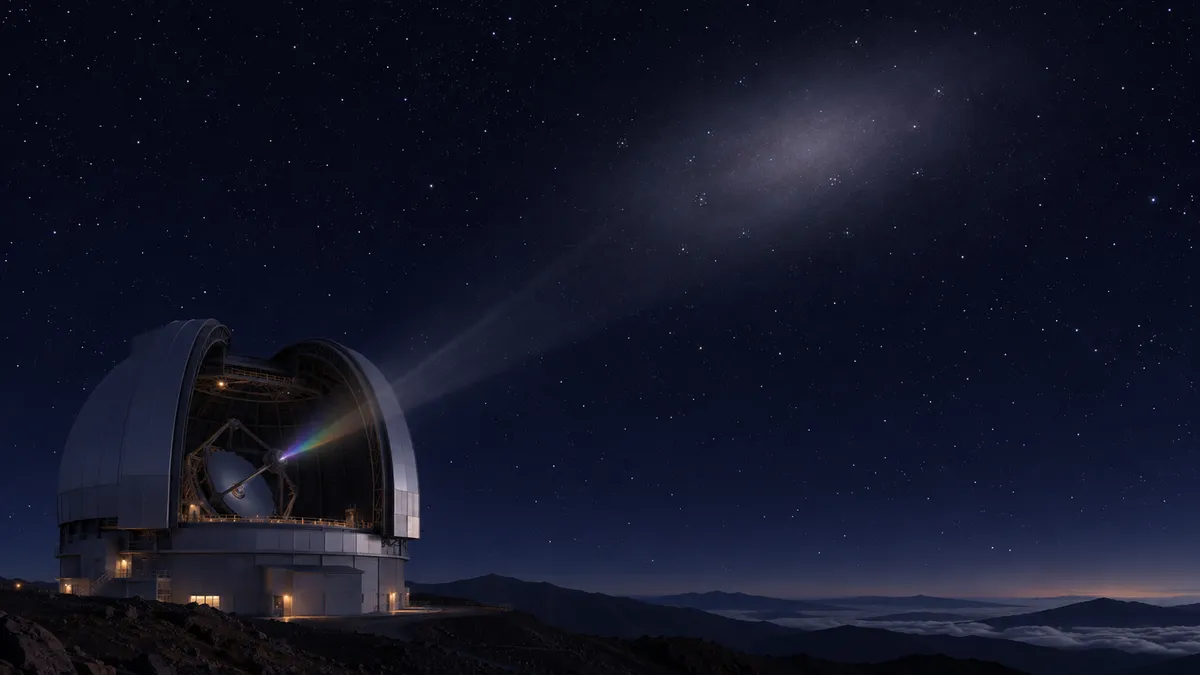
Ultra-diffuse galaxies are spread so thinly across the sky that even finding out how much dark matter they contain is difficult. Marco Mirabile and colleagues propose using the ancient star clusters around these galaxies as tracers, and calculate what a future instrument might achieve.
Galaxies with more than one possible past
Ultra-diffuse galaxies are extended systems with exceptionally low surface brightness: their light is spread over a large area, making them difficult to study. They occur both in crowded galaxy clusters and in more isolated settings. Their similar diffuse appearance does not necessarily mean they share a single origin.
One proposed explanation is that some are ‘failed’ massive galaxies: their star formation stopped early, leaving relatively few stars inside a substantial dark-matter halo. Another is that they are ordinary dwarf galaxies expanded by processes such as stellar feedback or environmental effects. Interactions and stripping offer additional routes. Some examples, including NGC 1052-DF2 and DF4, appear to have little dark matter in their inner regions; a proposed high-speed encounter could have separated ordinary matter from dark matter. These are competing interpretations, not conclusions that apply to every ultra-diffuse galaxy.
Globular clusters offer a way to investigate. These compact collections of mostly ancient stars preserve clues to their host's past. Their number, brightness distribution, ages and chemical composition can be compared with the galaxy's stars. Their motions can also trace its gravitational field, including the contribution from otherwise invisible dark matter.
From faint points to measurements
At the distances discussed in the paper, individual globular clusters are unresolved: a telescope collects their combined light rather than separating their stars. Images can identify candidates, but foreground stars and background galaxies can masquerade as clusters. A spectrum spreads the light by wavelength. Its features can help measure a candidate's motion along our line of sight and test whether it belongs to the galaxy, while also providing information about its stellar population.
The spread in velocities among genuine members can constrain the host's mass. Cluster counts provide a separate, indirect clue because richer globular-cluster systems tend to be associated with more massive halos. The proposed count–halo mass relation is still debated for ultra-diffuse galaxies, particularly those with few clusters. Small samples and unbound or intracluster objects can distort velocity dispersions and lead to overestimated masses.
The authors also want to measure the globular-cluster luminosity function: the distribution of clusters by brightness. In many galaxies it peaks at a characteristic brightness called the turnover. Observations of ultra-diffuse galaxies disagree on whether their turnover and distribution resemble those of ordinary dwarfs. Reaching the turnover would sample much more of the population, but does not by itself identify every cluster or eliminate contamination and selection biases.
What has been observed—and what is proposed
The paper reviews existing work rather than reporting new NEXUS observations. In the Hydra I cluster, about 50 megaparsecs away, the LEWIS survey used the MUSE instrument on the Very Large Telescope to study 18 ultra-diffuse and six other low-surface-brightness galaxies. A detailed study of four of those galaxies identified 11 spectroscopic globular clusters, including possible galaxy-associated or intracluster objects. The authors report that roughly six hours with MUSE did not reach the expected turnover at Hydra's distance.
Their proposed alternative is NEXUS, a near-infrared multi-slit component of SHARP for the Extremely Large Telescope. Its approximately 1.2-by-1.2-arcminute field and roughly 30 configurable slits are intended to collect spectra of multiple targets at once. Adaptive optics would correct atmospheric blurring. This combination is intended to make observations of faint, compact targets more efficient; it is an instrument concept and performance forecast, not an achieved survey result.
To estimate exposure times, the team used version 0.6 of the SHARP exposure-time calculator with a model cluster population 10 billion years old, metallicity Z = 0.004, and a Chabrier initial mass function. They assumed spectral resolution 2,000, a 200-milliarcsecond slit and an airmass no greater than 1.5. The target was a signal-to-noise ratio of about 5 at 1.6 micrometres for a cluster at the turnover. Under the assumed luminosity distribution, reaching that brightness corresponds to sampling roughly the brighter half of the population—not a complete census.
A forecast with conditions
For Virgo, about 16.5 megaparsecs away, the table estimates approximately five minutes with NEXUS, compared with about seven hours for MUSE. For Hydra I or Centaurus, at about 50 megaparsecs, the estimates are approximately five hours with NEXUS versus much more than 500 hours with MUSE. These are modeled times for reaching the turnover under the paper's specified assumptions, not measured observing times; the MUSE estimates use their own stated model and observing conditions.
The table also gives around 20 hours for NEXUS at the roughly 70-megaparsec distance of Perseus, but explicitly notes that Perseus is not observable from Cerro Armazones, the ELT site. It is a reference calculation, not a proposed observation of that cluster from the ELT.
If the forecasts hold, combining cluster velocities and counts with ages and metallicities could help distinguish formation pathways and test whether count-based and dynamical mass estimates agree. The precision of any such result will depend on the actual spectra, membership selection and sample size. The authors' manuscript is an arXiv version submitted on 4 November 2026; its versioned landing page reports publication in New Astronomy, volume 129, article 102620.
- ultra-diffuse galaxies
- globular clusters
- dark matter
- galaxy formation
- spectroscopy
- Extremely Large Telescope
- adaptive optics
- NEXUS
- SHARP
Related reading
Automatically matched by shared topic keywords. These links do not imply that the sources agree or establish a consensus.
A Sharper View of the Milky Way’s Hidden History
Source published
Shared keywords: dark matter
A Call for a Bigger JWST Survey of the First Galaxies
Source published
Shared keywords: galaxy formation
How Decaying Dark Matter Could Puff Up a Galactic Halo
Source published
Shared keywords: dark matter
Radio galaxies masquerade as tiny gravitational lenses
Source published
Shared keywords: dark matter
PrimordialPy connects inflation models to predictions of ancient black holes and cosmic ripples
Source published
Shared keywords: dark matter