TRANSMISSION // 2611.06963v1
A Sharper View of the Milky Way’s Hidden History
Source published
A science-case overview proposes using the near-infrared spectrograph SHARP to study stars in the Milky Way and nearby galaxies. Its two observing modes could connect stellar chemistry and motions to galactic structure, past mergers and dark matter, but the projected performance and scientific payoffs remain to be tested.
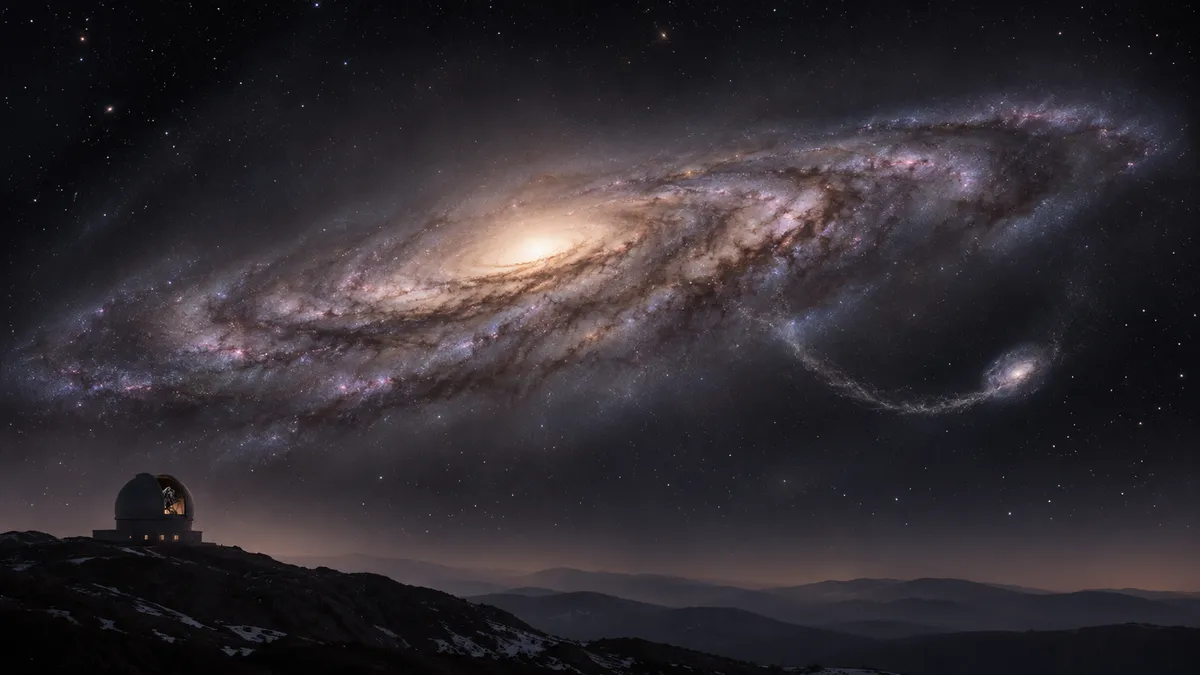
Galaxies preserve clues to their histories in the motions and chemical compositions of their stars. A proposed instrument could help read those clues in crowded, dusty regions that are difficult to study with optical surveys.
A proposal, not a discovery
The Milky Way is both a galaxy to be explained and a laboratory for explaining galaxies. Its disk, central bulge and surrounding halo contain stars born at different times and, in some cases, in other galaxies. Their positions, motions and chemical compositions retain traces of that history. But dust obscures parts of the inner Galaxy, and crowded fields make individual stars difficult to separate.
Hai-Feng Wang and colleagues describe science cases for SHARP, a proposed multi-mode near-infrared spectrograph conceived for extremely large telescopes and future space facilities. The paper is an overview of possible observations, not a report of new SHARP measurements. The version posted as arXiv:2611.06963v1 is marked as a preprint submitted to Elsevier; its landing-page comments say the Local Universe white paper has been published in New Astronomy. The authors describe the cases as general and note that further testing and community integration are needed.
Two ways to collect starlight
SHARP is designed to cover wavelengths from 0.95 to 2.45 micrometres in one exposure. Near-infrared light can penetrate dust better than visible light, while adaptive optics is intended to sharpen images blurred by the atmosphere. Spectroscopy spreads the light into wavelengths: absorption features help estimate stellar properties and composition, and wavelength shifts reveal motion toward or away from us.
The two modes address different observing problems. NEXUS is designed for multiple selected objects at once, with roughly 30 slitlets across a 1.2-by-1.2-arcminute field. Its resolving power reaches about 17,000 for point sources. VESPER uses 12 deployable integral-field units, which collect spectra across patches of sky, within an approximately 24-by-70-arcsecond field. The paper gives VESPER a resolving power of about 3,000–4,000. NEXUS is therefore suited to selected stars in relatively sparse fields; VESPER is intended for spatially resolved work in crowded or complex regions.
These are design capabilities, not demonstrated performance on the proposed targets. The authors estimate typical signal-to-noise requirements of about 30–50 for abundance measurements and 15–20 for kinematics and membership. An exposure-time calculation suggests that red giants of near-infrared K magnitude about 20–21 in nearby galaxies could reach the required signal-to-noise in a few hours per pointing. The paper explicitly calls this a rough estimate needing more detail; it is not a measured exposure time.
Reading the bulge and disk
The proposal builds on existing evidence. The paper notes that metal-rich bulge stars generally rotate faster and have a smaller spread of velocities than metal-poor stars, which tend to be more centrally concentrated. It also cites earlier work finding two breaks in the Milky Way disk’s radial density profile. Neither result is a new SHARP finding.
In the bulge, the authors propose combining stellar velocities and chemical measurements with existing survey data to distinguish overlapping populations and examine the bar and the debated X-shaped structure. Features from magnesium, silicon and carbon monoxide are among the proposed diagnostics. A star’s orbit can add information beyond its metal content when separating genuine bulge populations from foreground or background stars.
For the disk, the team wants to compare populations of different ages and chemical compositions to investigate how stars migrate, why the outer disk flares or warps, and where its density changes. Combining line-of-sight velocities from spectra with positions and motions from surveys such as Gaia can yield a fuller picture of stellar orbits where the needed measurements are available. The authors propose comparing patterns in that information with simulations of bars, spiral arms and satellite encounters. Similar studies are envisioned for some nearby dwarf galaxies, though resolving individual stars becomes harder in crowded external systems.
Streams, satellites and dark matter
The halo offers another route into the past. The Sagittarius dwarf galaxy has left leading and trailing streams of stars as it interacts with the Milky Way. The paper describes an existing simulation of the system and stresses that reproducing the stream’s full positions and velocities remains difficult, partly because of interactions involving the Large Magellanic Cloud. Future SHARP spectra could add velocities and chemical information for comparison with models; they do not by themselves establish which model is correct.
The authors also propose applying a previously developed machine-learning method, GS3 Hunter, to search for halo substructures. For dwarf galaxies and globular clusters, spatially resolved stellar motions and abundances could be compared with simulations to investigate tidal disturbance, orbital histories and dark matter. A key uncertainty is whether a system is in dynamical equilibrium: interpreting its motions as a straightforward measure of mass can be misleading if tides have disturbed it.
Ultimately, the authors hope such measurements will help test small-scale predictions of the standard cold-dark-matter cosmology. Those tests depend on obtaining suitable data and separating the effects of dark matter from ordinary matter and interactions. The overview lays out ways to pursue that goal; it does not claim that SHARP has already resolved the tensions.
- SHARP
- Milky Way
- Local Group
- near-infrared spectroscopy
- galactic archaeology
- stellar streams
- dark matter
Related reading
Automatically matched by shared topic keywords. These links do not imply that the sources agree or establish a consensus.
Simulated Stars Put Milky Way Mass Measurements to the Test
Source published
Shared keywords: milky way
Halo Stars Help Put the Milky Way’s Mass Near 1.3 Trillion Suns
Source published
Shared keywords: dark matter, milky way
Reading the Hidden Histories of Faint Galaxies Through Their Star Clusters
Source published
Shared keywords: dark matter
How Decaying Dark Matter Could Puff Up a Galactic Halo
Source published
Shared keywords: dark matter
Radio galaxies masquerade as tiny gravitational lenses
Source published
Shared keywords: dark matter