TRANSMISSION // 2611.06899v1
Two camera-based distance cues offer a conditional signal of pedestrian occlusion
Source published
A preprint reports that disagreement between pedestrian height and estimated depth can rank occlusion without training a separate occlusion model. Results are strongest for heavy occlusion on KITTI, but depend on detector boxes and depth-model behavior. Synthetic tests provide additional evidence, while a real-road robot recording exposes an important deployment limit.
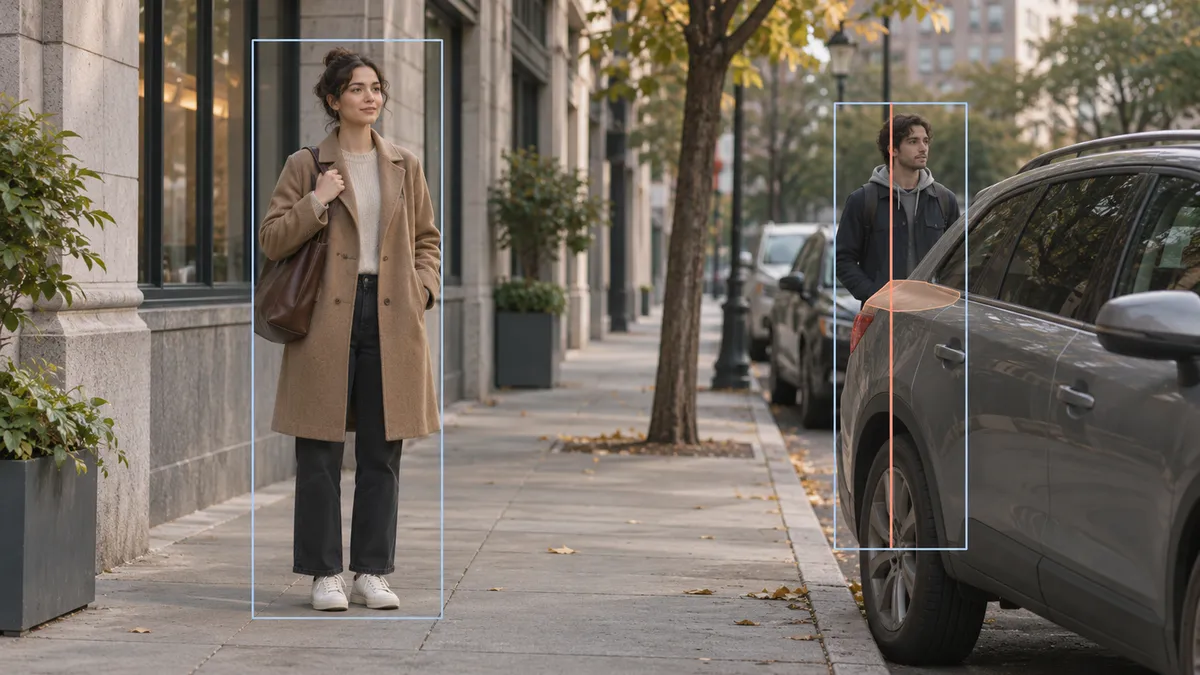
A camera may detect a pedestrian without revealing that another object hides part of their body. Researchers propose identifying that obstruction by comparing two distance cues already available in their pipeline: how tall the pedestrian appears and how close the nearest surface appears inside the detection box.
Detecting obstruction rather than recovering hidden pixels
In a preprint posted on November 4, 2026, Chibueze Praise Onyenweaku, Toyibat Adele, Sikirulahi Opeyemi Abdulkareem and Obed Honour Eje describe an occlusion score built from two camera-based distance cues. The aim is not to reconstruct hidden body parts or improve pedestrian detection directly. It is to identify when a pedestrian detection is likely to be partly obstructed.
The distinction matters: a robot could potentially use an occlusion warning when handling uncertainty. However, the paper evaluates the warning signal, not whether it improves planning or safety.
Why two distance estimates can disagree
The first cue is apparent height. Under the camera relationship used in the paper, a pedestrian’s distance is inversely related to their bounding-box height in pixels. This estimate assumes that the box spans the person’s full body, including hidden portions, rather than just the visible fragment.
The second cue comes from a monocular metric depth model, which estimates distance from a single image. When another object blocks a pedestrian, a nearby surface inside the pedestrian’s box can belong to the obstruction rather than the person. Reading the nearer depths can therefore produce a shorter distance estimate than apparent height suggests.
The proposed score multiplies a near-depth value by the box’s pixel height. Lower scores indicate greater likelihood of occlusion. The paper analyzes the minimum depth; its released implementation uses the fifth percentile, reducing dependence on a single potentially erroneous pixel.
For ranking detections, constant positive scale factors cancel. That removes the need to supply focal length, assumed stature or a depth rescaling factor to the score. No additional occlusion training or occlusion labels are required to construct it, although the detector and depth network are already trained models.
Strongest results on heavily occluded pedestrians
On KITTI, the researchers evaluated 1,941 matched detections representing 682 distinct pedestrians across three detector seeds. The score achieved an area under the receiver operating characteristic curve, or AUC, of 0.909 for heavy occlusion, with a 95% confidence interval of 0.876–0.938.
AUC measures ranking quality across decision thresholds: 0.5 represents chance-level discrimination, while 1 represents perfect separation. It is not the percentage of pedestrians correctly classified at a chosen threshold. The study’s heavy-occlusion grouping combines KITTI’s largely occluded and unknown categories.
Performance was lower for subtler obstruction: AUC was 0.826 for any occlusion and 0.775 for partial occlusion alone.
Detected pedestrians are a selected subset. The detector missed 27% of largely occluded pedestrians, compared with 3% of visible ones. Using annotated boxes for all 709 test pedestrians produced a heavy-occlusion AUC of 0.888. This checks the score beyond successful detections, but does not show that the deployed detector can find those missed people.
The authors also checked whether the score merely reflected distance. Within fixed distance bands, heavy-occlusion AUC remained between 0.894 and 0.925, while actual distance alone was near chance. The closest band contained only ten distinct heavily occluded pedestrians, making that estimate less precise.
Additional evidence, with restricted scope
In 573 synthetic CARLA frames containing 3,293 pedestrians, visibility was measured by rendering scenes with and without obstructions. The score reached AUC 0.819, compared with 0.644 for distance alone.
This was not an independent test of the complete detection pipeline. CARLA supplied full-body boxes, and the depth checkpoint was selected using CARLA ground-truth depth. Performance also declined with distance as that checkpoint’s estimates saturated.
A separate evaluation on 350 self-annotated Lagos frames motivated the work. A KITTI-trained detector’s mAP at a 0.5 overlap threshold fell from 0.8809 on its source benchmark to 0.4482 in Lagos. A CityPersons-trained baseline reached 0.7356 on the same Lagos frames. These results concern detector transfer, not the occlusion score: Lagos annotations lacked occlusion labels. Multiple dataset differences prevent attributing the gap to geography alone.
Calibration and deployment remain limiting factors
The calibration-free claim has a specific boundary. Multiplicative depth errors preserve the ranking, but additive offsets can make the score depend on range. Boxes that shrink around visible body parts can also undermine the height cue.
An important negative result appears in the limitations: on the authors’ real-road robot recording, a thresholded score performed no better at its operating point than flagging the smallest boxes. The benchmark results therefore do not establish reliable deployment across camera mountings.
Evaluation covers daytime pedestrians, not nighttime, rain or other object classes. The score cannot distinguish an actual occluder from another nearer surface inside a box, and it does not estimate the continuous fraction of a person hidden.
Finally, inexpensive scoring does not mean inexpensive depth estimation. The score took about 0.3 milliseconds per frame on the tested laptop CPU, but the default full pipeline took about 6.3 seconds. The authors make no real-time claim.
- pedestrian occlusion
- monocular depth
- apparent height
- object detection
- KITTI
- CARLA
- dataset transfer
- robot perception
Related reading
Automatically matched by shared topic keywords. These links do not imply that the sources agree or establish a consensus.
Using two-channel hearing to identify which object is making a sound
Source published
Shared keywords: robot perception
HALO humanoid learns household movements in simulation, then tackles unfamiliar rooms
Source published
Shared keywords: robot perception
Researchers examine multi-camera strategies for luggage re-identification
Source published
Shared keywords: object detection