TRANSMISSION // 2611.06785v1
Weighing a magnetic white dwarf through hot gas and a companion’s motion
Source published
X-ray models put the white dwarf in IGR J17014-4306 at roughly 0.9 times the Sun’s mass. Optical observations constrain its companion and orbit, but do not yet provide the independent mass measurement needed to test whether the X-ray estimates are biased.
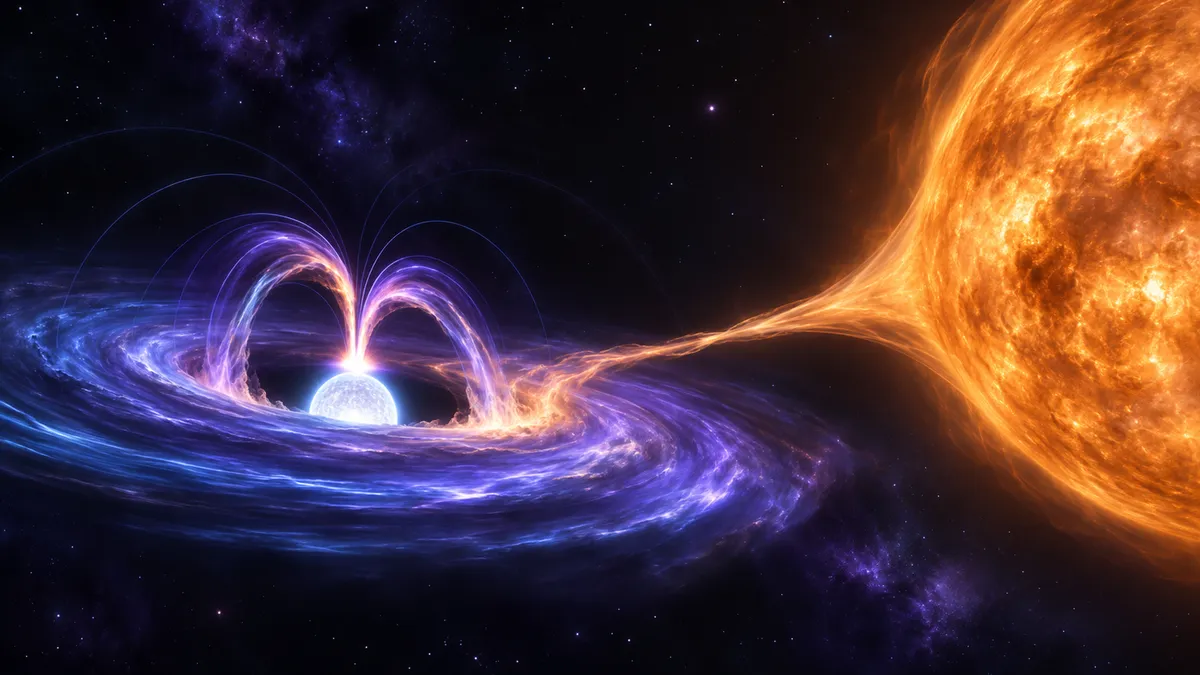
How reliably can astronomers weigh a star using gas falling toward it? A new preprint combines X-ray observations with a companion star’s orbital motion to investigate a magnetic white dwarf—and exposes the remaining gap between a plausible mass estimate and an independent test.
Two approaches to weighing one star
IGR J17014-4306 belongs to a class of interacting binary stars called intermediate polars. Its white dwarf draws material from a companion, while a magnetic field interrupts the inner accretion disk and channels the inflowing gas. The white dwarf rotates independently of the pair’s roughly 12.8-hour orbit.
The researchers investigate a persistent measurement problem: in several intermediate polars, masses inferred from X-ray emission are lower than masses determined from orbital motion. Is the same true here?
Their study, available as the November 4, 2026 arXiv preprint version 2611.06785v1, narrows the possibilities without resolving that question. Its strongest distinction is between what the observations directly constrain and what still depends on a model.
Reading the heat of falling gas
Gas approaching a magnetic white dwarf encounters a shock and becomes hot enough to emit X-rays. The maximum temperature provides information about the star’s gravitational pull. Turning that temperature into a mass requires assumptions about the accretion flow and a theoretical relationship between white-dwarf mass and radius.
The team jointly fitted observations from NuSTAR, XMM-Newton and Swift. Their main model describes plasma cooling through a range of temperatures, rather than gas at just one temperature. It also accounts for absorption along the line of sight and near the binary, a softer thermal component, and an iron emission line.
The fit gives a maximum plasma temperature near 50 kiloelectronvolts, an energy-based measure of temperature. Using the shock-temperature method, the authors infer a white-dwarf mass of 0.94 solar masses, with reported uncertainties of −0.07 and +0.09 solar masses.
A second approach fitted only NuSTAR photons above 10 kiloelectronvolts, where absorption is less troublesome. This physical accretion-column model, called ipolar30KK, gives 0.88 solar masses, with uncertainties of −0.12 and +0.14. The two estimates overlap, favoring a relatively massive white dwarf at around nine-tenths of the Sun’s mass.
But these are not fully independent measurements. The second fit fixes the magnetic disk-truncation radius using assumptions that include the first mass estimate. Moreover, the high-energy spectral turnover that would help pin down the mass is not clearly detected.
Following the companion’s motion
For an orbital constraint, the researchers obtained 121 optical exposures with the SOAR telescope over six nights in 2022 and 2023. They followed shifts in absorption lines produced by the companion star, grouping the observations into 12 orbital-phase bins.
The companion’s measured line-of-sight velocity varies with a semi-amplitude of 165 ± 4 kilometers per second. Combined with the orbital period, this yields a mass function of 0.249 ± 0.018 solar masses.
A mass function is not the white dwarf’s mass. It constrains a combination of both stars’ masses and the orbit’s viewing angle. Eclipses supply additional geometric information because the system must be viewed sufficiently close to edge-on.
Combining an adopted inclination range of 73–90 degrees with the X-ray mass estimates, the authors favor a companion-to-white-dwarf mass ratio between approximately 0.76 and 0.95. The corresponding companion mass is about 0.67–0.89 solar masses. These ranges therefore depend partly on the X-ray results; they are not an independent confirmation of them.
What remains uncertain
The optical spectra do not reliably trace the white dwarf’s own motion. Emission lines that might have served that purpose suffer from absorption, contamination and blending, and the measured velocities were erratic. Without that missing orbital information, a complete dynamical mass determination remains unavailable.
The companion measurement has its own caveat: irradiation could weaken absorption lines on its illuminated face, making the measured velocity amplitude differ from the motion of its center of mass. The importance of that effect is unknown.
Under the adopted geometry and the condition that the companion is no more massive than the white dwarf, the optical analysis gives a conditional upper mass limit near 1.14 solar masses. That limit sits above the X-ray estimates, but does not demonstrate that they are too low.
The result is a tighter set of constraints, not a settled calibration. Reliable measurements of the white dwarf’s orbital motion and more precise eclipse geometry would allow a sharper test of whether hot accreting gas gives the right answer.
- white dwarfs
- intermediate polars
- IGR J17014-4306
- X-ray spectroscopy
- optical spectroscopy
- binary stars
- stellar masses
- accretion
Related reading
Automatically matched by shared topic keywords. These links do not imply that the sources agree or establish a consensus.
Hard X-ray sources crowd the Milky Way’s nuclear stellar disk
Source published
Shared keywords: intermediate polars
Neutron star binaries may get their chance after a cluster’s black holes leave
Source published
Shared keywords: binary stars
Did two stars become one? Clues from the heaviest white dwarfs
Source published
Shared keywords: white dwarfs
A fast-spinning pulsar reveals a changing companion star
Source published
Shared keywords: binary stars
DQ Tau’s molecular gas follows a slower rhythm than its accretion bursts
Source published
Shared keywords: binary stars