TRANSMISSION // 2611.06783v1
FedFiOT aligns neural networks to improve federated learning with fewer exchanges
Source published
A preprint introduces FedFiOT, a method that jointly matches neurons across locally trained models and combines their parameters using estimated importance. Tests on three image-classification benchmarks show improvements over single-model baselines, with limits around scale, computation and privacy compatibility.
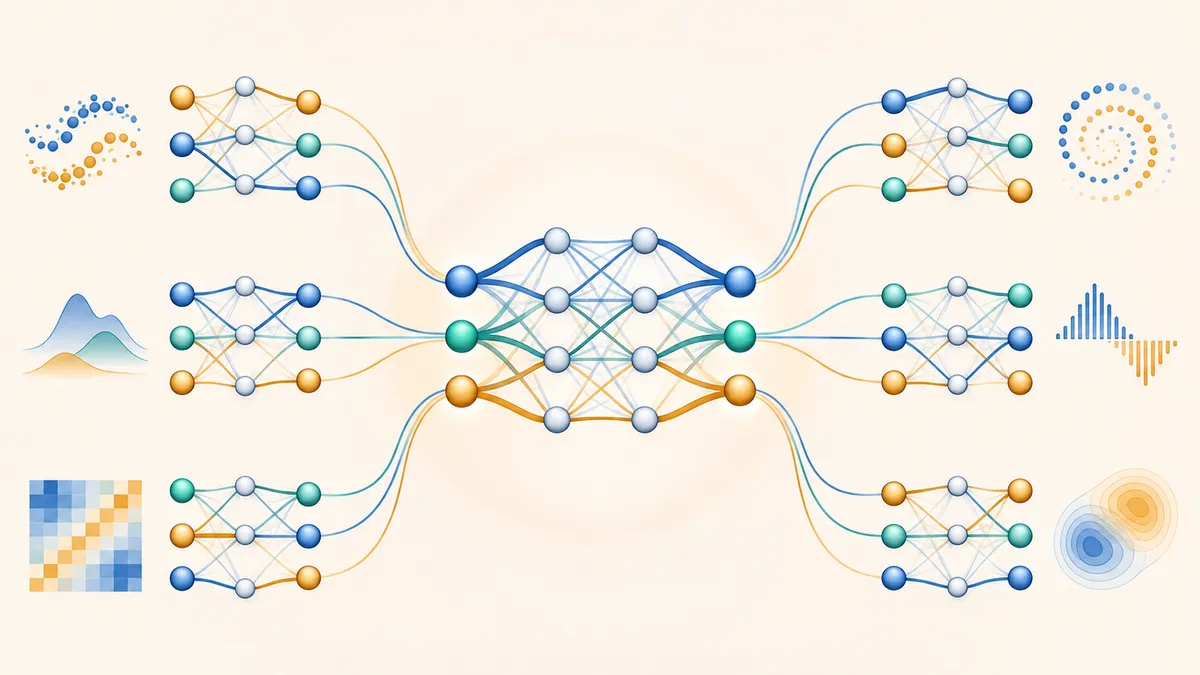
Combining neural networks is not simply a matter of averaging their numbers: different models can store similar features in different places. FedFiOT tackles this mismatch while accounting for how strongly individual parameters affect each model’s predictions.
Why averaging can go wrong
Federated learning lets clients train collaboratively while keeping their training datasets local. Typically, a server repeatedly distributes a model, receives locally trained updates and combines them. One-shot and few-round approaches restrict this exchange to one or a few communication rounds, making each combination step especially important.
In a preprint submitted to arXiv on November 4, 2026, Quan Minh Nguyen and colleagues introduce FedFiOT, a method for merging models when communication is limited. The authors are affiliated with the University of Florida and Seagate Technology.
The method addresses two connected problems. First, neural networks can represent the same function with hidden neurons arranged in different orders. Averaging parameters by position can therefore mix unrelated features. Second, a parameter may matter more to one client’s predictions than to another’s, particularly when their datasets contain different mixtures of classes.
Matching features and weighting importance
FedFiOT uses a diagonal empirical Fisher estimate as a proxy for parameter importance. Clients calculate this estimate from squared per-example gradients using their observed training labels. Larger entries indicate greater estimated sensitivity to changes in the corresponding parameters; they are not direct measurements of a feature’s usefulness everywhere.
Each client sends its trained weights and Fisher estimates to the server. The server then alternates between two operations, layer by layer. It first finds neuron correspondences, penalizing mismatches more heavily in coordinates with larger Fisher values. It then combines the aligned parameters through Fisher-weighted averaging.
The matching step is formulated as an optimal transport problem and solved as a one-to-one assignment using the Hungarian algorithm. The updated merged layer becomes the reference for the next matching step. Experiments allow up to eight iterations per hidden layer, stopping early when assignments stabilize.
Two adjustments control the weighting. Tempering compresses the range of Fisher estimates, reducing the dominance of exceptionally large entries. Damping adds a positive floor, so even coordinates with zero estimated importance receive a defined weight. The server also compares the completed aligned merge with an identity-aligned Fisher merge and retains the latter if the aligned candidate has a higher merging objective.
What the experiments report
The main experiments use six clients, a shared convolutional network architecture and three ten-class image benchmarks: SVHN, CIFAR-10 and CINIC-10. Training data are divided into unequal, heterogeneous client datasets using Dirichlet label splits. Results are means and standard deviations over three training seeds on a fixed partition.
Across the six main one-shot settings, FedFiOT has the highest mean accuracy among the methods in the main comparison table. Its advantage over FedFisher K-FAC, the strongest baseline there, ranges from 3.3 to 7.6 percentage points. On CIFAR-10 with heterogeneity parameter 0.1, for example, FedFiOT reaches 43.3% accuracy, compared with 38.6% for FedFisher and 30.3% for FedAvg.
Under a more concentrated CIFAR-10 label split, with parameter 0.05, FedFiOT achieves 41.4%, versus 31.9% for FedFisher. Separate four-round experiments report 66.7% on CIFAR-10 and 50.8% on CINIC-10. Removing alignment or replacing Fisher-weighted aggregation with uniform averaging lowers accuracy in the reported component studies.
FedFiOT does not win every comparison. Against the strongest tested FedBEns five-model ensemble, it is more accurate in three of six settings and less accurate in three. Unlike that ensemble, it returns one model and trains one model per client.
Communication savings have conditions
Sending both weights and diagonal Fisher entries doubles the number of uploaded values relative to ordinary model averaging. The experiments offset this by quantizing both to 16 bits, rather than sending model weights alone at 32 bits. Including layer-scale metadata, the resulting upload is approximately the same size as the paper’s FedAvg reference, not literally identical.
Additional computation remains: clients make an extra pass over their data to estimate Fisher entries, and server-side assignment has cubic complexity in layer width. These costs matter when considering wider networks.
What remains uncertain
The theory establishes that exact alternating updates do not increase the fixed-layer merging objective. It does not establish global optimality for the complete network or guarantee better test accuracy.
A separate stationarity bound assumes full client participation and bounded gradients, noise and Fisher entries. Persistent nonuniform Fisher weighting can leave a residual error term; the analysis does not promise convergence to an exact optimum under general heterogeneous conditions.
The empirical evidence concerns one CNN architecture and three image datasets, chiefly with six clients. Hyperparameters and local training lengths are selected using a 500-example server validation set. Secure-aggregation compatibility is left to future work. The preprint therefore supports a specific model-merging improvement under its tested conditions, not a general privacy, security or large-scale deployment guarantee.
- federated learning
- FedFiOT
- model merging
- neuron alignment
- Fisher information
- optimal transport
- one-shot federated learning
- communication efficiency
Related reading
Automatically matched by shared topic keywords. These links do not imply that the sources agree or establish a consensus.
AI Experts Can Use Different LoRA Ranks—But the Merge Method Matters
Source published
Shared keywords: model merging
Who Gets to Shape AI? The Case for Distributed Alignment
Source published
Shared keywords: federated learning
A layer-by-layer merging method aims to shorten AI reasoning without retraining
Source published
Shared keywords: model merging
What Incomplete Records Can Reveal About Joint Outcomes
Source published
Shared keywords: optimal transport
When Moving the Data Does Not Fix the Model
Source published
Shared keywords: optimal transport