TRANSMISSION // 2611.06734v1
Phone-tracked VR workout earns higher enjoyment ratings in small pilot study
Source published
An arXiv preprint describes a virtual-reality HIIT game that combines smartphone motion tracking with automated post-workout coaching. Twenty young adults rated the VR session higher for enjoyment and focus than an instructor-led alternative, but the study does not establish better fitness, injury prevention or lasting exercise habits.
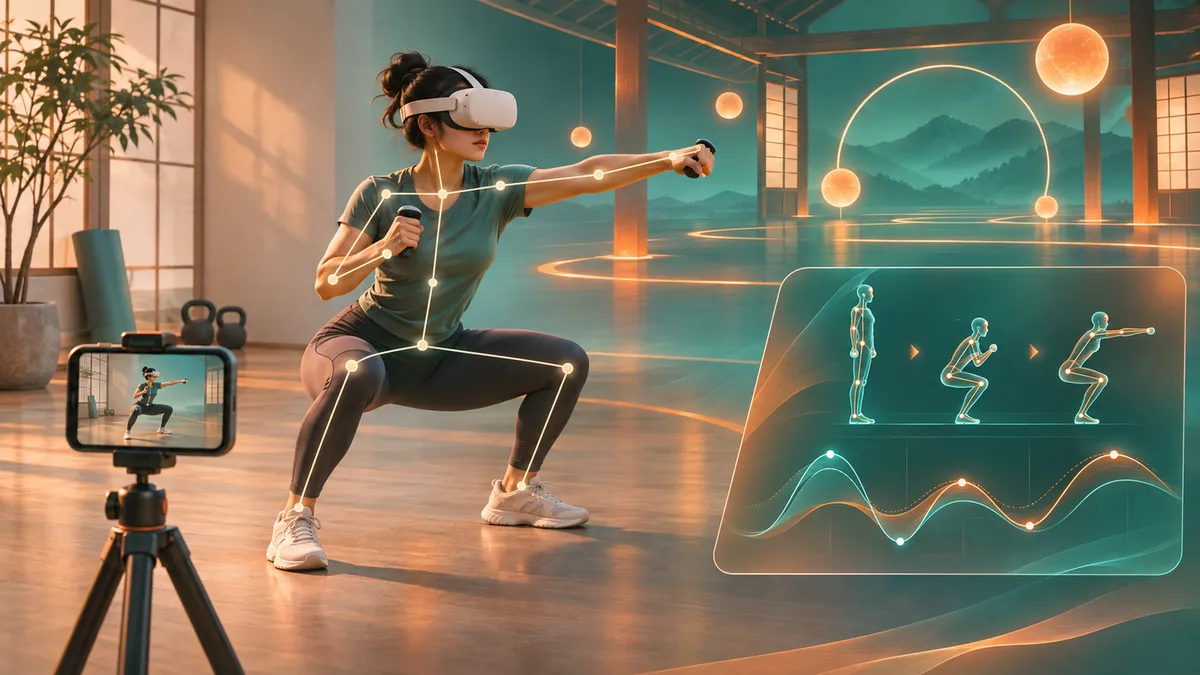
A smartphone camera watches the squats and punches while a VR headset supplies the virtual dojo. In a small exploratory study, this combination made a short workout more enjoyable for participants, without a significant difference in their reported motivation or confidence to continue.
A virtual dojo filled with approaching orbs is the setting for a fitness prototype described in an arXiv preprint submitted on November 4, 2026. Abhiram Kothagundu and colleagues combine a smartphone camera, a Meta Quest 3 headset and automated coaching to turn high-intensity interval training, or HIIT, into a reaction-based game. Their pilot study reports higher enjoyment and focus ratings in VR, but leaves questions about physical benefits and sustained use unanswered.
A phone watches the whole body
The design separates the immersive display from full-body motion tracking. The Quest 3 renders the environment, and its controllers provide vibration feedback. A smartphone on a tripod, positioned about 2.5 metres in front of the player, captures movements that head-and-hand tracking alone cannot fully observe.
Players respond to incoming orbs with 11 predefined movement combinations, including lateral punches, squat-punches and diagonal stretches. The challenges depend on spatial cues and reactions rather than matching movements to a musical beat. Setup includes body calibration before the fully immersive workout begins.
Although the authors present the phone as an accessible alternative to specialist motion-capture equipment, this is not a phone-only exercise system. The prototype also requires the VR headset and a backend server.
Tracking and coaching are different jobs
The implementation describes compressed camera frames streamed to the server at five frames per second. MediaPipe BlazePose extracts body landmarks, and the classifier uses 13 selected joints to construct a normalized matrix of distances between them. It compares those relationships with reference examples of the exercise combinations, checking consistency within a 2.5-second window.
This recognition step does not require training a separate classifier on a labelled exercise dataset. However, it still depends on the pose-estimation system, stored reference poses and a recognition threshold chosen during development.
The language model has a separate, post-workout role. Software using the Model Context Protocol, or MCP, supplies structured session measurements to GPT-4o, which generates a report covering strengths, corrections and a next goal. The system also includes a rule-based report template as a fallback. GPT-4o is not described as deciding each movement classification during gameplay.
What the participants reported
Twenty participants aged 18–25, primarily university students, each completed both conditions: the VR exergame and a non-VR, instructor-led version of the same 10-minute HIIT routine. This within-person comparison lets each participant contribute ratings for both experiences.
On the reported five-point questionnaire measures, enjoyment averaged 3.5 in VR versus 2.8 without VR. Focus or immersion averaged 3.2 versus 2.8, and willingness to recommend averaged 3.2 versus 2.7. The authors report statistically significant differences in paired tests, with p-values of 0.02, 0.03 and 0.04, respectively.
Not every measure favoured VR convincingly. Motivation averaged 2.8 versus 2.6, and confidence to continue averaged 2.9 versus 2.8; neither difference was statistically significant. Perceived intensity was similar, at 3.3 versus 3.4. These subjective intensity ratings do not establish equivalent cardiovascular workload, because the study lacked objective biometric intensity measurements.
A limited check on automated assessment
The researchers compared automated form assessments with ratings from one certified trainer across 10 randomly selected VR sessions. The trainer was blind to the system scores. The paper reports average agreement of 87.5%, with higher agreement for joint alignment and body symmetry than for reaction timing.
That is a preliminary check on consistency with one human evaluator, not proof of comprehensive coaching accuracy. It does not demonstrate that the feedback prevents injuries, improves exercise technique over time or can replace professional supervision. Nor should the percentage be read as a general accuracy rate for every generated coaching statement.
What remains uncertain
The small, young sample limits how widely the findings can be applied. First-session novelty of the VR workout may have influenced enjoyment, and self-reported responses may carry social desirability bias. Camera placement and lighting can affect tracking, while the classification threshold was not selected through systematic cross-validation.
The statistical reporting also warrants caution: the paper uses Mann–Whitney U tests as an additional check despite the paired study design, and does not describe a correction for testing multiple outcomes. The comparison changes immersion, game mechanics and feedback together, so it cannot isolate which component explains the ratings.
The clearest finding is therefore narrow: participants rated this short VR workout as more enjoyable and absorbing. Longer-term adherence, objective fitness gains and safety benefits remain unestablished; biometric measurements and longitudinal studies are proposed future work.
- virtual reality
- exergames
- HIIT
- smartphone motion tracking
- pose estimation
- MediaPipe BlazePose
- AI coaching
- human-computer interaction