TRANSMISSION // 2611.06724v1
Robot dexterity needs more than bigger AI models, survey argues
Source published
A preprint survey connects robotic-hand hardware, human demonstrations, transfer methods, learning and evaluation. It finds promising evidence for carefully aligned human data and tactile feedback, but limited proof of contact-rich transfer between different hands or sustained deployment reliability.
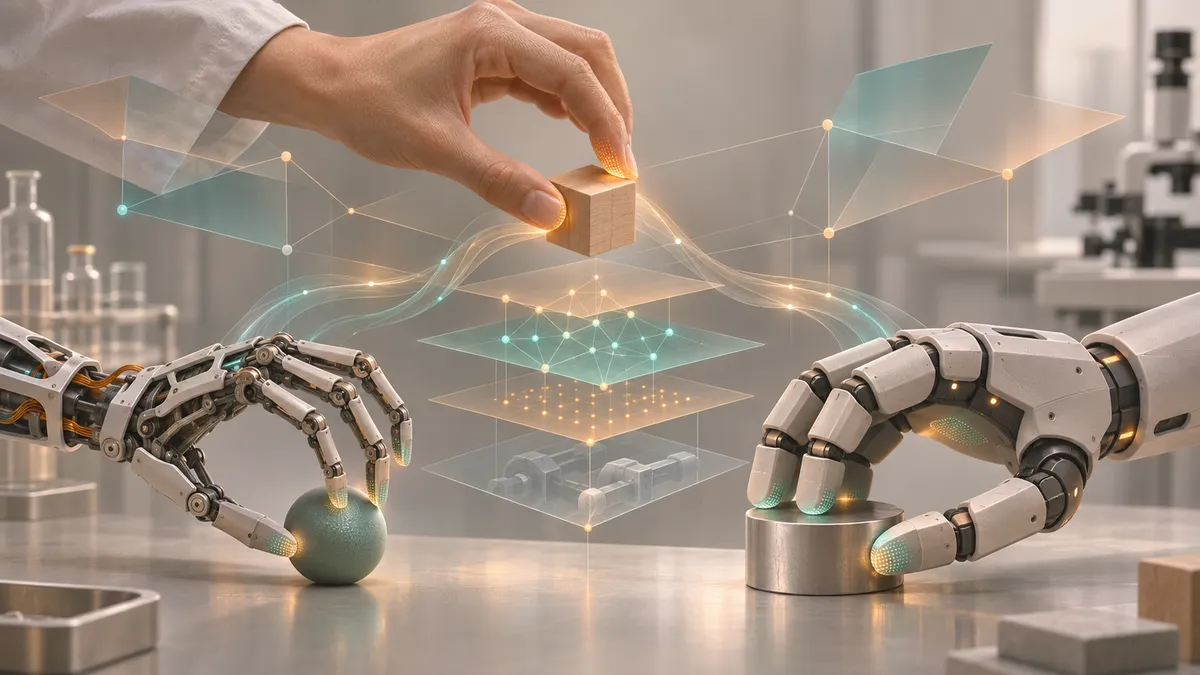
A robot hand can complete a task without applying the right force, protecting the object or working reliably for hours. A survey by Ji Pei argues that progress depends on connecting mechanical design, training data and contact control—and measuring more than whether a demonstration succeeds.
A whole-system view of robotic hands
In an arXiv preprint published on November 4, 2026, Ji Pei of Xi’an Jiaotong University reviews dexterous robotic hands through five connected layers: hardware, data, transfer between different bodies, learning, and evaluation. Human hand–object perception and touch cut across those layers.
The survey mainly covers January 2024 through early November 2026, with earlier research establishing technical lineages. It is a structured narrative synthesis, not a new robot experiment, pooled performance ranking or exhaustive systematic review. Its evidence includes research papers, preprints, company reports and trade coverage, which the author distinguishes throughout.
Hardware sets the limits
A model cannot remove a hand’s mechanical constraints. Joint arrangement, thumb range, transmission friction, force limits and sensor placement determine which movements and contacts are possible.
The survey describes competing designs rather than one winning mechanism. Direct-drive hands offer independently controlled joints; tendons can keep fingers light but introduce friction, slack and calibration demands. Coupled linkages can be inexpensive and durable while restricting independent finger motion. Soft and hybrid designs offer other trade-offs in compliance, strength and complexity.
Specifications also need careful reading. Active degrees of freedom count independently controlled inputs, whereas total degrees of freedom can include passive or coupled joints. Commercial prices and open-source component costs are not equivalent purchasing quotes. Endurance ratings cannot establish replacement intervals without comparable loads and failure definitions.
Human recordings need a bridge
Human demonstrations provide scale, but their usefulness depends on alignment. A recorded movement must be translated into feasible robot commands, while differences in camera views, body proportions and contact sensing must also be addressed.
In the survey’s account of EgoScale, task completion rose from 0.30 to 0.71 as human pretraining increased from 1,000 to 20,000 hours. Its pipeline also used approximately 50 hours of aligned human recordings and four hours of robot data. The result supports that particular recipe, not a claim that video volume alone delivers dexterity.
Other comparisons reinforce the importance of data composition. DexWild reported worse performance with a robot-to-human data ratio of 1:5 than 1:2. Liber-0 reported that 10,000 hours of glove recordings outperformed two million hours of web video under identical post-training. However, Liber-0’s evidence comes from a company blog without public code, and many reported outcomes are partial-credit progress scores rather than binary success.
Transfer must preserve contact
Retargeting means mapping human motion onto a robot hand. Matching fingertip positions is insufficient when the target has different fingers, coupled joints or limited thumb reach. A visually convincing grasp may still be physically impossible.
The reviewed methods increasingly preserve contact relationships or repair trajectories in simulation. Shared action representations can align joints by function, while model-specific adapters translate common decisions into commands for each hand. Yet the survey finds no universally best action representation, and simulated feasibility does not prove real-world safety.
Reported zero-shot transfer—execution without target-specific task training—is strongest for grasping. Evidence is much thinner for transferring tool use or contact-rich in-hand manipulation between substantially different hands.
Touch and fast feedback are promising
Touch can reveal contact, slip and forces that cameras miss. TouchScale reported that visual-tactile mid-training increased real success on four contact tasks from 22.5% to 57.5%. That is a within-study finding, not a score directly comparable with other systems.
Several reviewed architectures separate slower task decisions from faster movement generation and local contact response. Sharpa’s hardware-and-model stack illustrates this co-design approach. Nevertheless, the survey does not establish that every task requires touch or that a separate contact controller always beats end-to-end control. Different tactile sensors also remain difficult to transfer between.
Demonstrations are not deployment evidence
The survey’s case analyses include hardware-matched wearable collection at Sunday and Generalist. Their scale claims require qualification: neither case establishes large-scale use of a 20-plus-degree-of-freedom multi-fingered hand, and neither has released data or models for independent evaluation.
Evaluation is another weak link. DexVerse found no generalization advantage from web pretraining for high-degree-of-freedom hand control under its benchmark conditions. Laboratory benchmarks also expose a distinction between completing a procedure and producing a physically valid result.
Pei recommends reporting precision, force, damage, interventions, latency, downtime and repairs alongside successful attempts and uncertainty. The proposed commercial-kitchen architecture and acceptance thresholds are design exercises, not validated deployments or standards.
The survey identifies eleven open problems, including durability, tactile standardization, cross-hand transfer, safety and economics. Human-data governance is also essential: household recordings can reveal interiors and habits even without faces. Its central conclusion is conditional rather than celebratory: aligned data and contact feedback can help, but reliable dexterity still requires controlled comparisons and sustained physical evidence.
- dexterous robotic hands
- foundation models
- human demonstration data
- cross-embodiment transfer
- tactile sensing
- robot evaluation
- robot reliability
Related reading
Automatically matched by shared topic keywords. These links do not imply that the sources agree or establish a consensus.
Different EEG Models Find Shared Patterns—but Bigger Is Not Always Better
Source published
Shared keywords: foundation models
EEG Models May Separate People Better Than the Tasks They Perform
Source published
Shared keywords: foundation models
Recursa improves AI legal research by revising its own working knowledge
Source published
Shared keywords: foundation models