TRANSMISSION // 2611.06637v1
Teaching Motion-Prediction Models the Near Future First
Source published
A preprint introduces staged training for predicting future human poses, with learned compensation factors intended to limit forgetting as models tackle longer horizons. Tests report lower joint-position errors across several models and three datasets, although the enhanced method is not consistently better than its simpler counterpart and training takes longer.
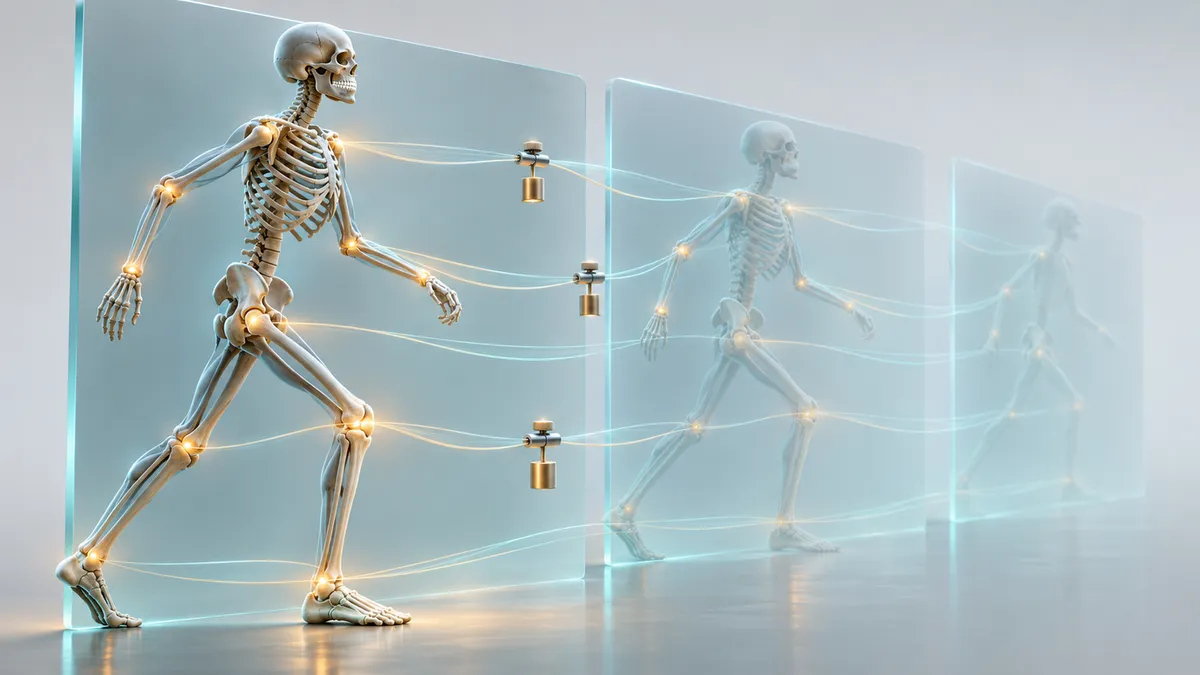
Predicting a person’s next pose and predicting their pose a second later are related but differently demanding tasks. Researchers propose teaching models these horizons progressively, while adjusting training to preserve what they learned about the nearer future.
A training problem across time
Human motion prediction estimates future body poses from an observed sequence of poses. Rather than forecasting where a person travels alone, the task here concerns the three-dimensional positions of body joints at different future moments.
In Human Motion Prediction via Continual Prior Compensation, Jianwei Tang and colleagues investigate whether learning all prediction horizons together can hinder near-future accuracy. The work is an arXiv preprint, version 1, posted on November 4, 2026; its reported findings should be read as preprint results.
The authors’ preliminary experiments compare training on short horizons, training on short and long horizons together, and learning short horizons before adding longer ones. Short-only training performs better on the short-term comparison than joint training. Progressive training improves the long-term comparison over joint training, but still loses some short-term accuracy relative to short-only training. These observations motivate both a staged curriculum and a mechanism intended to reduce forgetting.
Extending the horizon without starting over
The proposed Continual Prior Compensation framework, or CPC, divides the future sequence into consecutive segments. Training initially targets the first segment. Later stages expand the target to include additional segments while retaining earlier ones. Each stage starts from the model parameters learned previously.
For the 25-frame prediction setting, the default division is three segments containing 3, 9 and 13 frames. This is not a system that learns new activities continuously after deployment: its subtasks are prediction intervals within a supervised training procedure.
CPC adds a learned Prior Compensation Factor, estimated through an auxiliary neural-network head. The factor is intended to represent lost prior information and adjusts the weight given to the newly added segment’s prediction error. In the training objective, a larger factor reduces that weight, limiting emphasis on the new segment relative to earlier targets. Factors estimated in completed stages are averaged across training samples for subsequent stages.
CPC++ makes this compensation more detailed. Instead of representing the combined prior loss with one factor, it estimates separate factors associated with earlier subtasks. Its Prior Loss Estimation Module uses attention to exchange information across tasks and pooling to aggregate information within each task. These are learned estimates, not direct observations of a model’s memory.
What the benchmarks show
The main experiments use Human3.6M, CMU-MoCap and 3DPW. Prediction quality is measured primarily by mean per-joint position error: the average distance between predicted and reference joint positions, in millimeters. Lower values are better.
With PGBIG as the underlying prediction model, Human3.6M error at 80 milliseconds falls from 10.3 millimeters to 9.4 with CPC and 9.1 with CPC++. At 1,000 milliseconds, the corresponding values are 110.3, 108.8 and 109.2 millimeters. Both approaches improve these baseline results, but CPC++ is not better at both horizons.
On CMU-MoCap, the 1,000-millisecond error falls from 80.1 millimeters to 78.4 with CPC and 76.8 with CPC++. On 3DPW, the same comparison is 104.1, 96.0 and 96.3 millimeters. These results show that the additional fine-grained machinery does not consistently outperform the simpler approach.
Human3.6M experiments also report improvements when the frameworks are applied to LTD, MotionMixer and siMLPe. A separate experiment with the POTR transformer reports lower angular errors; those values use radians and should not be compared directly with millimeter-based results.
Evidence for compensation, with qualifications
An ablation follows the earliest subtask as training expands. Its error increases by 0.83 without compensation, compared with 0.27 using CPC’s factor and 0.14 using the fine-grained factors. This supports reduced degradation in that experiment, not complete elimination of forgetting.
The paper also derives upper-bound training objectives. One result bounding the gap between an objective and its upper bound requires a conditional probability of at least one-half. The authors report that 97.8% of samples satisfy this condition in their Human3.6M analysis with PGBIG. That is a condition-specific theoretical result, not a guarantee of prediction accuracy for every sample or dataset.
Costs and limits
Training takes longer. One timing comparison reports 16.3 hours for PGBIG and 19.5 hours with the proposed strategy. The authors state that inference remains unchanged from the baseline, so the extra training machinery does not imply faster prediction.
The reported comparisons do not include uncertainty intervals. Benchmark pose errors also do not establish safer autonomous driving, better robot interaction or reliable deployment in unfamiliar environments. The supported conclusion is narrower: staged training with learned compensation improved the tested motion-prediction models, with benefits that vary across datasets, horizons and compensation designs.
- human motion prediction
- continual learning
- Continual Prior Compensation
- CPC++
- pose forecasting
- catastrophic forgetting
- computer vision
Related reading
Automatically matched by shared topic keywords. These links do not imply that the sources agree or establish a consensus.
Measuring Representation Drift to Help Vision Models Learn Without Forgetting
Source published
Shared keywords: catastrophic forgetting, computer vision, continual learning
Skill++: Helping AI agents find the right skills as their libraries grow
Source published
Shared keywords: continual learning
A Portable AI Memory Layer Transfers Some Learned Skills Without Retraining
Source published
Shared keywords: catastrophic forgetting
Exo lets AI agents rewrite their harness while working
Source published
Shared keywords: continual learning
Why AI Reasoning Training May Favor Familiar Problems
Source published
Shared keywords: catastrophic forgetting