TRANSMISSION // 2611.06464v1
Using AI Disagreement to Improve Microdroplet Design
Source published
A simulation-based preprint uses disagreement among neural networks to guide additional fluid simulations and improve microdroplet predictions. The authors also demonstrate inverse design across 30 simulated configurations, while showing that confident models can still make substantial errors.
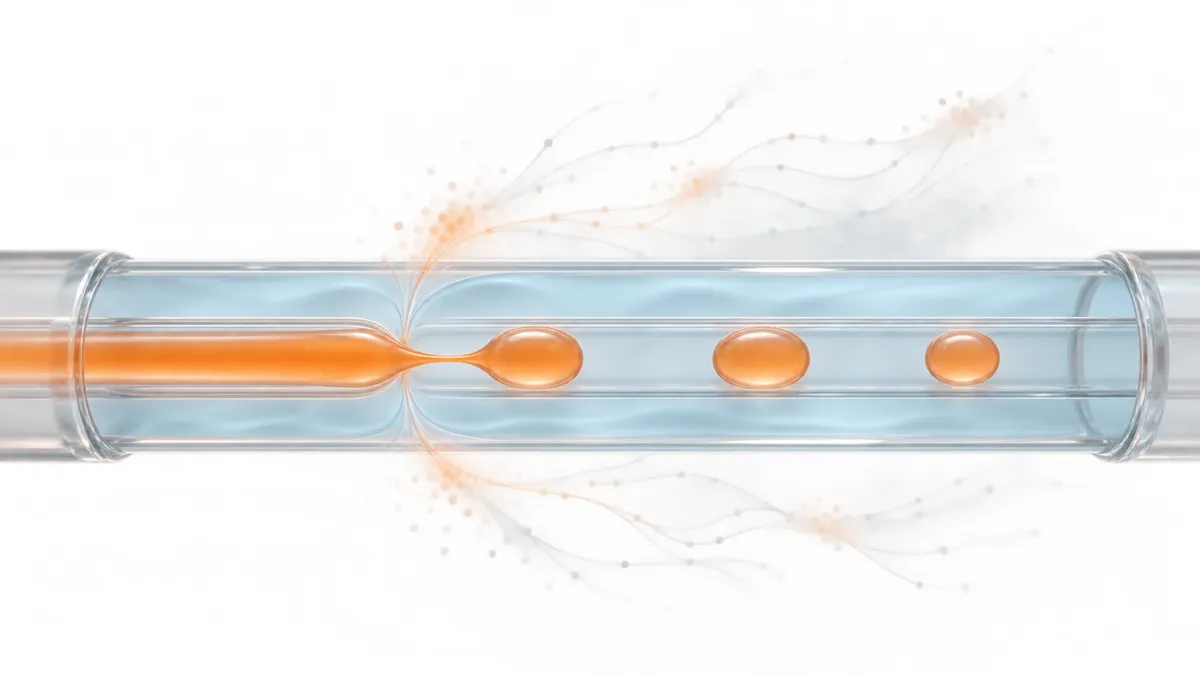
Designing a tiny droplet generator means finding operating conditions that produce the desired droplet size without switching into an unwanted flow pattern. David Gabriel Harispe, Matías Gerard and Pablo A. Kler propose using neural-network disagreement to identify where expensive simulations could most usefully improve that search.
Finding where a fast model needs help
In a November 2026 preprint, David Gabriel Harispe, Matías Gerard and Pablo A. Kler describe a computational workflow for designing coaxial microdroplet generators. Their approach combines detailed fluid simulations, fast neural-network approximations and an optimization algorithm. Its central idea is to spend additional simulation effort where the networks disagree, especially near transitions between different flow patterns.
The reported results support improved predictions in the difficult regions selected for refinement. They do not establish that model confidence guarantees accuracy, or that the proposed designs will perform equally well in laboratory devices.
Two fluids, several possible outcomes
The studied device contains two concentric capillaries carrying fluids that do not mix. The inner fluid forms droplets within the surrounding outer fluid. Depending on the geometry, fluid properties and operating conditions, the system can produce dripping, a narrowing jet or a widening jet.
The authors focus on predicting droplet diameter in the dripping regime. Their detailed simulations use the Volume of Fluid method in the open-source Basilisk solver to follow the interface between the fluids. These simulations supply reference results for training faster models, called surrogates.
Two separate groups of 20 neural networks perform different jobs: one predicts the flow regime, while the other predicts diameter for dripping configurations. Networks within each group share an architecture but differ in their initial weights and training-data partitions.
For regime prediction, disagreement is measured through voting: how many networks choose the same flow pattern? For diameter, the researchers measure the spread of predictions relative to their mean, using the coefficient of variation.
These measures describe disagreement between models—not variation among physical droplets. As the paper explicitly cautions, agreement can coexist with a shared error.
Directing simulations toward difficult boundaries
The researchers first explored disagreement using synthetic configurations generated by interpolation between existing cases. These configurations were inexpensive to produce, but their physical outcomes were not independently verified through simulations.
The analysis located substantial disagreement near boundaries between dripping and jetting. The authors interpret this as consistent with the sensitivity of these transitions: small parameter changes can alter the flow regime, making sparsely sampled boundaries difficult to learn.
They then selected additional configurations using both disagreement and knowledge of the expected regime boundaries. Detailed simulations supplied new labels and diameters for retraining. Further simulations helped balance the representation of different regimes.
Importantly, the initial classifier sometimes confidently selected the wrong regime near these boundaries. Some configurations predicted to drip instead produced widening jets in simulation. The refinement therefore corrected the training picture rather than merely making existing predictions more unanimous.
What improved in the independent checks
On a separate simulation-labeled test set of 55 configurations, regime-classification accuracy increased from 49.1% to 87.3%. On another test set containing 171 dripping configurations, diameter predictions with errors of at most 3% increased from 47 to 91. Predictions exceeding 10% error fell from 38 to 11, and median absolute percentage error decreased from 4.98% to 2.71%.
These test configurations were concentrated in regions targeted by enrichment. The authors explicitly limit the interpretation: the results measure improvement in those difficult regions, not accuracy across the entire parameter space. Diameter-test candidates were also screened by the updated regime ensemble.
The uncertainty changes were not uniformly favorable. Although disagreement decreased in regions associated with dripping, overall regime disagreement increased along some parameter ranges associated with jetting. The authors identify those regions as candidates for further enrichment.
Designing backward from a target size
The refined models were then used inside particle swarm optimization, which searches among candidate operating configurations. Its scoring function combines target-size matching with penalties for uncertain diameter predictions, weak support for dripping and proximity to selected search boundaries.
The authors tested ten target diameters spanning 21.75–248.8 micrometers, with three optimization runs per target. All 30 resulting configurations produced dripping in subsequent, independent simulations. The reported median absolute prediction error against those simulations was 2.77%; 21 cases were within 5% and 29 within 10%.
One case exposed the confidence measure’s limitation particularly clearly: the diameter error reached 16.58% even though disagreement was only 3.14%.
The remaining limits
The demonstration uses one coaxial geometry, fixed densities and surface tension, and an axisymmetric simulation model. Its design validation is computational, not a new experimental demonstration. The ensembles do not capture uncertainty from choosing a different network architecture or discretizing the fluid equations.
The authors also acknowledge that restoring previously excluded baseline cases may explain part of the classifier improvement. Their boundary penalty covers only two search variables, leaving others able to approach sparsely sampled limits. Application to other device geometries remains a proposed extension. The contribution is therefore a simulation-supported refinement strategy, not a general guarantee of reliable droplet design.
- microfluidics
- microdroplet generation
- surrogate modeling
- uncertainty quantification
- neural network ensembles
- active learning
- inverse design
- computational fluid dynamics
- particle swarm optimization
Related reading
Automatically matched by shared topic keywords. These links do not imply that the sources agree or establish a consensus.
When Less Data Helps: A Task-Focused Approach to Machine Learning
Source published
Shared keywords: active learning
FastAgent uses rapid physics screening to target detailed simulations
Source published
Shared keywords: computational fluid dynamics
Making uncertainty measurable when AI predicts whole distributions
Source published
Shared keywords: uncertainty quantification
Reserving resources for AI agents when their workloads are unknown
Source published
Shared keywords: uncertainty quantification
CARM adapts trust masks as scientific super-resolution data change
Source published
Shared keywords: uncertainty quantification