TRANSMISSION // 2611.06434v1
EviSeek Gives Embodied AI a Reason to Look Before It Answers
Source published
A preprint proposes organizing an embodied agent’s actions and memory around explicit evidence needs. In simulated tests, EviSeek improved overall question-answering accuracy over a single-model baseline while using fewer model tokens, though some tasks became harder.
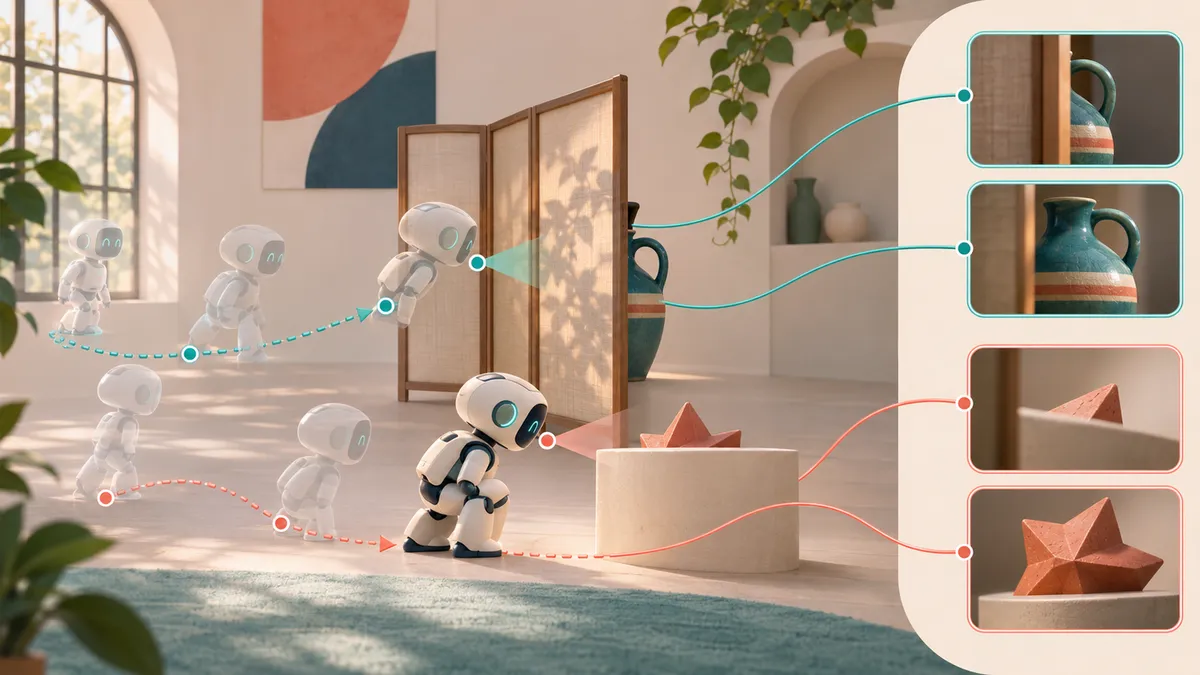
An agent asked whether two objects are touching may need to move around them before answering. EviSeek turns that information need into an explicit objective—and keeps selected observations for the final answer.
An answer about a physical scene can depend on something a camera cannot initially see: a gap between objects, the contents of a container, or what happens when an object is moved. An embodied AI agent can change its view or interact with the scene, but those actions do not necessarily produce the evidence the question requires.
In a preprint, Jintao Li and colleagues propose EviSeek, a framework that makes the desired evidence explicit before an agent explores. Rather than simply planning a sequence of plausible actions, it identifies observations that would help answer the question, pursues them, and retains selected results. The researchers report improvements on two simulated benchmarks, with important differences across task types.
From a question to an evidence target
EviSeek uses a pretrained vision-language model without task-specific training or parameter updates. Given a question and an initial view, it first lists “evidence demands”: observable pieces of information relevant to the answer. These are meant to describe what needs to be seen without presuming which answer is correct.
For a comparison between two bottles, for example, the agent might need informative views of each bottle. It then creates subtasks for acquiring those views. During execution, it can adjust its actions to what it observes, including changing viewpoint or performing an available physical intervention.
Selected images and action outcomes go onto an evidence board, linked to the subtask and demand that motivated them. Other observations can help immediate control without being kept for the final answer. In the main ESI-Bench configuration, the initial plan remains fixed, although actions respond to observations. A subtask can end even if no evidence was retained, so the system does not guarantee that every demand has been satisfied.
Accuracy and model use
The primary evaluation covered 3,436 questions across ten task families in the simulated ESI-Bench environment. The researchers excluded 66 of the benchmark’s 3,502 released questions: 60 skipped by the official active-perception code and six whose reference images failed to render. Both active systems used the same question set, task interface and ceiling of 30 primitive environment actions.
The comparison was with the benchmark’s Single-model agent, which also uses a vision-language model to interact and receives task-specific exploration advice. The systems differ in planning, memory, answer context and stopping behavior, rather than in just one isolated feature.
With Qwen3-VL-32B, EviSeek achieved 52.7% overall accuracy, compared with 45.6% for Single-model—a 7.1-percentage-point gain. With Gemini 3.1 Pro, accuracy rose from 55.7% to 59.3%, reported as a 3.7-point gain before rounding. These are question-weighted results; paired statistical tests reported by the authors supported the overall improvements.
The gains were uneven. Spatial Relations accuracy rose from 28.3% to 46.2% with Qwen and from 36.9% to 46.6% with Gemini. But Metric Comparison fell from 42.0% to 33.5% with Qwen and from 52.7% to 44.5% with Gemini. Physical Dynamics also declined with Qwen, from 65.3% to 53.3%, while improving with Gemini.
Mean token use per episode fell from 139,380 to 76,470 with Qwen and from 86,887 to 74,839 with Gemini. That did not always mean fewer environment actions: Gemini EviSeek averaged 12.17 steps, versus 10.71 for its Single-model baseline.
Was the answer visually supported?
The researchers also used a separate GPT-5.5 judge to assess the images available at answer time. The judge saw the question, answer options, ground-truth answer and images, but not the agent’s prediction. It assigned visual support of 0, 0.5 or 1; correctness was then weighted by that grade.
This visual-support-weighted accuracy increased from 31.90% to 38.71% with Qwen and from 43.19% to 47.83% with Gemini. The assessment excludes action-result text, however, so it is not a complete measure of all information available to an agent.
Component tests offer further, though bounded, evidence. With Qwen, removing explicit demands while retaining task decomposition reduced online accuracy to 46.6%. Two other tests reused EviSeek’s recorded trajectories and changed only answer-time memory: replacing the evidence board with recent-view memory produced 47.6% accuracy, while uniform frame sampling produced 47.4%.
Navigation and limits
A navigation variant was also evaluated on EXPRESS-Bench, comprising 2,044 question–trajectory pairs across 174 simulated scenes. Using Gemini 3.1 Flash-Lite and RGB observations, it achieved 41.60 grounded correctness versus 19.48 for the RGB Single-model baseline. Fine-EQA scored higher at 49.92, using depth observations and mapping. Unlike the main ESI-Bench configuration, the navigation variant used coverage checks and replanning.
Both benchmarks use simulation and predefined action interfaces. The preprint does not establish how the approach transfers to physical robots, where sensor noise and uncertain movement or contact could change the evidence obtained. Nor does an evidence board itself solve spatial reasoning: the underlying model still has to interpret what it sees. The results suggest that organizing exploration around evidence needs can help in the tested settings, not that it eliminates errors or improves every task.
- EviSeek
- embodied question answering
- active perception
- evidence acquisition
- vision-language models
- robot navigation
- preprint