TRANSMISSION // 2611.06374v1
Can grassroots contracts make AI platforms more accountable?
Source published
A preprint by Ehud Shapiro proposes participant-governed smartphone networks that identify AI agents and attach signatures to shared content. Its prototypes and formal arguments offer a design for accountability, not proof that deepfakes or AI harms can be eliminated.
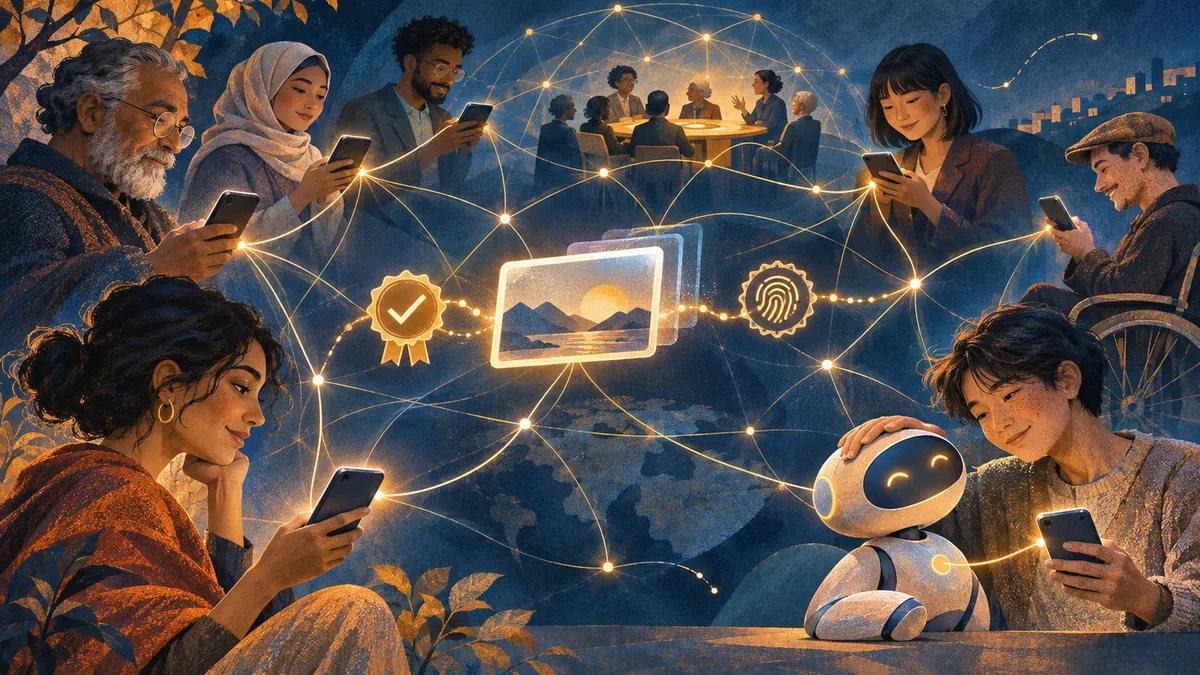
Instead of asking platform owners to control AI more carefully, a new preprint asks what happens when users build the platform around mutual agreements—and keep the evidence of who said and shared what.
A different starting point for AI safety
Debates about AI and social media often assume that a company will remain in charge of the platform. Ehud Shapiro’s preprint, Corralling AI Risks with Grassroots Contracts, challenges that assumption. It proposes smartphone-based networks governed by their participants, with rules designed to make AI agents and shared content attributable.
The paper focuses on three risks: AI gaining influence through control of major platforms; agents operating without an accountable human or organisation behind them; and deepfakes circulating without an identifiable source. Its answer is not a better deepfake detector or a promise that AI will behave well. It is a proposal to change who controls a network and what evidence travels through it.
The distinction matters. Attribution can help people seek accountability, but it is not the same as preventing harm or proving that a claim is true.
Contracts rather than platform terms
Shapiro draws on Pierre-Joseph Proudhon’s idea of groups freely adopting mutual agreements and joining other groups by consent. A grassroots contract translates that idea into rules for a digital platform: who may take an action, whose agreement it requires, and what changes as a result. For example, friendship requires the agreement of both people; either can end it.
Unlike a conventional user agreement between a person and a platform operator, the proposed contract is mutual among participants. The design uses their phones and network connections rather than a central operator or hardwired server. Separately formed groups can later connect by consent.
The preprint argues that this removes a single platform controller who could hand the whole system over to AI. That is a structural comparison, not a demonstration that participants’ devices or choices are immune to manipulation.
An agent with someone behind it
Under the proposed AI contract, an agent has its own signing key, a principal who creates it, and a developer whose code is signed. A guardian must participate when the agent establishes an acquaintance or friendship; the principal can also retire it. Each agent act names its principal and developer and carries the principal’s signed statement that the agent runs the developer’s code.
The paper compares responsibility to that for a car: developers are accountable for defects, while guardians are accountable for reckless operation. But the contract distinguishes between rules a protocol enforces and commitments it merely records. In particular, the signed statement does not establish which code is actually running. A false statement would instead be evidence against the principal.
There is another important gap. The protocol cannot tell whether a program is acting under a person’s own key. In that case, the contract treats the signed acts as the person’s responsibility; it does not reliably expose the program as AI. Nor does the contract determine an agent’s goals or restraints. The paper itself notes the danger of assigning responsibility to someone without meaningful control.
Provenance is not truth
The proposed social network adds a chain of digital signatures. An author signs an item, and each person or agent forwarding it signs over it. A recipient can inspect the chain. A deepfake brought in from outside could still be shared, but someone would have signed it into the network; an item with no signature is not an item of the proposed platform.
This is different from detecting synthetic media. Signatures show who signed and forwarded content, not whether it is genuine, accurate, or created by AI. A person can sign AI-generated material as their own. Someone can also remove existing signatures using other software and sign the result; the paper treats that as a breach, with the new signature providing evidence—not as something technically impossible.
The proposed evidence could support recourse, including court action, but a signature alone does not settle legal culpability or guarantee a remedy. And a reader who does not know an AI author may see its signature without having the direct record that identifies it as an agent.
Prototype, not finished alternative
The preprint presents mathematical arguments about the protocols and describes working prototype apps produced through a series of translations from contracts to software, with AI used to code the layers. It reports correctness proofs for parts of that implementation chain and app testing. The illustrated setup runs agents within an iPhone simulator; it is not evidence of a mature, widely deployed network.
Shapiro acknowledges that much work remains before the apps could compete with incumbent platforms. The paper also leaves aside harms from using AI itself, such as bad advice or emotional dependence, and harms people can amplify with AI, including fraud and harassment.
The editorial promise of the proposal is therefore narrower—and more useful—than a claim to have solved AI safety. It asks designers to build consent, distributed control and attributable actions into the platform itself. Whether those rules can become usable, trusted and effective at scale remains an open question.
- AI governance
- grassroots contracts
- decentralized social networks
- AI agents
- digital provenance
- deepfakes
- accountability
- preprint