TRANSMISSION // 2611.05790v1
AI trained on physics equations speeds up models of spinning neutron stars
Source published
A preprint introduces neural operators that learn rotating neutron-star structure without labeled solutions. The author reports roughly thousandfold faster evaluations than a numerical benchmark, with potential applications to dense-matter inference and pulsar evolution.
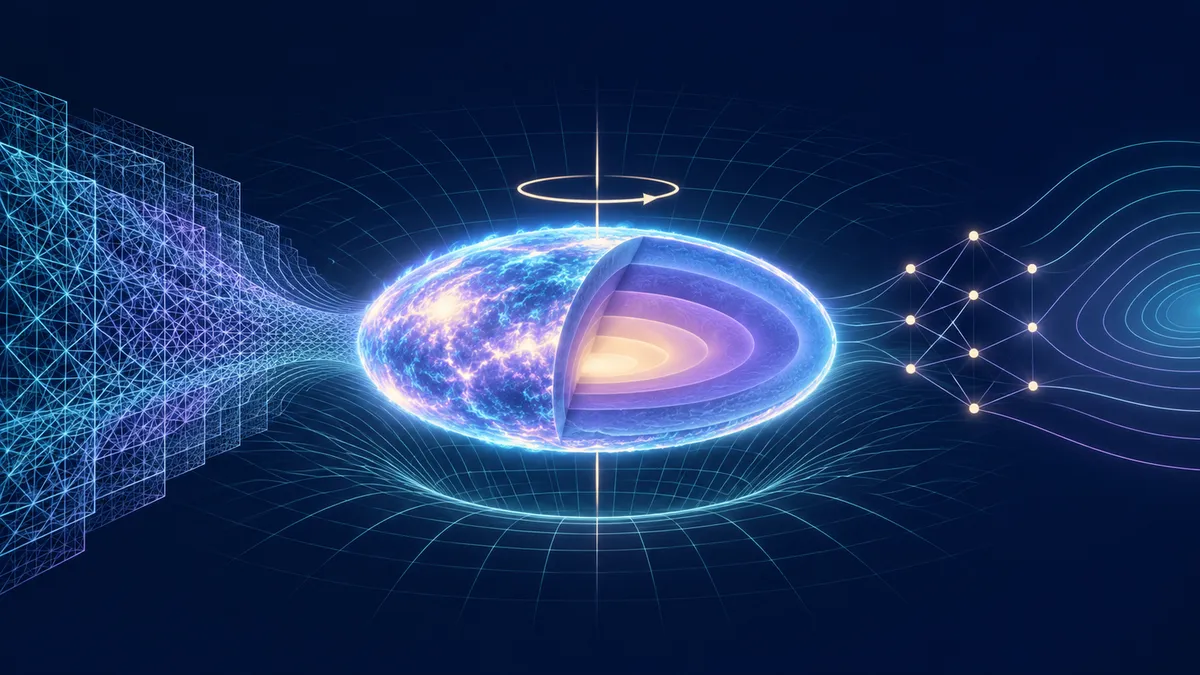
Modeling a rapidly spinning neutron star means solving coupled equations of gravity and matter again and again. A new study explores whether a neural network trained to satisfy those equations can make the calculations fast enough for large statistical studies.
Neutron stars offer a way to investigate matter at densities that are difficult to probe in terrestrial experiments. Their masses and radii depend on the equation of state: the relationship between pressure and energy density inside them. But rotation complicates that relationship. A rapidly spinning star cannot always be represented accurately by a spherical model or a low-order correction to one.
In a November 2026 arXiv preprint, Anarya Ray presents physics-informed neural operators designed to accelerate calculations of uniformly rotating neutron stars in general relativity. The study reports roughly a thousandfold speed-up over its rotating-star numerical benchmark, while retaining close agreement in the tested structural properties. These are computational results reported in a preprint, not a newly established measurement of neutron-star matter.
Learning from equations rather than answers
Conventional rotating-star solvers repeatedly update estimates of the gravitational fields and matter distribution until they reach a self-consistent equilibrium. That process becomes expensive when researchers need to evaluate many possible equations of state or repeatedly recalculate a star as it gains matter.
Ray instead uses DeepONet, a neural-network architecture that learns mappings between functions. Here, it takes a sampled pressure–energy-density relationship and stellar parameters, including central conditions and a measure of flattening, and predicts spatial profiles of gravitational metric potentials. Those profiles support calculations of quantities such as mass and equatorial radius.
The crucial distinction is how the network learns. It is not trained to copy a collection of answers produced by an existing stellar solver. Instead, its loss function measures whether its predicted fields agree with integral representations of the governing equations. Training pushes the network toward self-consistency with the physics.
“Unsupervised” therefore does not mean the method uses no training inputs. The study generates 40,000 stellar configurations from sampled equations of state and stellar parameters. The equations of state obey imposed causality and thermodynamic-stability constraints. What the training omits is labeled stellar solutions. Numerical solutions remain important for benchmarking the trained model.
The architecture also builds in equatorial reflection symmetry and the expected decay of gravitational fields far from the star. Its outputs are continuous functions that can be evaluated away from the coordinate grid used during training, although the training loss itself is evaluated numerically.
Testing the consequences of rotation
The paper compares the rotating neural solver with RNS, an established numerical code. Its benchmark table reports evaluation times of about 35 milliseconds for the neural method versus 45 seconds for the reference calculation, alongside small relative errors in mass and radius. These timings describe the reported evaluation comparison, not the cost of training the network or a guarantee for every computing setup.
Ray then tests why faster rotating-star calculations might matter. In a simulated-observation exercise, stellar configurations are generated independently with RNS using a specified equation of state. The analysis attempts to recover that underlying relationship from uncertain mass and radius measurements at specified spin frequencies.
In this controlled setting, neglecting rotation or using second-order rotational corrections favors matter models that are too stiff in parts of the density range. The rotation-aware neural analysis avoids the illustrated exclusions of the injected relationship. The assumed measurement precision is optimistic, motivated by future observations; it should not be confused with the precision of current datasets.
An additional analysis uses existing neutron-star observations. The paper describes the changes caused by including rotation as more modest relative to present measurement uncertainties.
Faster structure is not a complete population model
A second demonstration follows accretion-driven spin-up in a simplified mass-transfer model. The neural solver tracks the full RNS-based evolution more closely than the illustrated fixed-radius and second-order treatments. The example shows how structural approximations can produce accumulating spin differences; it is not a completed simulation of an observed pulsar population.
The scope also remains bounded. The claimed predictive accuracy applies to equations of state within the training distribution. Broader matter models, differential rotation and magnetic equilibrium are proposed extensions. Integration with detailed binary-evolution calculations is ongoing work, and the paper says the implementation will be released publicly upon acceptance, with access meanwhile available by request.
The contribution is therefore a faster route through a defined stellar-equilibrium problem—not a discovery of the true equation of state. Its promise is to make more faithful rotational calculations practical inside analyses that require them repeatedly.
- physics-informed neural operators
- neutron stars
- DeepONet
- equation of state
- general relativity
- pulsar spin evolution