TRANSMISSION // 2611.05771v1
AI author imitation can look convincing to a metric by copying the examples
Source published
A preprint comparing six language models found limited success at imitating individual Amazon reviewers. Gemini 3 Pro achieved the strongest similarity scores, but extensive reuse of supplied sentences and phrases complicated that apparent advantage.
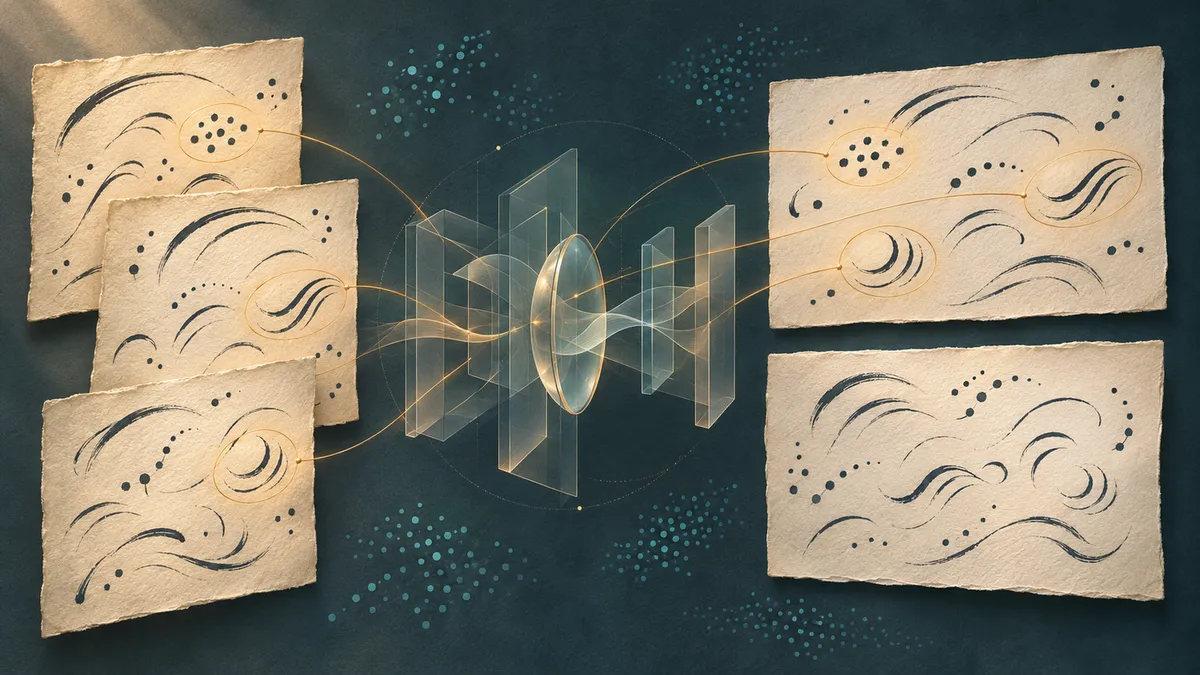
Imitating someone’s writing involves more than producing fluent prose. A comparison of six AI models asks whether they can reproduce an ordinary reviewer’s individual style—and shows why copying must be separated from genuine stylistic imitation.
A language model can produce a polished product review without sounding like the person it was asked to imitate. In a preprint submitted to arXiv on November 4, 2026, Harshit Gupta and Shunichi Ishihara of the Australian National University examined that distinction using six models and writing samples from 100 Amazon reviewers.
Their central finding is qualified: most models struggled under the tested conditions, while the strongest apparent performer, Gemini 3 Pro, extensively reused material from its examples. Similarity scores alone therefore risk overstating successful style transfer.
Testing individual style across topics
The researchers drew on the Amazon Authorship Verification Corpus and selected 100 authors with especially consistent writing, using six reviews per author. These were not a random sample of everyday writers: the selection deliberately prioritised stable stylistic patterns that could provide coherent evidence for imitation.
Each author’s six reviews were divided into two groups of three. For each group, models received the examples and generated a review about a product category absent from that group. This was intended to test whether style could transfer to a different topic rather than merely reproduce familiar subject matter.
The comparison covered Gemini 3 Pro, Claude Opus 4.5, GPT 5.2, GPT 5.2 Pro, DeepSeek 3.2 and Grok 4.1 Fast. A simple prompt requested imitation with minimal guidance. A complex prompt added instructions about sentence rhythm, vocabulary, detail and tone, alongside an explicit prohibition on copying sentences or phrases.
The design produced 2,400 generated reviews. Models were asked for 600–900 words, and outputs were subsequently normalised to approximately four kilobytes while preserving sentence boundaries.
What counted as successful imitation?
The team benchmarked six systems for representing writing style numerically and selected LUAR-MUD for the subsequent analysis. In this representation, a smaller cosine distance indicates greater similarity between texts.
Using genuine human reviews, the researchers established a distance threshold of 0.2648 for distinguishing same-author from different-author pairs. Generated reviews falling below that threshold relative to their examples counted as successful impersonations under this evaluation—not as demonstrated deception of human readers.
The paper reports an overall threshold-based success rate of 32.5% for Gemini 3 Pro, compared with 2.5% for Claude Opus and 1.5% for Grok 4.1 Fast. Both GPT models and DeepSeek recorded 0%. Gemini’s average distance nevertheless remained higher than the benchmark average for genuine same-author review pairs.
More elaborate instructions were not a dependable improvement. Effects varied by model, and Grok performed substantially worse on the distance measure with the complex prompt.
When similarity comes from reuse
The overlap analysis changed how the leading result should be interpreted. Across the evaluated material, Gemini produced 743 exact sentence matches under simple prompting and 690 under complex prompting. The comparison between human-written review groups contained 58 exact matches.
A separate phrase-overlap measure also showed unusually high reuse. The mean of author-level maximum trigram Jaccard scores was 0.917 and 0.902 for Gemini’s two prompt conditions, against 0.330 for the human baseline. These are summary overlap scores, not percentages of each review that were copied.
The authors interpret this combination as evidence that Gemini’s apparent advantage was largely driven by direct textual reuse rather than stylistic transfer alone. Explicit anti-copying instructions did not eliminate that behaviour. Other models showed much less overlap, although avoiding copying did not itself establish successful imitation.
Consistency mattered more than distinctiveness
Authors whose example reviews formed tighter stylistic clusters generally received closer imitations. This relationship was statistically significant after multiple-testing correction for five models; DeepSeek showed the same direction but did not reach significance.
By contrast, an author’s distinctiveness relative to other selected writers was not a reliable predictor. Topic similarity also failed to provide a consistent explanation across models. These are associations, not evidence that changing an author’s consistency would necessarily cause a particular outcome.
The researchers additionally trained classifiers to distinguish seven sources: human reviews and outputs from each model. Accuracy ranged from 86.5% to 86.8% across three text representations, with author identities kept separate between training and testing within each fold. This supports source-attribution signals within the experiment, not a general-purpose guarantee of AI detection.
A bounded snapshot
The study concerns English Amazon reviews and models evaluated during December 2025–January 2026. It does not establish performance across languages, genres or later model versions. Cooperative imitation prompts also differ from a motivated attacker repeatedly optimising against a detector.
The manuscript contains reporting inconsistencies, including a GPT 5.2 Pro overall mean that does not match its listed prompt-specific means, so its detailed ranking warrants caution.
Most importantly, the experiment did not measure whether recipients would believe an impersonated message. The authors warn that failing an automated authorship test does not imply failing to deceive a person. Their methodological conclusion is narrower: evaluate textual reuse alongside stylistic similarity before treating a close match as successful imitation.
- large language models
- authorship impersonation
- writing style
- stylometry
- textual reuse
- authorship verification
- forensic linguistics