TRANSMISSION // 2611.05738v1
OdorSpaces tests how virtual robots can trace hidden gas leaks and fires
Source published
A simulation benchmark combines indoor geometry with physics-based gas fields to study odor-guided navigation. Its learning-based agent performs better than simple odor-following rules, but fire localization remains difficult and real-world deployment is untested.
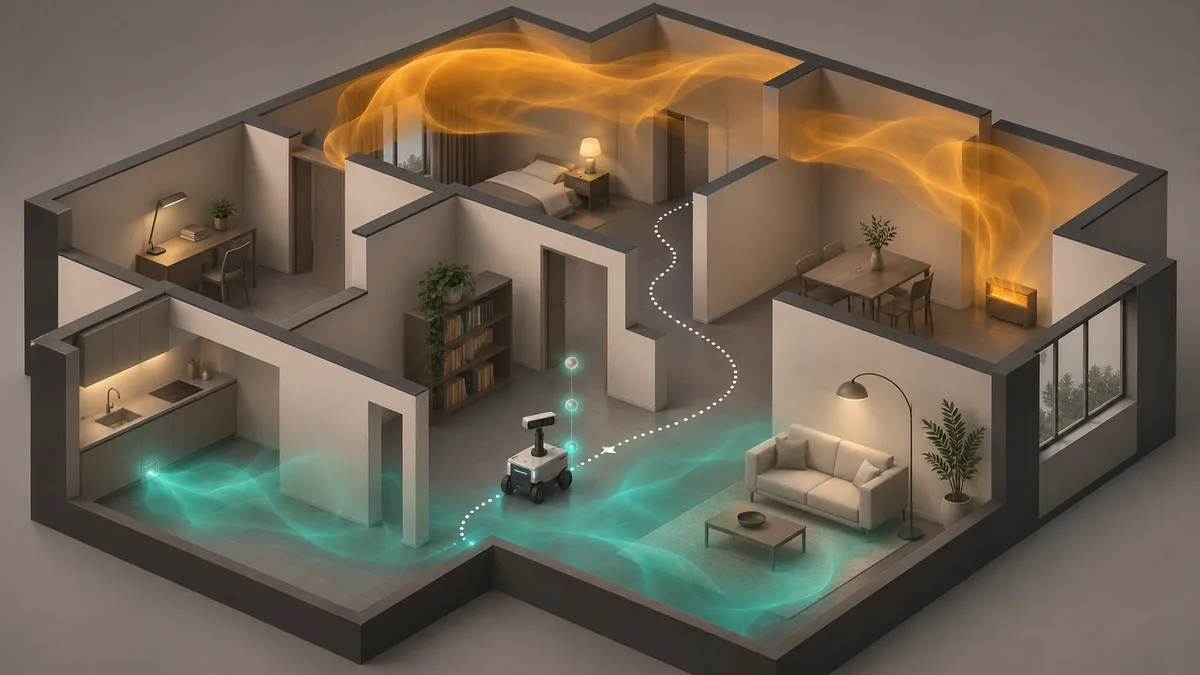
A strong chemical reading does not necessarily point straight toward its source. OdorSpaces gives virtual robots a controlled way to learn that distinction, combining depth-camera observations, gas measurements and movement history to seek hidden sources in simulated rooms.
Finding a hidden gas leak requires more than moving toward the strongest nearby chemical reading. Walls can block the route, and gas transport can create concentration peaks away from the source. OdorSpaces, a research platform from Changyeon Lee and colleagues at the University of Maryland, College Park, turns that problem into a navigation benchmark. Their November 2026 arXiv preprint, whose landing metadata reports acceptance at the Conference on Robot Learning 2026, evaluates agents entirely in simulation.
The platform connects Habitat-Sim, which supplies indoor visual environments and navigation, with gas fields generated by Fire Dynamics Simulator, or FDS. The goal is to study how an agent can combine information about traversable space with chemical measurements that change across locations and over time.
Two different kinds of chemical trail
The benchmark models two scenarios. In the first, propane leaks from a hidden source. Because propane is denser than air, its concentration tends to be higher near the floor. In the second, a methanol pool burns, producing carbon dioxide that initially rises with the heated flow. The researchers use carbon dioxide density as a surrogate cue for fire-related odor, rather than simulating the full chemical mixture associated with burning materials.
These scenarios pose different navigation problems. Near-floor propane can provide useful local concentration gradients. Fire-generated gas can rise, spread and descend as it interacts with room geometry, making a strong reading a less reliable guide to the source.
The researchers generate gas fields offline and then query them during navigation. These fields evolve over simulated time, but the navigating agent does not alter their airflow. Across both scenarios, the benchmark contains 11,442 simulations based on 17 Replica scenes and 25 Matterport3D scenes, divided into training, validation and test sets.
What the agent actually senses
Although the environments support photorealistic rendering, the tested policy receives depth images, not ordinary color photographs. These reveal obstacles and free space without showing the hidden source. Chemical observations come from an idealized arrangement of sampling points at the agent’s center and four surrounding directions, repeated at four heights and across a short time window. Position and heading history provide recent movement context.
Separate encoders process these inputs, which are combined and passed through recurrent memory before the policy chooses to move forward, turn left, turn right or stop. Training uses reinforcement learning, with rewards for approaching the source and stopping correctly. A further bonus rewards movements that both reduce source distance and increase measured gas concentration.
Importantly, navigation begins only after the starting position exceeds a gas-detection threshold. The benchmark therefore tests localization after detection, not the broader problem of exploring a building before encountering any chemical evidence. Standard evaluation starts the agent within a maximum navigable distance of nine meters from the source, and episodes end by the 600-second simulation horizon.
Better than simple rules, but not uniformly best
The main score is success weighted by path length, or SPL. It rewards stopping at the source while penalizing unnecessarily long routes; it is not simply the percentage of successful episodes.
For propane in Replica scenes, the proposed policy reaches 65.26% SPL, compared with 54.50% for an alternative reinforcement-learning baseline. In Matterport3D propane scenes, however, that baseline has a small numerical advantage: 65.41% versus 63.82%. The proposed method therefore does not win every comparison.
Fire localization is substantially harder. The policy achieves 24.72% SPL in Replica and 14.16% in Matterport3D, exceeding the alternative learning baseline in both datasets. All three rule-based methods score zero SPL in the fire tests. These results support learning from combined inputs over simply following local chemical peaks, while showing that the task remains far from solved.
Additional experiments complicate any claim that every architectural component always helps. Multiple sensing heights improve fire-task SPL substantially, but removing recurrent memory actually improves the Replica fire result. The reported variability comes from three test seeds; training uses one seed, limiting what the experiments establish about training stability.
A controlled benchmark, not a deployed detector
The current simulations use enclosed domains without imposed external wind or mechanical ventilation. Sensors provide idealized density measurements, leaving practical noise, response delays and placement constraints unresolved. Failure examples include agents drawn toward obstacles or misleading concentration peaks.
OdorSpaces offers a structured setting for studying these problems, not evidence that a physical robot can safely locate leaks or fires. Its contribution is a reproducible simulation task that exposes both the value of combining geometry with chemical evidence and the remaining difficulty of turning that evidence into reliable navigation.
- OdorSpaces
- robotic olfaction
- embodied navigation
- reinforcement learning
- gas source localization
- fire localization
- physics-based simulation