TRANSMISSION // 2611.05652v1
EEG Models May Separate People Better Than the Tasks They Perform
Source published
An arXiv preprint finds that five EEG foundation models and three conventional signal-processing approaches organize recordings more strongly by participant identity than by task. Stronger identity-based organization was associated with poorer task classification. Subtracting participant-specific averages and fine-tuning models improved decoding in the reported experiments, but gains varied and practical deployment questions remain.
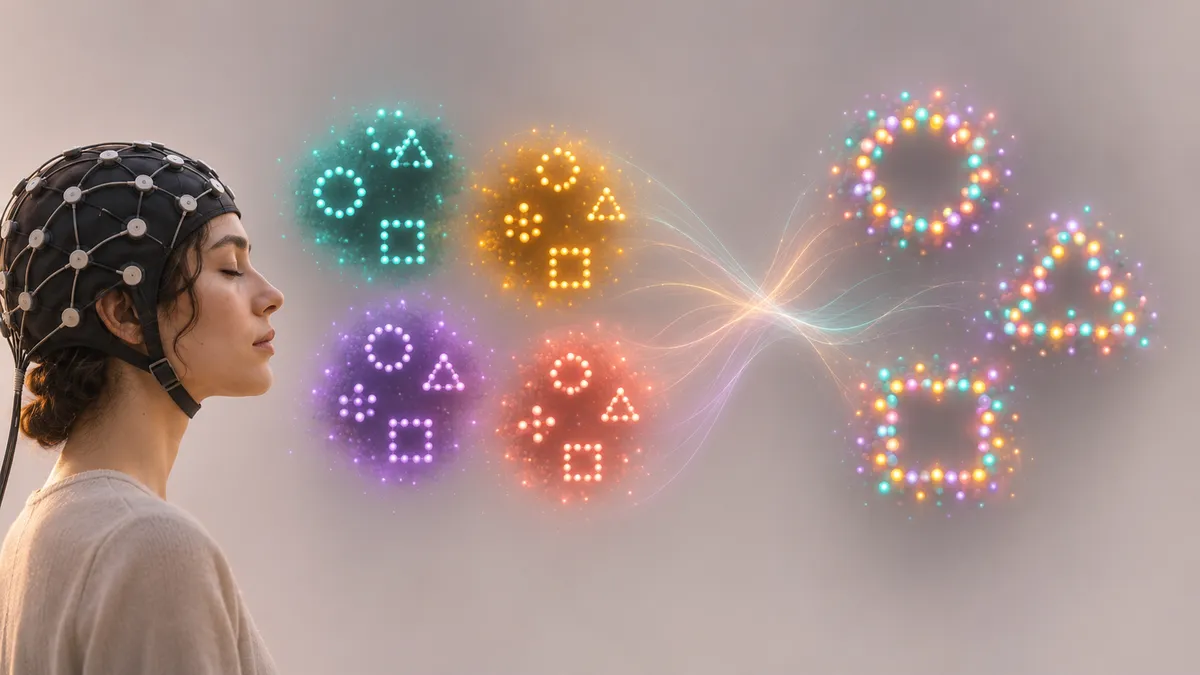
For a brain–computer interface, distinguishing a left-hand movement from a right-hand movement can matter more than distinguishing one person from another. A new study examines whether EEG representations make that distinction easy—and reports that participant identity often dominates their organization.
When identity dominates the representation
EEG records electrical potentials at the scalp. Those recordings contain both relatively persistent individual characteristics and temporary changes associated with tasks or stimuli. Researchers call these traits and states, respectively.
In an arXiv preprint posted on November 3, 2026, Anusha Madapura, Aditya Kommineni and Shrikanth Narayanan of the University of Southern California investigate how these two kinds of information are organized in EEG representations. The supplied version is a preprint; its metadata does not establish peer-reviewed publication.
The study’s central finding is that the tested representations group trials more strongly by participant than by task. The authors argue that this organization helps explain why pretrained EEG models can struggle to decode task states without further adaptation. Their experiments support an association, rather than establishing identity-dominated organization as the sole cause of poor decoding.
Measuring the shape of EEG features
An embedding is a numerical representation of a recording. Nearby embeddings are similar according to the representation, but that similarity need not reflect the distinction an application needs.
The researchers compared five pretrained foundation models—REVE, BIOT, CSBrain, CBraMod and LaBraM—with three conventional feature types: frequency-band power, coherence and signal complexity. The models represent different pretraining approaches, including contrastive learning, tokenization and masked reconstruction.
Evaluation covered Physionet-MI, which includes actual and imagined movements; High Gamma, which records actual movements; and six ERPCore paradigms involving responses to faces, sounds, words and other experimental conditions. Throughout the analysis, participant identity served as the trait label and task class as the state label. The experiments therefore do not directly establish how the representations encode other traits, such as age or sex.
The main measure, the hierarchy ratio, compares distances between participants performing the same task with distances between tasks performed by the same participant. Values above one indicate stronger participant-level separation; values below one indicate stronger task-level separation. A second measure checks whether neighboring embeddings share participant or task labels, with the reported comparisons corrected for chance.
A consistent pattern, with task-dependent consequences
Every model–dataset combination in the main hierarchy table had a ratio above one, ranging from 1.62 to 20.73. This pattern appeared in both foundation-model embeddings and conventional signal features: it was not unique to large pretrained models.
The neighborhood analysis also favored participant identity. For the three models highlighted in the figure, reported participant purity above chance ranged from 26.1% to 39.6%, compared with 1.36% to 2.43% for task purity.
To assess task decoding, the researchers trained logistic-regression classifiers on fixed embeddings, describing an 80/20 split between training and test participants. Across foundation models and datasets, the hierarchy ratio had a Spearman correlation of −0.73 with chance-corrected balanced accuracy. In other words, stronger participant-based organization tended to accompany worse task classification.
That result does not mean task information was absent. It suggests that the information was less accessible to the simple classifier used in these experiments.
Two ways to change the organization
The first intervention was straightforward: subtract each participant’s average embedding from that participant’s trial embeddings. This centers each person’s recordings around their own mean, aiming to reduce participant-specific offsets.
The authors report improved classification after this normalization, with the largest gains in the movement datasets. For REVE, they report gains of approximately 5.1 on Physionet-MI and 11.5 on High Gamma in comparisons presented using chance-corrected balanced accuracy (ΔBAC). The paper does not define the correction sufficiently to establish equivalent percentage-point gains in uncorrected balanced accuracy. ERPCore gains were generally smaller, with limited or no improvement for tasks whose baseline performance was at chance. The abstract’s roughly 10% improvement should therefore not be read as a universal gain.
The second intervention was task-specific fine-tuning on Physionet-MI. As training progressed, hierarchy ratios decreased while task accuracy increased. REVE, LaBraM and CSBrain crossed below one, reaching approximately 0.61, 0.54 and 0.56, respectively. Not every tested model was reported to make that transition.
What the findings leave open
Participant-mean normalization requires recordings from the participant being normalized. The paper does not clearly specify how held-out participants’ means would be estimated under deployment constraints, such as decoding their first trial. Practical use therefore depends on calibration details not resolved here.
Reporting also leaves uncertainty: Physionet-MI is listed as having 105 participants in the dataset table but 109 in the description, and the main reported relationships lack confidence intervals or significance tests.
The authors propose learning separate trait and state subspaces in future models. Their present evidence supports a narrower conclusion: for these datasets and methods, representation geometry is associated with task-decoding performance, and normalization or fine-tuning can improve it. It does not demonstrate clinical benefit or a working real-time interface.
- EEG
- foundation models
- brain–computer interfaces
- representation learning
- participant identity
- state decoding
- subject-mean normalization
- preprint