TRANSMISSION // 2611.05644v1
A 1941 Result Revisited: Separating Predictable Structure from New Information
Source published
A translation and commentary preprint by Bulat Gafarov and Madina Karamysheva revisits V. N. Zasukhin’s multivariate extension of Wold’s decomposition. The edition explains how stationary vector processes separate into linearly deterministic and purely nondeterministic components, and why their innovation coordinates need not have a unique causal interpretation.
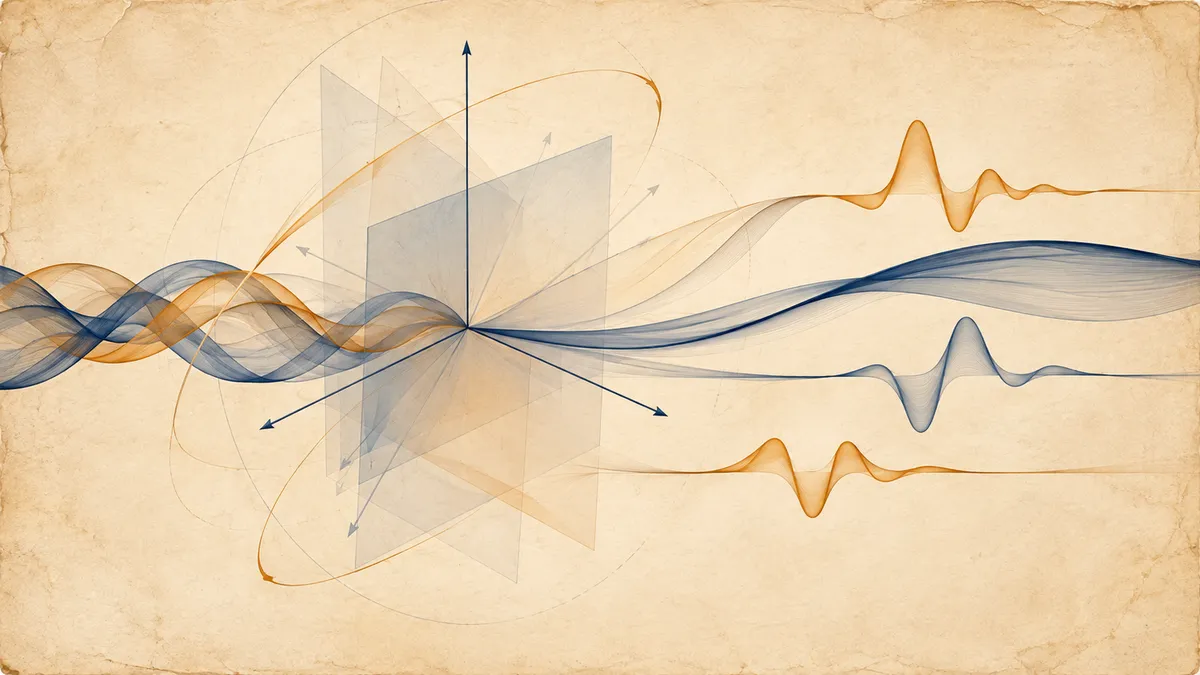
When several quantities evolve together over time, how much of their future is already contained in their past—and how much reflects genuinely new information? A 2026 arXiv preprint by Bulat Gafarov and Madina Karamysheva makes an early mathematical answer accessible in English. Their translation and commentary examines V. N. Zasukhin’s three-page 1941 note on multidimensional stationary random processes, distinguishing its original theorems from later historical and econometric interpretation.
A historical theorem, not a new empirical study
The preprint, titled “On the Theory of Multidimensional Stationary Random Processes (1941): Translation and Commentary,” presents an English translation, editorial discussion and retypeset Russian transcription. Zasukhin’s original note appeared in Doklady Akademii Nauk SSSR and was presented by A. N. Kolmogorov on November 10, 1941. The current edition is a translation-and-commentary preprint, not a report of new empirical findings.
Gafarov and Karamysheva document explicit recognition of Zasukhin’s contribution. Peter Whittle wrote in 1953 that Zasukhin had generalized Wold’s representation to the multivariate case. Norbert Wiener and Pesi Masani likewise attributed the decomposition and a related spectral criterion to him. The editors do not claim the first English translation: Wiener and Masani acknowledged an earlier translation by G. Kallianpur.
Two components with different relationships to the past
Zasukhin considers vectors of random variables observed at integer times. Their second moments are finite, and their cross-moments depend on the time separation rather than the calendar date. This is a second-moment stationarity framework; it does not require Gaussian distributions or zero means.
His first theorem states that every nonsingular process in this setting has a unique decomposition into a singular component and a regular component. The components are orthogonal across all coordinates and times, and both lie within the linear space generated by the original process.
The terminology needs care. “Singular” here means linearly deterministic: future values can be approximated arbitrarily accurately using linear combinations of past observations. It does not simply mean that a spectral density matrix is singular. “Regular” corresponds to pure nondeterminism: the intersection of the linear spaces generated by observations up to every possible cutoff contains only zero. Zasukhin’s definition excludes the identically zero process from this category.
The editors explain these statements using closed linear spans in a Hilbert space of finite-second-moment random variables. The deterministic component is obtained by orthogonally projecting observations onto the information that remains in every past space.
Building the regular component from innovations
The second theorem represents the regular component as a one-sided moving average of normalized innovations. Each observation combines current and earlier innovations with fixed coefficients; future innovations do not enter. The infinite sum is understood to converge in mean square.
These innovations are orthogonal across coordinates and dates and have unit second moments. Orthogonality does not establish statistical independence, and the theorem does not assume Gaussianity.
Crucially, the number of innovation coordinates, q, can be smaller than the number of observed coordinates, n. Several observed series can therefore be generated by fewer distinct innovation directions. The theorem also requires the contemporaneous coefficient matrix to have rank q.
Although q is uniquely determined, the innovation coordinates are not. Normalized representations can differ by a fixed unitary change of basis—or an orthogonal rotation for real-valued processes—with corresponding changes to the moving-average coefficients.
A precise frequency-domain criterion
Zasukhin’s third theorem characterizes regularity of full rank, meaning q equals n. It requires three conditions together: all spectral functions must be absolutely continuous; the determinant of the spectral density matrix must be positive almost everywhere; and the integral of its logarithm over the frequency interval from −π to π must be finite.
Positivity alone is therefore insufficient. The logarithmic integrability condition is an additional requirement, and the theorem concerns full-rank regularity rather than every possible lower-rank case.
What the results do—and do not—identify
The editors connect innovation rotations retrospectively to structural vector autoregressions. In an unrestricted Gaussian structural VAR, orthogonally rotated structural shocks can be observationally equivalent. Zasukhin’s result captures a related mathematical nonuniqueness, but it neither assigns causal meanings to innovation coordinates nor establishes a causal economic model. The commentary notes that counting identifying restrictions is only a necessary order condition; further conditions determine whether identification actually holds.
A central limitation is documentary: Zasukhin’s short note states the results without detailed proofs. The edition points to Wiener and Masani’s later proofs and explains how the innovation-basis uniqueness statement follows from uniqueness of innovation spaces. Its contribution is to clarify the original statements, their assumptions and their reception—not to replace the missing original derivations with a new empirical demonstration.
- V. N. Zasukhin
- Wold decomposition
- stationary random processes
- multivariate time series
- innovations
- spectral density
- structural identification
- history of mathematics
- translation and commentary