TRANSMISSION // 2611.05566v1
PrimordialPy connects inflation models to predictions of ancient black holes and cosmic ripples
Source published
Flavio Pineda introduces an open-source Python library that calculates how single-field inflation models could produce primordial black holes and scalar-induced gravitational waves. Two worked examples generate asteroid-mass black hole distributions and millihertz wave signals, but these are theoretical predictions dependent on assumptions about early-universe physics—not detections.
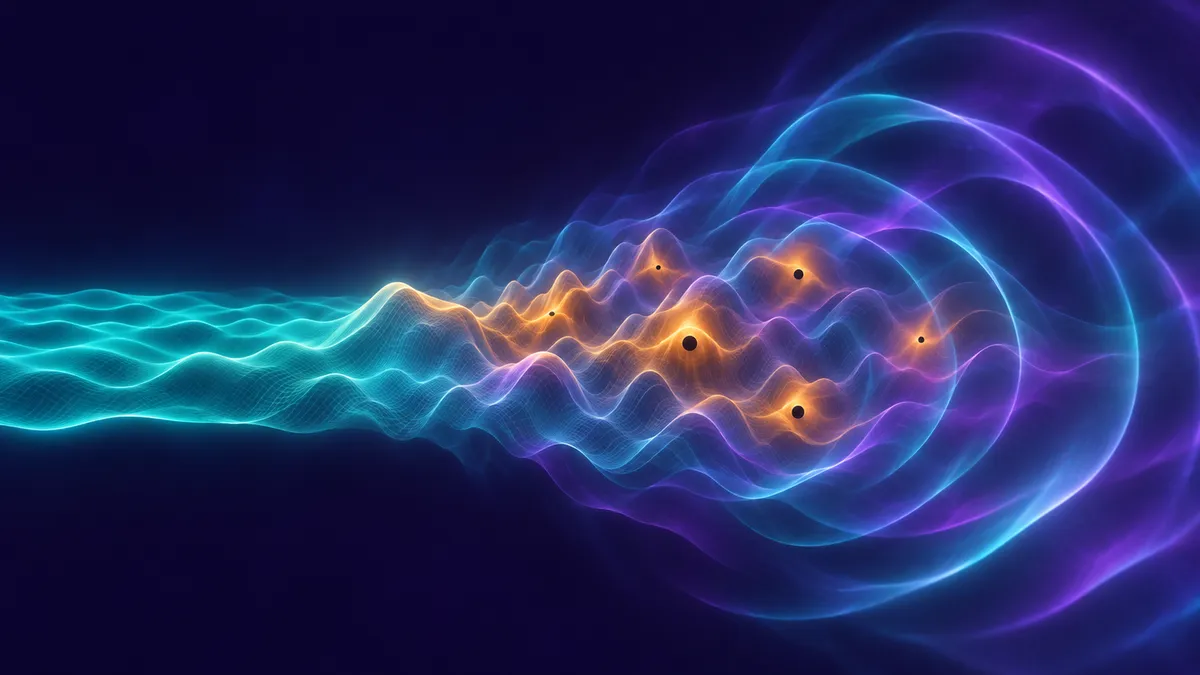
Could a small feature in the physics driving cosmic inflation leave behind both ancient black holes and gravitational waves? A new software paper presents PrimordialPy, a Python toolkit designed to calculate that connection while keeping the underlying assumptions available for scrutiny.
A tiny bump in a mathematical model of the early universe can have substantial consequences. It may briefly slow the field driving cosmic inflation, amplify primordial fluctuations and, under suitable conditions, help produce black holes long before stars existed. In a preprint submitted on November 3, 2026, Flavio Pineda of Universidad Autónoma Metropolitana Iztapalapa presents PrimordialPy, an open-source Python library that connects these calculations.
The contribution is computational, not observational. The paper describes software for predicting primordial black hole populations and associated gravitational-wave backgrounds. It does not report finding either signal. The supplied version is identified as ready for journal submission, not as an accepted, peer-reviewed publication.
Following a possible early-universe chain reaction
Inflation proposes a period of accelerated expansion in the very early universe. In the models addressed here, one scalar field—the inflaton—drives that expansion. Its potential describes how its potential energy changes with the field’s value.
Many calculations use the slow-roll approximation, which simplifies the equations when the inflaton evolves gently. But a localized feature in the potential can cause a temporary ultra-slow-roll phase. During this interval, curvature fluctuations can grow strongly, including at wavelengths already larger than the Hubble horizon. Standard slow-roll estimates can then become unreliable.
In the scenarios examined, sufficiently enhanced fluctuations later re-enter the horizon during radiation domination. Some regions could become dense enough to collapse into primordial black holes. The scalar fluctuations can also generate gravitational waves through second-order effects. These scalar-induced waves are distinct from the primordial tensor fluctuations that inflation can generate directly; they are not waves from black hole mergers.
One toolkit, several connected calculations
According to Pineda, users specify an inflaton potential and its parameters, and PrimordialPy calculates the background evolution and the scalar and tensor perturbation spectra. A power spectrum describes the strength of fluctuations across different spatial scales.
The package solves the evolution equations numerically rather than relying on slow-roll formulas. It uses symbolic differentiation to obtain derivatives of the potential and distributes independent perturbation calculations across processor cores. Its black hole and induced-wave modules can also accept externally calculated scalar power spectra, allowing researchers to use those components without the inflation solver.
The paper reports an end-to-end runtime below 40 seconds and peak memory use below 500 megabytes on a six-core AMD Ryzen 5 workstation. Those are author-reported benchmarks for the described setup, not guaranteed performance for every model or requested resolution.
Two examples, not two discoveries
Pineda demonstrates the pipeline using a modified KKLT inflation potential and a modified alpha-attractor potential. Both include a localized feature that produces a strong small-scale enhancement while retaining large-scale predictions the paper compares with cosmic microwave background constraints.
Both examples yield black hole mass distributions peaking near 1.6 × 10⁻¹³ solar masses, described as the asteroid-mass range. Their reported abundance values differ substantially: approximately 0.038 for the KKLT example and 0.901 for the alpha-attractor example. The paper defines abundance relative to dark matter and presents mass-dependent distributions; these numbers are model outputs, not measurements of the universe’s black hole content.
The corresponding induced gravitational-wave spectra peak around 0.008 hertz, or eight millihertz, with dimensionless spectral energy densities around eight billionths. Pineda places these predictions in the sensitivity region of the planned Laser Interferometer Space Antenna, LISA. A predicted spectrum near a detector’s sensitivity is a reason to investigate a model, not a demonstrated detection or a complete detectability assessment.
Where the assumptions matter
The built-in inflation solver covers canonical single-field models: one inflaton with a standard kinetic term. It does not currently provide the multi-field dynamics or detailed preheating and reheating calculations listed as future extensions.
The black hole calculation assumes Gaussian fluctuation statistics and uses a Press–Schechter estimate of collapse above a density threshold. Abundance is exponentially sensitive to that threshold and the fluctuation variance. The paper itself notes sensitivity to numerical sampling and integration, while non-Gaussian statistics are planned rather than included in the current release.
Likewise, the induced-wave calculation assumes the relevant fluctuations re-enter during radiation domination. Numerically solving the chosen equations without slow-roll approximations does not remove these physical assumptions. PrimordialPy’s value is therefore a connected, reusable way to explore conditional predictions—not proof that primordial black holes explain dark matter.
- PrimordialPy
- cosmic inflation
- primordial black holes
- scalar-induced gravitational waves
- early-universe cosmology
- dark matter
- scientific Python
- LISA
Related reading
Automatically matched by shared topic keywords. These links do not imply that the sources agree or establish a consensus.
How Decaying Dark Matter Could Puff Up a Galactic Halo
Source published
Shared keywords: dark matter
Reading the Hidden Histories of Faint Galaxies Through Their Star Clusters
Source published
Shared keywords: dark matter
Radio galaxies masquerade as tiny gravitational lenses
Source published
Shared keywords: dark matter
A Sharper View of the Milky Way’s Hidden History
Source published
Shared keywords: dark matter
Halo Stars Help Put the Milky Way’s Mass Near 1.3 Trillion Suns
Source published
Shared keywords: dark matter