TRANSMISSION // 2611.05559v1
Bio-VQA exposes the fine-detail limits of vision-language models in biology
Source published
Bio-VQA tests 18 open-weight vision-language models on biological naming, traits, spatial tasks and individual recognition. The researchers report sharp weaknesses at finer levels of detail, while emphasizing that their results cover one evaluation protocol—not every model or deployment setting.
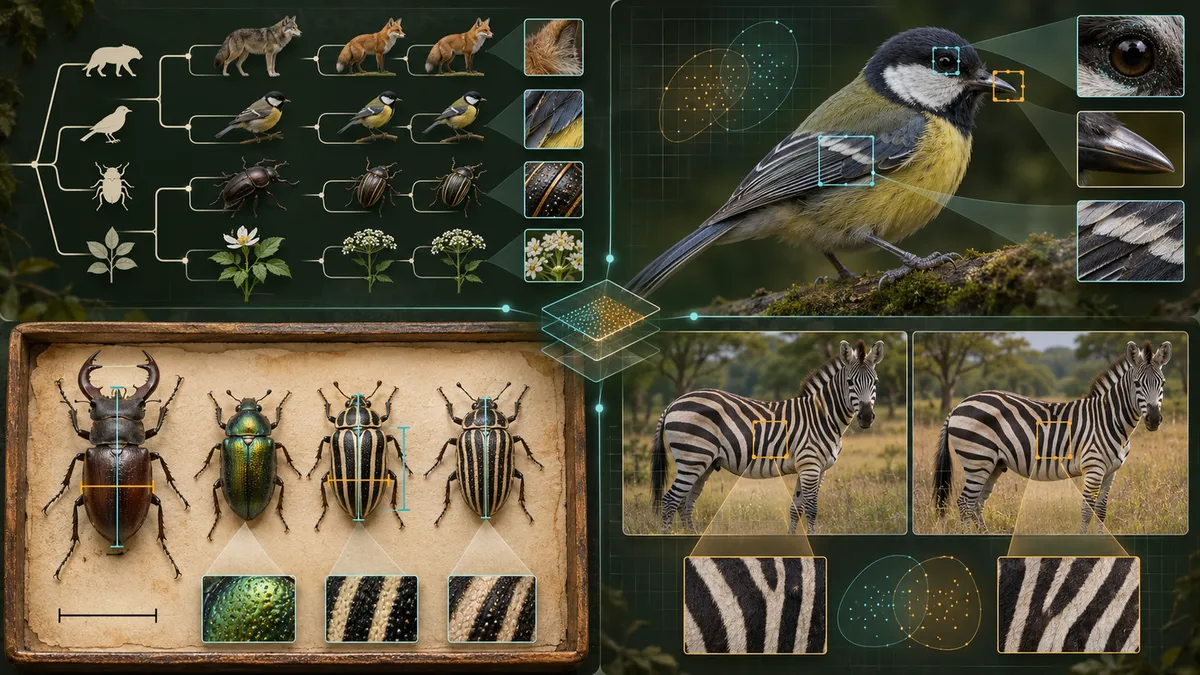
Recognizing a bird is not the same as naming its species, locating its left wing or identifying it in another photograph. Bio-VQA separates these abilities to examine how much biological detail vision-language models actually recover from images.
A biodiversity photograph can support several different questions: What organism is present? How many are there? Which traits are visible? Has this individual appeared before? Bio-VQA examines whether general-purpose vision-language models can answer across this range, rather than treating species identification as a substitute for biological understanding.
The benchmark comes from S M Rayeed, Qian Ma, Charles V. Stewart and Yao Ma at Rensselaer Polytechnic Institute. Its arXiv version was submitted on November 3, 2026, and the landing page reports acceptance to WACV 2027.
Across 18 open-weight models, the researchers find that broad recognition often gives way to much weaker performance when questions require precise names, measurements or individual identity. These are findings about the evaluated models and conditions, not proof that every vision-language system has the same limits.
Four ways to examine biological detail
Bio-VQA contains approximately 1.86 million questions over 217,000 images drawn from 11 public datasets. Its 24 tasks cover four components: taxonomic identification, fine-grained attributes, quantitative spatial reasoning and individual re-identification.
The taxonomy component samples ten organismal groups, including birds, mammals, insects, arachnids and several plant groups. Attribute questions use an annotated bird dataset. Spatial tasks include counting, measuring beetle traits against scale bars and locating animals. Re-identification asks whether two photographs show the same individual, using wildlife catalogs covering five species.
Questions are generated where existing annotations supply an answer. The evaluation uses greedy decoding, one attempt per item and no chain-of-thought prompting. Alongside exact answers, the authors report graded measures that distinguish some near misses from more distant errors. Simple rules that never inspect an image provide reference scores for interpreting apparent competence.
Broad categories are easier than precise names
Across the 18 models, average exact-match accuracy is 72.5% at phylum level but 12.3% for a full scientific name. Broad-category scores also need context: half the taxonomy images are chordates, so answering “Chordata” every time already achieves 50% at phylum level.
Providing answer choices changes the task substantially. On the same images and common-name targets, average accuracy rises from 3.9% for open-ended answers to 64.5% with four options. The result demonstrates a large recognition–recall gap; choosing a supplied name should not be mistaken for reliably generating one unaided.
The biological specialist BioCLIP-2 performs better at fine taxonomic identification. However, it was trained on the corpus supplying the benchmark’s taxonomy images and selects from a closed label set, whereas the generalists generate open-ended answers. The authors therefore treat it as an optimistic reference, not a fully matched comparison.
Counting approximately is not counting exactly
The models often produce counts near the correct value without getting the total right. For Qwen3-VL-32B, the paper reports 41.7% exact accuracy on single-image biological items containing two to ten animals, compared with 94.9% on CountBench everyday-object items in that count range.
That comparison is indicative rather than a controlled isolation of biological content. The authors acknowledge differences in scene density, occlusion and answer formats between biological and standard counting evaluations.
Measurement reveals another distinction. Fifteen models score below a rule that predicts a fixed value for each measurement type, judged by whether answers fall within 20% of the true measurement. Yet some models below that threshold still rank specimen sizes reasonably well. Reading relative variation and reporting correctly calibrated dimensions are separate abilities.
Resemblance can mislead identity judgments
For re-identification, the researchers construct easy, random and hard photograph pairs using DINOv2 image similarity. Hard pairs deliberately oppose resemblance and identity: different animals look similar, while repeat photographs of one animal look less alike.
Seventeen of the 18 models show negative discriminability under this adversarial construction. The wildlife specialist MegaDescriptor also fails under the hard condition on Grevy’s zebra. The authors interpret this as evidence of vulnerability to appearance-based matching—not deliberate wrong answers or a universal inability to recognize individuals.
What the results leave open
The study excludes proprietary models and tests only one decoding protocol. Public source images may have appeared in training. Attribute grounding is tested only on birds, and several spatial tasks depend exclusively on beetle imagery. There is no benchmark-wide human performance reference.
The scoring itself also has limits: its anatomy similarity measure can over-credit confusion between left and right body parts. The authors use exact matching for their laterality analysis and disclose the mismatch with human judgments.
Bio-VQA’s contribution is therefore diagnostic: it separates abilities that a single leaderboard score can conceal, while making explicit how task format, baselines and dataset construction affect the conclusions.
- Bio-VQA
- vision-language models
- biodiversity monitoring
- biological visual question answering
- taxonomic identification
- spatial reasoning
- animal re-identification
- AI evaluation