TRANSMISSION // 2611.05547v1
Stellar Motions Put NGC 3227’s Black Hole at About 12 Million Suns
Source published
A new analysis of archival Gemini observations estimates the central black hole in NGC 3227 at 12 million solar masses, with a reported uncertainty of 5 million. The result agrees with an independent light-echo measurement, offering a useful cross-check of black hole weighing techniques, although modeling assumptions and imperfect fits remain important limitations.
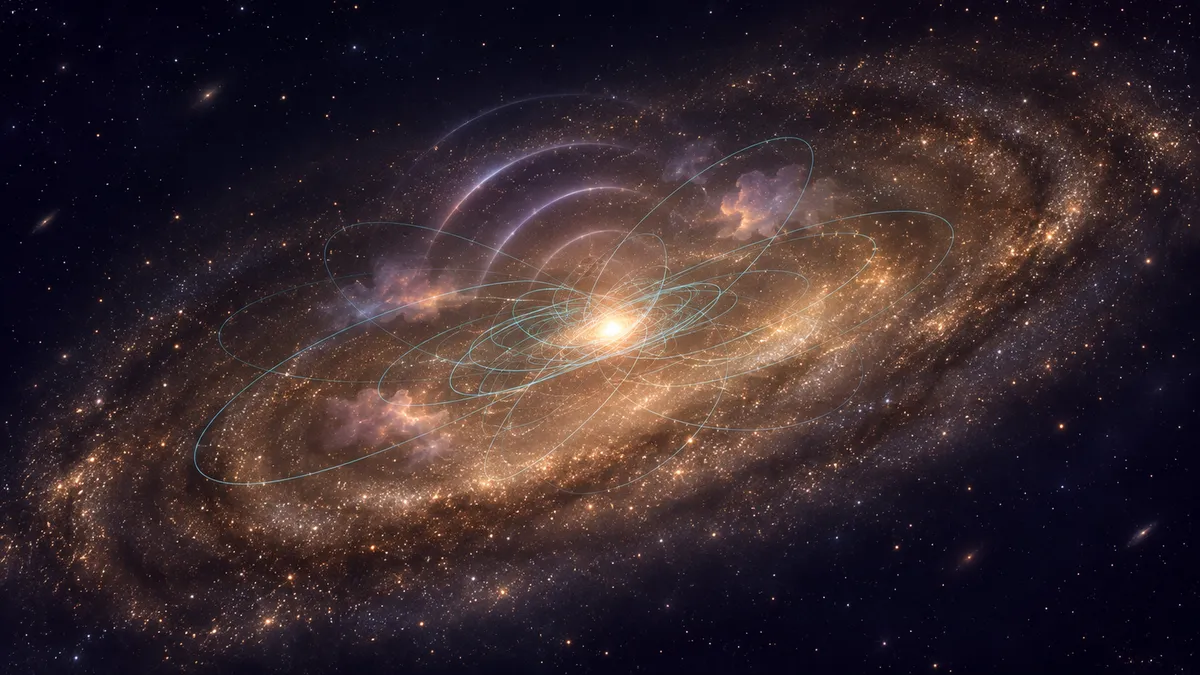
Astronomers cannot put a black hole on a scale, but they can study how its surroundings move and respond to light. In the nearby active galaxy NGC 3227, a fresh analysis of stellar motions provides a more tightly constrained mass estimate—and a rare opportunity to compare different methods on the same object.
Weighing an unseen center
Nabanita Das and colleagues report that the supermassive black hole in NGC 3227 has a best-fit mass of 12 million times the Sun’s mass, with a reported uncertainty of 5 million solar masses. Their study, posted as an arXiv preprint and listed as submitted to The Astrophysical Journal, revisits an existing measurement rather than announcing a newly discovered black hole.
The importance extends beyond this galaxy. Different techniques measure black hole masses under different assumptions, often in different populations of galaxies. Finding objects where several approaches can be compared helps researchers test whether those measurements share a consistent scale. NGC 3227, a nearby Type-1 Seyfert galaxy with an actively accreting central black hole, offers one such opportunity.
What the stars reveal
The team used archival near-infrared observations taken with the Near-Infrared Integral Field Spectrograph, or NIFS, at Gemini North in December 2016. Nine exposures supplied one hour of observing time. These observations provide spectra across a small region surrounding the galaxy’s nucleus, allowing stellar motions to be measured at different positions.
The researchers fitted carbon monoxide absorption features in the stellar spectra to recover distributions of velocities toward or away from Earth. Crucially, they measured not just the average velocity and its spread, but also finer details describing how those distributions depart from a simple bell-shaped curve.
Those details matter because different combinations of stellar orbits and central mass can produce similar basic velocity measurements. The additional information helps disentangle those possibilities. An earlier stellar-dynamical study by R. I. Davies and colleagues lacked sufficient signal-to-noise to constrain these higher-order features.
The bright active nucleus still complicated the analysis. In some central regions, its light overwhelmed the stellar signatures, so the team excluded those measurements from the dynamical modeling.
Building a galaxy from possible orbits
To interpret the motions, the authors combined the Gemini spectra with a Hubble Space Telescope image. They described the galaxy’s light using four components: a nuclear disk, bulge, bar and larger disk.
Using the open-source FORSTAND code, they built Schwarzschild orbit-superposition models. In this approach, a large library of possible stellar orbits is combined to reproduce the observed light and motions within an assumed gravitational field. The researchers used 50,000 orbits and explored different black hole masses, stellar mass-to-light ratios and component shapes.
The resulting mass is therefore a model-based inference from observations, not a direct image of the black hole. The preferred models also yielded a V-band stellar mass-to-light ratio of 2.53 ± 0.09 in solar units.
Distance is another essential ingredient: stellar-dynamical black hole masses scale linearly with the adopted distance. The team used 23.7 ± 2.6 megaparsecs, based on a measurement for NGC 3227’s interacting companion, NGC 3226. They rescaled earlier dynamical estimates to that same distance before comparing them.
A useful agreement between methods
After that adjustment, the earlier stellar-dynamical estimate becomes 19 ± 9 million solar masses. The new result is consistent with it, but has a smaller reported uncertainty.
It also agrees with a previous estimate from modeling velocity-resolved reverberation mapping, led by Misty C. Bentz. Reverberation mapping uses the delay between changes in the central source’s brightness and the response of surrounding gas. Combining those light-travel delays with gas velocities constrains the black hole’s mass without requiring the galaxy’s distance.
That earlier analysis gave a central estimate of 12.3 million solar masses, with substantial asymmetric uncertainties. Unlike simpler reverberation estimates, it modeled the velocity-dependent response rather than adopting a population-average conversion factor.
A gas-dynamical estimate by E. K. S. Hicks and M. A. Malkan is higher: about 31 million solar masses after distance rescaling. The authors report that it nevertheless lies within two standard deviations of their result.
Where the uncertainty remains
The models do not reproduce every observed feature. They assume axisymmetry, treating the photometric bar as an axisymmetric flattened component rather than fully modeling a bar’s structure. Systematic residuals remain, and the fit statistic is substantially higher than expected from the stated measurement uncertainties.
Consequently, the authors base their adopted uncertainty on the spread among comparably good model solutions rather than a narrow formal interval from one fit. They also caution that the small observed field cannot adequately constrain the dark matter halo.
The study provides a valuable consistency check, not proof that every mass-measurement bias has disappeared. Its contribution is a better-constrained stellar estimate in a galaxy where independent techniques can be tested against one another.
- NGC 3227
- supermassive black holes
- stellar dynamics
- reverberation mapping
- Gemini Observatory
- Schwarzschild orbit modeling
- Seyfert galaxies
Related reading
Automatically matched by shared topic keywords. These links do not imply that the sources agree or establish a consensus.