TRANSMISSION // 2611.05536v1
Stellar Accelerations and Jerks Could Help Gaia Find Hidden Black Holes
Source published
A new preprint proposes using two measures of changing stellar motion to prioritize Gaia sources that might host massive, dark companions. Simulations identify promising search regions, but ordinary binaries and multiple-star systems can imitate the signal, and the study confirms no new black holes.
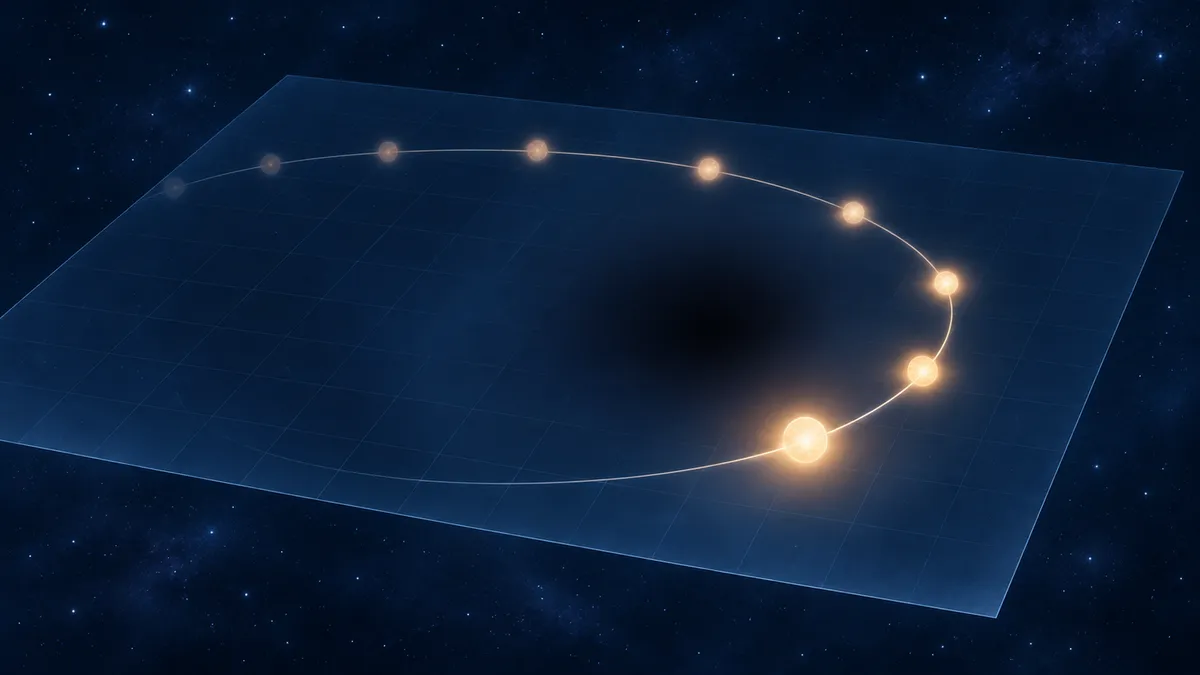
A star’s changing motion can reveal the gravitational pull of an unseen companion—even when astronomers cannot reconstruct its full orbit. Andrew B. Kinnion, Jeff J. Andrews and Eirini Kasdagli propose combining stellar acceleration with its rate of change, called jerk, to make searches for hidden black holes more selective.
A star need not complete an observable orbit to offer clues about an unseen companion. Its changing motion across the sky can reveal a gravitational tug. In a new preprint, Andrew B. Kinnion, Jeff J. Andrews and Eirini Kasdagli investigate how two measures of that motion could help astronomers choose promising black-hole candidates for follow-up observations.
Their study is a search strategy, not a discovery announcement. Posted to arXiv on November 3, 2026, the manuscript is submitted to the Astrophysical Journal; the supplied version is a preprint, not an established peer-reviewed result.
Two clues from an incomplete orbit
Gaia Data Release 3 contains 91,268 sources with nine-parameter astrometric solutions, which the authors call Astro-9. These fits describe motion across the sky that includes both acceleration and jerk. Acceleration measures how motion changes; jerk measures how that acceleration changes with time.
The distinction matters because acceleration alone is ambiguous. A relatively light companion in a short orbit can produce an acceleration resembling that caused by a heavier companion in a longer orbit. Adding jerk helps separate those possibilities statistically.
It does not generally reveal a unique companion mass. For an arbitrarily tilted, eccentric orbit, the available acceleration and jerk measurements leave more unknown orbital properties than constraints—even if the visible star’s mass is known. The authors therefore investigate which combinations of measurements are most characteristic of massive companions, rather than claiming to solve every orbit.
Testing the method with simulated binaries
Kinnion and colleagues first construct three simplified populations: tilted eccentric orbits, face-on eccentric orbits, and face-on circular orbits. Each contains a one-solar-mass luminous star and a companion assumed to contribute no light. They separately test companion masses of 0.01, 0.1, 1 and 10 times the Sun’s mass, with orbital periods spanning 100 to 10,000 days.
A fourth population incorporates stellar and binary evolution through the POSYDON simulation code. Starting with 500,000 binaries at solar metallicity, the researchers select evolved, detached systems containing a black hole and a non-degenerate star. The sample shown after simulated Gaia selection contains black holes of roughly 10–20 solar masses and luminous companions of 0.6–1 solar masses.
Crucially, the team does not compare ideal orbital calculations directly with the catalog and stop there. Using gaiamock, they generate synthetic observations and retain systems assigned nine-parameter fits. This approximates Gaia’s observational selection and the effects of fitting motion over DR3’s 34-month baseline.
The simulations show that companion masses tend to occupy different regions in acceleration–jerk space, although orbital geometry and fitting effects broaden and overlap those regions.
Where the authors suggest looking
For the simplest face-on circular orbits, companion mass is related to acceleration raised to the seventh power divided by jerk raised to the fourth power. Here, acceleration and jerk are expressed in physical units using parallax, rather than left as angular measurements. Large values of this combined quantity provide the authors’ broad guide for prioritizing massive dark companions.
Their more realistic simulated population also suggests concentrating on accelerations around 0.0001–0.001 metres per second squared, paired with jerks near 10⁻¹¹ metres per second cubed.
These are model-based search regions, not detection thresholds. The authors compare the simulated black-hole distribution with the observed Astro-9 distribution to rank promising regions. Because their simulated population is not normalized to the actual abundance of black-hole binaries, the resulting map does not supply calibrated probabilities or predict a discovery count.
Signals that can mislead
Several limitations complicate that ranking. Short-period binaries can receive acceleration fits that poorly represent their instantaneous orbital motion. Ordinary stellar companions contribute light, making Gaia track the system’s light-weighted position rather than just one star. Eccentric binaries near closest approach can also produce strong signals. The study’s distribution plots omit measurement error bars, and its models do not include triple or higher-order systems.
HD 12871 illustrates the danger. It lies in a promising region and has archival radial-velocity measurements implying a substantial hidden companion mass. Yet spectroscopic evidence discussed by the authors favors a triple or more complex stellar system, not a compact companion. The method identifies an interesting gravitational configuration without establishing what produces it.
The authors also simulate different orbital phases of the already known black-hole binary Gaia BH3. Only a few hundred of 10,000 realizations receive Astro-9 fits, illustrating that even a massive black hole can miss this catalog because of observational selection.
Future Gaia data could test the proposed ranking and better constrain incomplete orbits. For now, the result is a way to focus follow-up observations—not a shortcut from unusual stellar motion to a confirmed black hole.
- Gaia DR3
- astrometry
- black hole candidates
- binary stars
- astrometric acceleration
- orbital jerk
- POSYDON
- gaiamock
- compact objects
Related reading
Automatically matched by shared topic keywords. These links do not imply that the sources agree or establish a consensus.