TRANSMISSION // 2611.05521v1
Distant Stars Give Two Different Estimates of the Milky Way’s Mass
Source published
Gustavo E. Medina and DESI colleagues used two types of outer-halo stars to estimate the Milky Way’s enclosed mass. Their simulation-corrected results differ by about 20%, highlighting how stellar selection and modeling assumptions still shape the answer.
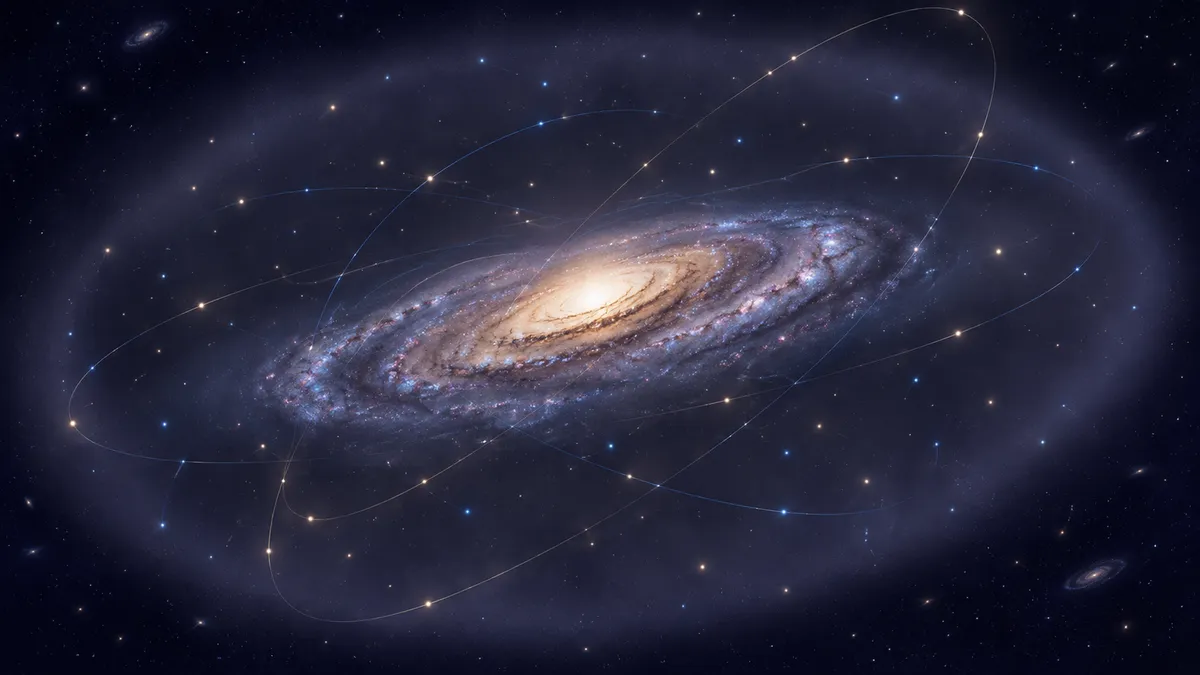
The Milky Way’s distant stars offer a way to weigh the Galaxy, but different stellar populations do not necessarily give the same result. A new DESI preprint measures that difference while testing how much its mass-estimation method depends on simplified models and simulated galaxies.
Two stellar populations, two answers
Gustavo E. Medina and colleagues in the DESI Collaboration report that the Milky Way contains about 640 billion solar masses within 80 kiloparsecs of its center when estimated using blue horizontal-branch stars. Using RR Lyrae stars instead gives about 530 billion solar masses within the same radius. A solar mass is the mass of the Sun.
The quoted uncertainties are 60 billion and 50 billion solar masses, respectively. The blue horizontal-branch estimate is about 20% higher, although the authors report that the two mass profiles agree within roughly 1.5 standard deviations overall. The difference highlights the influence of the stars chosen to trace the Galaxy’s gravity; it does not establish that either population gives the definitive answer.
The study is an arXiv preprint submitted on November 3, 2026. Its landing page says it is intended for submission to OJAp, rather than reporting an accepted, peer-reviewed publication.
How distant stars become a scale
The observations come from the second data release of the Dark Energy Spectroscopic Instrument, covering its first three years of operations. Combined with Gaia measurements of stellar motion across the sky, DESI’s spectra provide information for modeling the stars’ movements through the Galactic halo.
The final analysis uses 279 blue horizontal-branch stars and 213 RR Lyrae stars, approximately 50–80 kiloparsecs from the Galactic center. Both populations have calibrated brightness relationships that help establish their distances. RR Lyrae stars pulsate, so the researchers also correct their measured line-of-sight velocities for atmospheric motions associated with those pulsations.
Although the parent catalogs reach farther, the fitted samples are deliberately restricted. The team uses DESI’s main-survey bright program, applies quality and stellar-classification cuts, and removes known members of dwarf galaxies and globular clusters, along with candidate Sagittarius stream stars. The RR Lyrae magnitude limit helps avoid the increasingly incomplete sampling of fainter, more distant stars.
The researchers apply the Galactic Mass Estimator, a hierarchical Bayesian model that carries measurement uncertainties into the inferred mass profile. Its assumptions include spherical symmetry, dynamical equilibrium, power-law descriptions of the gravitational potential and stellar density, and a constant measure of the balance between radial and tangential stellar motions. These are simplifying assumptions, not directly observed properties guaranteed to hold throughout the halo.
Simulations reveal a systematic bias
Before interpreting the observations, Medina and colleagues test their method on synthetic catalogs from AuriDESI, built from the Auriga galaxy simulations. They examine six simulated halos from four observer positions each: 24 halo–viewpoint combinations, not 24 independent galaxies.
Those tests reveal a systematic problem. The estimator overpredicts the simulated enclosed masses by approximately 15% at 80 kiloparsecs. The authors therefore apply a radius-dependent correction calibrated from the simulations to their observational results, propagating the scatter in that correction into the reported uncertainties.
This calibration is important, but it is not a guarantee of accuracy for the real Galaxy. The mock stellar populations differ from DESI’s observed populations in their radial distributions and relative numbers. Halos with ongoing interactions also show larger residual deviations from an equilibrium model.
A further warning comes from Sagittarius stream membership. Including candidate stream stars lowers the real-data mass estimates by about 10%, whereas retaining massive-stream stars in the mocks produces no significant average shift. The authors suggest differences in stream selection or stream populations as possible explanations.
Beyond the measured region
Extending the fitted profiles to 100 kiloparsecs gives 740 billion solar masses, with an uncertainty of 70 billion, for blue horizontal-branch stars. RR Lyrae stars give 620 billion, with an upper uncertainty of 60 billion and a lower uncertainty of 70 billion. These are extrapolations, not measurements supported by tracers spanning that full distance.
For a broader halo estimate, the team fits a Navarro–Frenk–White halo model, with fixed disk and bulge contributions, to the inferred mass and slope at 65 kiloparsecs. This yields masses of 1.12 trillion and 0.89 trillion solar masses, with respective uncertainties of +0.14/−0.12 trillion and +0.11/−0.10 trillion. These describe the mass within a radius whose mean enclosed density is 200 times the universe’s critical density.
Those values depend on the adopted outer-halo model. The present analysis also lacks an explicit correction for the Large Magellanic Cloud’s gravitational influence and a full treatment of survey selection. The result is therefore a calibrated but assumption-dependent estimate—and evidence that tracer choice remains consequential even within one method.
- Milky Way mass
- DESI DR2
- Galactic halo
- blue horizontal-branch stars
- RR Lyrae stars
- Galactic Mass Estimator
- AuriDESI simulations
- Sagittarius stream
- dark matter halo
Related reading
Automatically matched by shared topic keywords. These links do not imply that the sources agree or establish a consensus.
DESI Halo Stars Point to a Milky Way Mass of About 1.2 Trillion Suns
Source published
Shared keywords: blue horizontal branch stars, dark matter halo, desi dr2, milky way mass, rr lyrae stars
Halo Stars Help Put the Milky Way’s Mass Near 1.3 Trillion Suns
Source published
Shared keywords: blue horizontal branch stars, galactic halo
Simulated Stars Put Milky Way Mass Measurements to the Test
Source published
Shared keywords: blue horizontal branch stars