TRANSMISSION // 2611.05518v1
DESI Halo Stars Point to a Milky Way Mass of About 1.2 Trillion Suns
Source published
The DESI Collaboration combines four modeling methods applied to 10,036 distant stars to estimate the Milky Way’s mass. Its results favor a galaxy whose enclosed mass keeps growing well beyond the inner regions, but the total depends on extrapolation and simulation-based calibration.
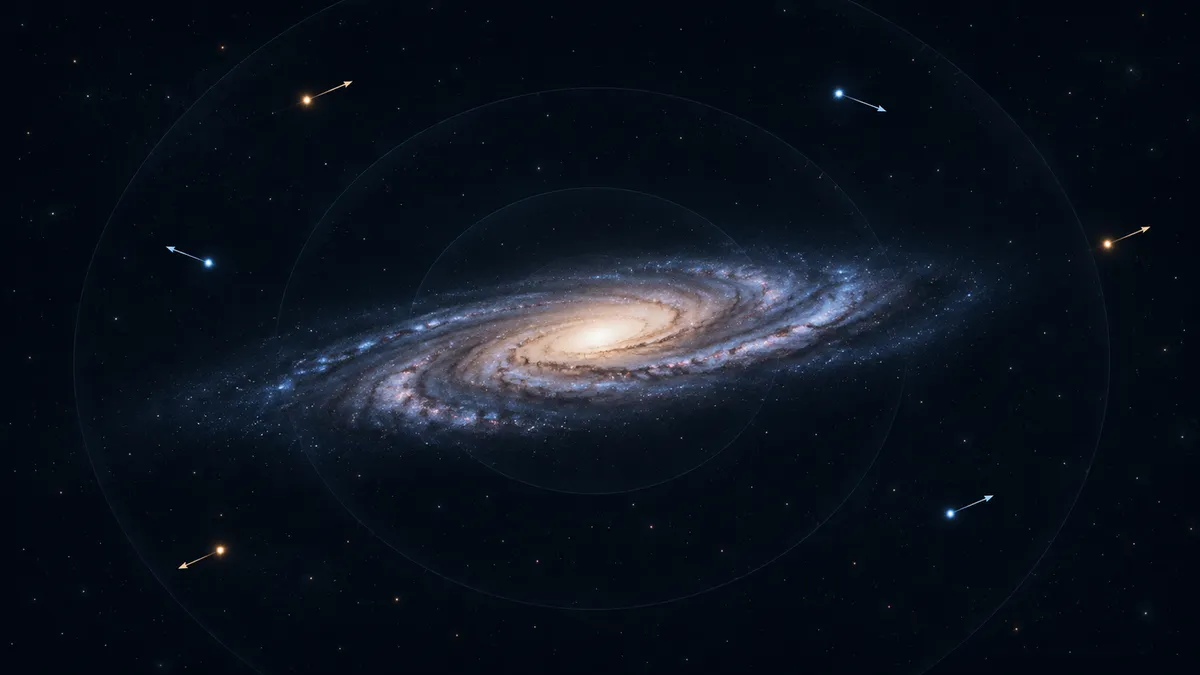
Distant stars offer clues to the Milky Way’s gravitational pull. Using DESI observations and Gaia measurements, researchers have combined several ways of interpreting those clues—while testing how their assumptions can lead them astray.
The DESI Collaboration estimates that the Milky Way contains about 636 billion solar masses within 80 kiloparsecs of its center, and reports a broader virial mass estimate of 1.19 trillion solar masses. A solar mass is the mass of the Sun. These are estimates inferred from stellar motions and gravitational models, not direct measurements of all the Galaxy’s matter.
The distinction between the two results matters. The enclosed mass describes matter within a specified distance. The virial mass, labeled M200c in the paper, requires substantial extrapolation beyond the observed stars. The authors explicitly caution that this larger-scale estimate depends on how the Galaxy’s mass distribution is modeled.
Distant stars as gravitational clues
In DESI DR2 Results III: The Mass of the Milky Way, the researchers analyze 5,198 blue horizontal branch stars and 4,838 RR Lyrae stars. Both populations provide reliable distance estimates and can trace the Galaxy’s outer stellar halo.
The combined sample spans approximately 10–95 kiloparsecs from the Galactic center. DESI supplies velocities along the line of sight, while Gaia supplies proper motions—the stars’ apparent movement across the sky. Together with distances and positions, these measurements provide three-dimensional positions and velocities.
The authors remove stars associated with known globular clusters, dwarf galaxies and the prominent Sagittarius stream. Such groups can bias estimates intended to describe the broader halo. They also model survey completeness, accounting for the fact that the observing program does not sample every part of the sky equally.
Four methods, shared assumptions
The team applies four approaches: emPDF, the Galactic Mass Estimator, or GME, and two versions of NIMBLE. These methods connect stellar positions and motions to the gravitational field in different ways. NIMBLE uses flexible curves to describe stellar densities and velocities; GME adopts power-law descriptions of the outer halo; emPDF builds a distribution function empirically from the data.
However, all four assume spherical symmetry and dynamical equilibrium: roughly, a system whose overall statistical structure is steady. These are modeling assumptions, not observational findings. Real stellar halos contain debris from past accretion events and need not satisfy them exactly.
To assess the consequences, the researchers test every method on simulated surveys based on six Auriga galaxies, each viewed from four positions. These 24 mock surveys include tailored selection effects and measurement uncertainties resembling those of DESI and Gaia.
Because the simulated galaxies’ masses are known, the authors can measure each method’s biases. Their combined estimate corrects those biases and accounts for correlations between methods, rather than treating all eight method-and-star-population results as independent evidence.
What the combined analysis finds
Within 80 kiloparsecs, the reported mass is 636 billion solar masses, with a 68% interval extending 48 billion below and 53 billion above that value. The team provides a combined enclosed-mass profile from 20 to 80 kiloparsecs, finding that it rises throughout this range.
For M200c, the reported 1.19 trillion solar masses has uncertainties of 0.12 trillion below and 0.14 trillion above. Combining only RR Lyrae results or only blue horizontal branch results gives closely matching central estimates of 1.20 trillion solar masses.
That agreement does not mean every method agrees. Some individual estimates differ substantially. More importantly, GME receives about 75% of the combined virial-mass weight because of its performance on the simulations. Removing GME raises the estimate to 1.52 trillion solar masses and expands its relative uncertainty from roughly 11% to 22%. The authors identify this dependence as a reason for caution.
Where confidence has limits
Simulation-based calibration is only as transferable as the simulations are realistic. The authors note uncertainties in simulated galaxy formation, and acknowledge that different views of the same simulated galaxy may remain correlated. Twenty-four mock surveys are therefore not equivalent to 24 unrelated galaxy histories.
Neither the methods nor the mocks explicitly reproduce the Milky Way’s dynamical disturbance from the Large Magellanic Cloud. The paper cites earlier work showing that such disturbances can bias equilibrium-based mass estimates by up to 20% over the relevant distances; that is not a measured correction to this study.
The authors find broad agreement with previous halo-based estimates and tension with some lower masses inferred from the Galactic rotation curve. They favor biases in those rotation-curve analyses as an explanation, but state that their study was not designed to resolve the disagreement.
The supplied landing page identifies arXiv version 1 as submitted on November 3, 2026, and lists submission to The Astrophysical Journal. The extracted manuscript is dated November 5. These materials do not establish journal acceptance or completed peer review. The paper also describes the stellar data as awaiting public release with DESI DR2.
- Milky Way mass
- DESI DR2
- stellar halo
- RR Lyrae stars
- blue horizontal branch stars
- Gaia
- galactic dynamics
- dark matter halo
- simulation-based calibration
Related reading
Automatically matched by shared topic keywords. These links do not imply that the sources agree or establish a consensus.
Distant Stars Give Two Different Estimates of the Milky Way’s Mass
Source published
Shared keywords: blue horizontal branch stars, dark matter halo, desi dr2, milky way mass, rr lyrae stars
Simulated Stars Put Milky Way Mass Measurements to the Test
Source published
Shared keywords: blue horizontal branch stars, stellar halo
Halo Stars Help Put the Milky Way’s Mass Near 1.3 Trillion Suns
Source published
Shared keywords: blue horizontal branch stars
Stellar motions reveal clues to NGC 253’s merger history
Source published
Shared keywords: stellar halo