TRANSMISSION // 2611.05496v1
Webb maps gas and stars moving differently around faint active black holes
Source published
A study of eight nearby galactic nuclei finds gas frequently rotating differently from the surrounding stars, with possible jet-related disturbances. Radiation from the active nucleus appears to dominate gas excitation, while highly ionized gas is bright enough for detailed motion maps in only two targets.
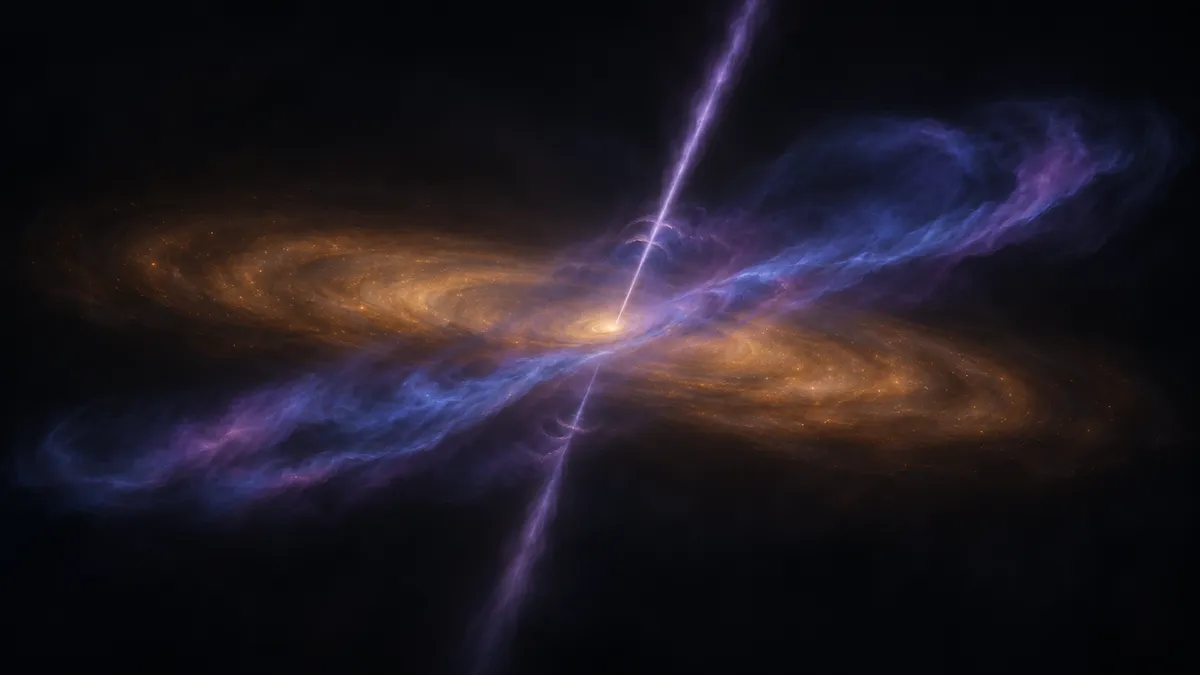
A faint galactic nucleus need not have a simple environment. Using the James Webb Space Telescope, Antoine Dumont and colleagues have mapped stars and several forms of gas around nearby active black holes, revealing orderly rotation alongside misalignments and possible disturbances from radio jets.
The black holes in the ReveaLLAGN survey are active, but comparatively dim. They belong to a class called low-luminosity active galactic nuclei: systems whose total radiation output is far below their theoretical Eddington luminosity. Their weakness makes it difficult to separate the nucleus from the surrounding galaxy, even though the authors describe this as the most common mode of black hole accretion in the local Universe.
Antoine Dumont and colleagues used Webb’s Near Infrared Spectrograph, NIRSpec, to investigate eight such nuclei: M87, M104, M94, M81, NGC 1052, NGC 4258, NGC 5128 and NGC 4395. Their study, ReveaLLAGN 2, was submitted to arXiv on November 3, 2026. The versioned landing page states that it has been accepted for publication in Astronomy & Astrophysics.
Separating the motions of stars and gas
NIRSpec’s integral field unit records spectra across a small region of sky. The researchers used stellar absorption features and gas emission lines to map motion toward or away from the observer, as well as velocity dispersion—the spread of velocities contributing to a spectrum. Different spectral features trace stars, warm molecular hydrogen, ionized hydrogen and highly ionized gas.
Before interpreting those spectra, the team corrected instrumental artifacts known as “wiggles,” caused by undersampling of the telescope’s point-spread function. These distortions matter: in M94, the authors found that leaving them uncorrected inflated the inferred stellar velocity dispersion by at least 40% in the two most central spatial bins. They used their WICKED software to mitigate the problem, although some residual artifacts remained.
Where stellar motions could be measured, the maps showed disk-like rotation. Despite broader wording in the abstract, the detailed analysis reports no reliable stellar kinematics for M87 or NGC 4395 because usable stellar absorption features were too weak or absent, with instrumental wiggles further complicating M87.
The stellar velocity dispersion generally increased toward the nucleus, but M94 was an important exception. Its dispersion fell across the inner region before a modest rise at the very center. The authors suggest an additional stellar component, possibly a counter-rotating structure, could help explain this pattern. M104 also showed a more complicated, peanut-shaped dispersion pattern rather than a simple central peak.
Gas does not always follow the stars
The gas maps revealed a more varied picture. Warm molecular hydrogen often showed rotation, but its orientation frequently differed from that of the stars. In NGC 5128, also called Centaurus A, the authors report gas rotating in the opposite sense to the stellar disk.
Such differences could mean that gas arrived through accretion and has not settled into the same arrangement as the stars. Alternatively, outflows or interactions with jets could disturb its motion. These are interpretations of the observed velocity patterns, not direct observations of a complete feeding route into a black hole.
Several galaxies showed unusual gas motions or larger velocity dispersions near the projected directions of their radio jets. NGC 1052, for example, displayed disturbed molecular gas and broadened ionized-gas emission associated spatially with the jet direction. However, the authors explicitly caution that alignment alone does not establish a jet interaction: outflows driven by the active nucleus could produce similar signatures.
Radiation dominates, with localized hints of shocks
To investigate what excites the gas, the team compared molecular hydrogen emission with the hydrogen recombination line Brγ. They interpret the ratios as indicating that radiation from the active nucleus generally dominates, rather than strong star formation or widespread shock heating.
Localized regions nevertheless showed ratios consistent with shocks, most clearly in NGC 5128 and more tentatively in NGC 4395 and NGC 1052. This diagnostic has limits: its thresholds are empirical, and it cannot distinguish shocks caused by a jet from those produced by other outflows. Weak Brγ emission also made some maps noisy, requiring substantial masking in M87 and M104.
The researchers report highly ionized “coronal” emission lines in spectra combining light from the nuclear regions of all eight targets. Only NGC 5128 and NGC 4395 had sufficiently strong signals for spatially resolved coronal-gas velocity maps. These are the sample’s highest-Eddington-ratio sources; the distinction is line brightness, not simply whether coronal emission exists.
The study provides a detailed observational basis for future dynamical modeling, rather than new black hole mass measurements. Its gas-line fits use a single Gaussian profile, which the authors acknowledge can oversimplify overlapping motions. The resulting picture is therefore informative but not unique: relatively orderly stellar rotation surrounds gas whose geometry, excitation and possible jet interactions require more detailed analysis.
- astrophysics
- James Webb Space Telescope
- NIRSpec
- low-luminosity active galactic nuclei
- black holes
- gas kinematics
- stellar kinematics
- radio jets
- ReveaLLAGN
Related reading
Automatically matched by shared topic keywords. These links do not imply that the sources agree or establish a consensus.
Webb finds a faint oxygen signal inside a nearly pristine galaxy
Source published
Shared keywords: james webb space telescope
A Call for a Bigger JWST Survey of the First Galaxies
Source published
Shared keywords: james webb space telescope
How JWST Could Trace the Seeds of the First Massive Black Holes
Source published
Shared keywords: james webb space telescope
Early Galaxies Put New Limits on Hidden Neutrino Interactions
Source published
Shared keywords: james webb space telescope
Stellar motions reveal clues to NGC 253’s merger history
Source published
Shared keywords: stellar kinematics