TRANSMISSION // 2611.05493v1
Stellar motions reveal clues to NGC 253’s merger history
Source published
Katya Gozman and colleagues measured individual velocities for 89 stars around NGC 253’s southwestern shell. Their results suggest a mixture of stars acquired through a merger and stars belonging to the galaxy’s extended disk, while leaving the merger’s timing and the halo’s overall rotation unresolved.
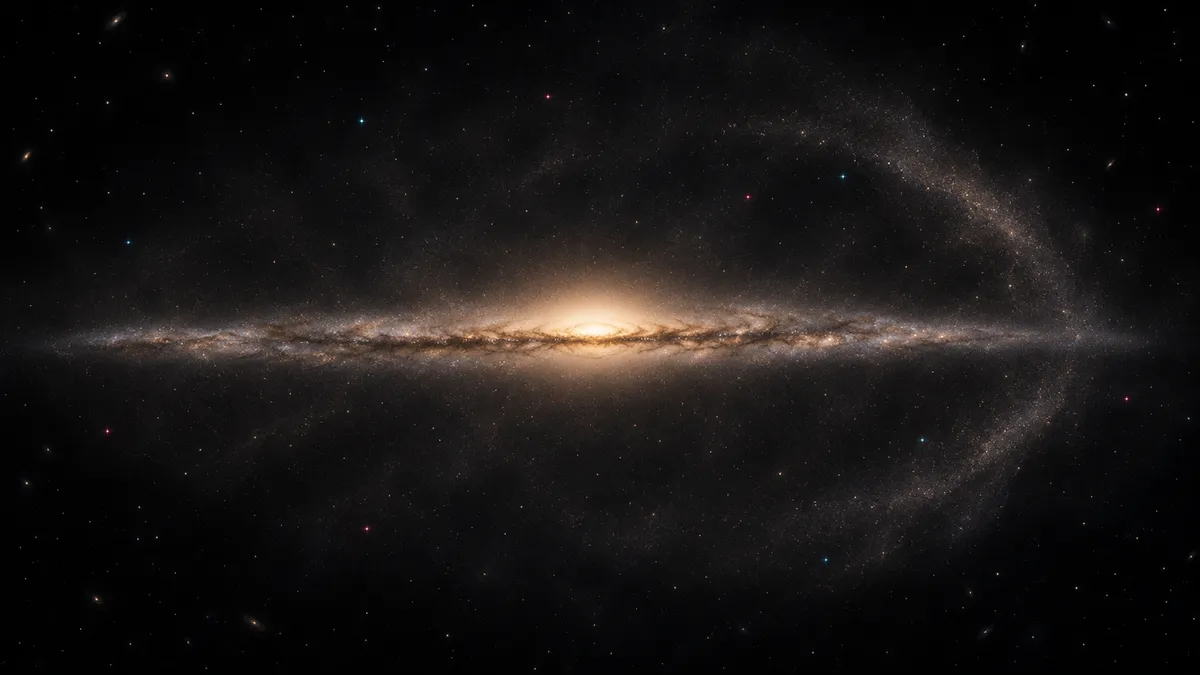
A faint shell around NGC 253 may preserve evidence of a past galactic encounter. By measuring how individual stars move along our line of sight, researchers have added a new dimension to a structure previously mapped through images.
A galaxy’s outskirts can preserve traces of encounters long after the smaller companion has dispersed. In NGC 253, Katya Gozman and colleagues have measured individual stellar velocities around a previously identified southwestern shell, finding patterns they interpret as evidence for both merger debris and an extended outer disk.
The authors report the first individual resolved-star velocity measurements in NGC 253’s stellar halo. They also describe their work as the first detection of stellar-halo kinematic substructure in a Milky Way-mass galaxy beyond the Local Group—the galactic neighborhood containing the Milky Way and Andromeda.
Reading a faint stellar record
NGC 253 is a nearly edge-on spiral about 3.5 million parsecs away. Its diffuse stellar halo includes a southwestern shell previously detected through both combined starlight and observations of individual stars.
In the hierarchical picture of galaxy formation, galaxies grow through mergers with smaller systems. Stars stripped from those companions can form streams, shells and other concentrations before their motions gradually spread them into a smoother halo. But not every star seen far from a galaxy’s center arrived from elsewhere: some formed within the main galaxy. Distinguishing these origins requires more than an image.
Gozman’s team targeted bright asymptotic giant branch, or AGB, stars using the Michigan/Magellan Fiber System on the 6.5-meter Magellan/Clay telescope in Chile. The instrument collects spectra from many objects simultaneously. The analyzed observations, taken in 2023 and 2024, totaled 24.8 hours of exposure.
Of 225 stellar targets, 89 yielded velocities meeting the team’s recovery criteria—about 40 percent. These are line-of-sight velocities, measuring motion toward or away from us rather than complete three-dimensional trajectories.
Earth’s atmosphere was a major obstacle. Its emission lines overwhelmed much of the faint stellar signal, requiring a two-stage sky-subtraction procedure. The researchers compared the cleaned spectra with synthetic stellar templates and used mock observations containing realistic sky residuals to evaluate reliability. They adopted an uncertainty of approximately 40 kilometers per second for each recovered stellar velocity.
Three patterns, two likely origins
The team analyzed the stars’ positions and velocities using two approaches: smoothing the velocity field and applying an unsupervised clustering algorithm. Both revealed similar structure.
One group along the galaxy’s projected major axis—the long direction of its disk—had strongly positive velocities. Another, near the perpendicular minor axis, had negative velocities. A third southwestern group, coinciding with the known shell, had velocities close to the galaxy’s overall motion.
To test whether these patterns could arise through random associations between position and velocity, the researchers repeatedly shuffled velocities among the observed positions. The real data showed stronger spatial coherence than any of 1,000 shuffled trials in the smoothing analysis and stronger clustering than any of 10,000 trials in the clustering analysis.
The physical interpretation required additional comparisons. Major-axis stars moved broadly like the galaxy’s rotating gas disk. Together with comparisons to simulated galaxies, this led the authors to identify that group as mostly stars formed within NGC 253’s extended disk. They interpret the other two groups as mostly accreted halo and shell stars.
After subtracting NGC 253’s overall velocity, the likely disk population had a median line-of-sight velocity of 167 kilometers per second, with reported uncertainties of minus 14 and plus 16. The combined likely accreted population had a median of minus 34 kilometers per second, with uncertainties of minus 12 and plus 16. A shell velocity near zero in this reference frame does not mean its stars are stationary.
Evidence, not a complete reconstruction
The authors argue that the shell’s visible structure and coherent motions favor a relatively recent accretion, broadly within the past few billion years. They do not determine a precise merger date; that would require dynamical modeling beyond this study.
Important limits remain. The sample is small, individual velocity errors are substantial, and separating the shell from the surrounding accreted halo remains somewhat tentative. Targeting bright AGB stars favors younger and intermediate-age populations rather than the older stars commonly used to trace halos. The spectra also cannot provide the chemical measurements needed to establish individual stars’ origins more securely.
Some stars could be Milky Way foreground objects, although the team’s exclusion tests preserved the main clustering results. Nor can this limited field establish the halo’s overall rotation or angular momentum.
The study is available as an arXiv preprint submitted on November 3, 2026; its versioned landing page states that it has been accepted by The Astrophysical Journal. The authors present it as a pathfinder for larger, deeper spectroscopic surveys that could turn today’s suggestive reconstruction into a more detailed merger history.
- NGC 253
- stellar halo
- galaxy mergers
- stellar kinematics
- shell structure
- AGB stars
- Magellan telescope
Related reading
Automatically matched by shared topic keywords. These links do not imply that the sources agree or establish a consensus.
Molecular Gas Reveals a Hidden Nucleus Shining Unevenly
Source published
Shared keywords: galaxy mergers
Webb maps gas and stars moving differently around faint active black holes
Source published
Shared keywords: stellar kinematics
DESI Halo Stars Point to a Milky Way Mass of About 1.2 Trillion Suns
Source published
Shared keywords: stellar halo
Simulated Stars Put Milky Way Mass Measurements to the Test
Source published
Shared keywords: stellar halo