TRANSMISSION // 2611.05487v1
Webb finds a faint oxygen signal inside a nearly pristine galaxy
Source published
A preprint reports oxygen emission confined to the compact core of LAP2, a gravitationally magnified galaxy at redshift 4.2. The contrast could reflect uneven chemical enrichment, but differing radiation conditions and uncertain abundance calibrations leave that interpretation open.
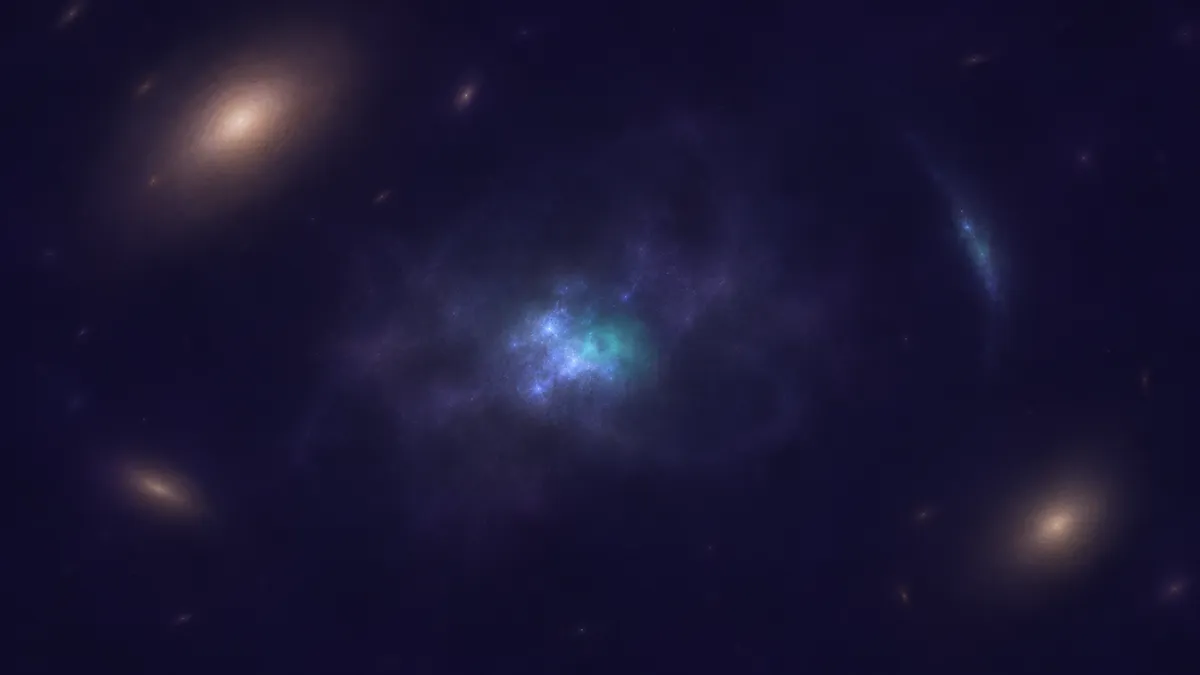
A tiny, distant galaxy looks exceptionally oxygen-poor when its light is combined. Looking inside it, researchers report a faint oxygen signal in the core—a possible glimpse of chemical enrichment before newly made elements spread through the surrounding gas.
LAP2 offers an unusually close look at a distant galaxy with very little apparent chemical enrichment. In a new preprint, Matteo Messa and colleagues report faint oxygen emission from its compact core, even though the same emission line is undetected when they combine light across the system. The result suggests a patchwork of conditions on scales of roughly ten parsecs, rather than a galaxy that can be understood from a single average measurement.
The distinction matters for searches for nearly pristine gas and potentially metal-free stars. But oxygen emission is not a direct inventory of every oxygen atom. The authors identify more than one explanation for the contrast, and their numerical abundance estimates depend on a calibration stretched beyond its directly tested range.
A natural telescope reveals the structure
LAP2 lies at redshift 4.2 behind the galaxy cluster Abell 2744. The cluster's gravity bends and magnifies its light, producing multiple images of the same source. A lens model gives the image used for the main analysis a total magnification of about 50, making an intrinsically very faint system accessible to detailed study.
The team combined new James Webb Space Telescope NIRSpec observations with archival NIRCam imaging. NIRSpec's integral-field observations provide spectra across an area of sky, allowing the researchers to map hydrogen and oxygen emission instead of sampling only part of the stretched galaxy through a narrow aperture. The observing programme provided about 13.6 hours of nominal coverage for the principal image, although its position near the edge of one pointing reduced the effective depth.
After accounting for lensing, the authors estimate a stellar mass of roughly 100,000 solar masses, comparable to a massive star cluster. Their imaging model gives the compact core an effective radius of about seven parsecs, within a broader component spanning about 20 parsecs in effective radius. Those sizes depend on the lens model and assumptions about the source's unresolved shape.
Strong hydrogen emission, blue ultraviolet light and hydrogen-line ratios consistent with little or no dust attenuation point to a young burst of star formation. Fits that include the emission lines favour a mass-weighted age around seven million years, but the inferred age changes with assumptions about escaping radiation.
An oxygen pocket—or different illumination?
Across the main extraction aperture, the oxygen line designated [O III] 5007 is not detected. The authors place a three-sigma upper limit of 0.61 on its strength relative to the hydrogen H-beta line. Using an extrapolated empirical calibration, they translate that into an oxygen abundance no more than about half a percent of the solar value.
A smaller aperture centred on the compact core reveals an oxygen signal at approximately four-sigma significance. Applying the same calibration there gives an abundance around one percent of solar. This is not contradictory: a faint, concentrated signal can become harder to distinguish from noise when a larger area is included.
If the line-ratio difference really traces chemical composition, local stellar enrichment could explain it. Under the authors' assumed gas conditions, only about 0.2 solar masses of newly synthesized oxygen would be needed. That is an illustrative enrichment budget, not a measurement of oxygen recently expelled by stars. Whether stellar ejecta could cool and mix into the observed gas quickly enough remains unresolved.
Alternatively, the core's more concentrated radiation field could produce stronger oxygen emission without any abundance difference. The calibration itself is another substantial limitation: direct measurements do not anchor it at LAP2's inferred abundance. Electron density can also affect the line, and the team lacks a direct density measurement. The evidence therefore establishes a spatial difference in emission more securely than a chemical gradient.
Not a discovery of metal-free stars
The researchers do not detect the helium emission line often used to investigate exceptionally hot, potentially metal-free stellar populations. Their upper limit is not restrictive enough to exclude a contribution from such stars, but it does not demonstrate their presence.
LAP2 also appears sparsely surrounded in available galaxy catalogues. The authors suggest this could help nearly pristine gas survive after cosmic reionization, while acknowledging that uneven spectroscopic selection prevents a formal environmental-density estimate.
This account is based on the supplied paper text, its original versioned arXiv landing page and metadata derived from that page. Listed as arXiv:2611.05487v1 and submitted to Astronomy & Astrophysics, the work is a preprint, not established here as peer-reviewed research. The extracted text does not provide independent access to the figure images. Its strongest takeaway is the value of resolving a galaxy's internal emission before assigning it a single chemical label.
- LAP2
- James Webb Space Telescope
- oxygen abundance
- extremely metal-poor galaxies
- gravitational lensing
- NIRSpec
- chemical enrichment
- Population III stars
- preprint
Related reading
Automatically matched by shared topic keywords. These links do not imply that the sources agree or establish a consensus.
The First Stars Alone May Not Explain Tiny Galaxies’ Iron
Source published
Shared keywords: chemical enrichment, population iii stars
A Call for a Bigger JWST Survey of the First Galaxies
Source published
Shared keywords: james webb space telescope
Webb maps gas and stars moving differently around faint active black holes
Source published
Shared keywords: james webb space telescope
Tracing cosmic arcs: HLA-Net uses geometry to shortlist gravitational lens candidates
Source published
Shared keywords: gravitational lensing
Radio galaxies masquerade as tiny gravitational lenses
Source published
Shared keywords: gravitational lensing