TRANSMISSION // 2611.05484v1
Euclid forecast points to millions of galaxy spectra, with oxygen-line counts less certain
Source published
A Euclid Collaboration preprint forecasts roughly 42 million hydrogen-alpha emitters in the mission’s wide survey under one simulated observing framework. Oxygen lines could extend its reach to earlier cosmic epochs, but model disagreement and simplified observations limit confidence in the predicted totals.
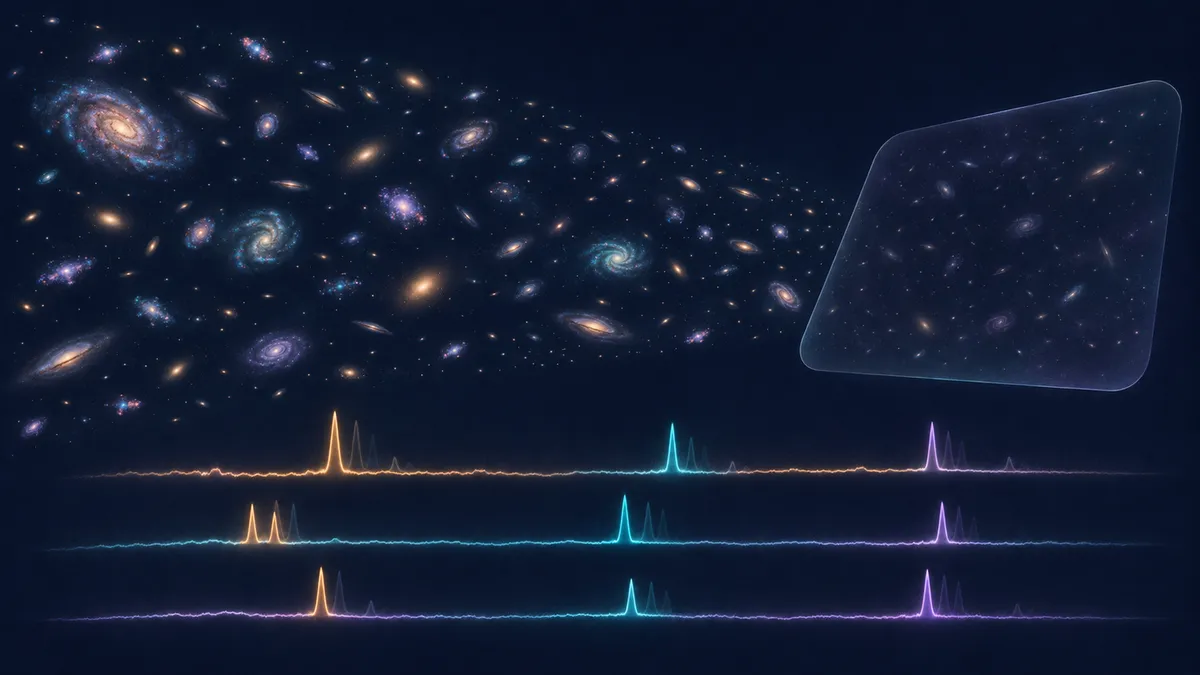
How many galaxies will Euclid identify from bright features in their spectra? A new simulation study predicts large samples, while showing why counts depend on galaxy models, measurement choices and which emission lines astronomers search for.
Euclid could recover roughly 42 million galaxies emitting the hydrogen-alpha line in its wide survey, according to a new forecast from the Euclid Collaboration. The authors also predict about 1.7 million such emitters in the mission’s deep survey. These are simulated sample sizes, not galaxies counted in Euclid observations, and the selected samples include some objects assigned incorrect redshifts.
The study, led by P. Cassata and colleagues, is an arXiv preprint, version 2611.05484v1, submitted on November 3, 2026. Its landing page lists submission to Astronomy & Astrophysics, not an accepted publication. The central message is both promising and cautionary: Euclid should assemble substantial spectroscopic samples, but forecasts for some lines depend strongly on how galaxies and observations are modelled.
Reading the universe through bright lines
Emission lines are bright features at particular wavelengths in a galaxy’s spectrum. Hydrogen and oxygen lines help astronomers investigate star formation, dust and the conditions of galactic gas. Identifying the lines also provides redshifts, measurements of how their wavelengths have shifted as the universe expands.
Hydrogen-alpha, or Hα, is Euclid’s primary spectroscopic tracer for mapping cosmic structure. At sufficiently high redshift, however, it moves beyond the instrument’s wavelength coverage. Oxygen lines, labelled [O II] and [O III], could extend studies beyond redshift two, reaching epochs inaccessible through Hα alone. That opportunity motivates forecasting more than the mission’s principal hydrogen-line sample.
The authors compare predictions for the Euclid Wide Survey, covering approximately 14,000 square degrees, with the deeper observations planned across 53 square degrees. The deep survey’s longer exposures and broader spectral coverage offer better opportunities to detect multiple lines from the same galaxy and resolve ambiguous identifications.
From model galaxies to measured samples
The team first compared mock galaxy catalogues called MAMBO, SPRITZ, Flagship and GAEA. Their approaches differ: some assign properties using observed relationships, while others incorporate physical prescriptions for galaxy formation and gas emission. Not every catalogue covers every line or the full relevant redshift range.
Predictions agree more closely for the blended Hα and neighbouring nitrogen-line complex than for oxygen emission. The authors report relative scatter among wide-survey mock predictions of about 19% for that hydrogen-plus-nitrogen blend, compared with 44% for [O II] and 41% for [O III]. These figures describe disagreement between models, not statistical error bars on a future measurement.
Next, the researchers used MAMBO alone to generate simulated one-dimensional spectra with FastSpec. They included instrumental blurring, spectral dispersion, detector noise and diffuse foreground light, then processed the spectra through Euclid’s official spectroscopic pipeline to estimate redshifts and line fluxes. Average corrections compensated for light lost or underestimated in this particular setup.
Within that framework, the authors forecast about 1.3 million [O II] and 7.6 million [O III] emitters in the wide survey. The corresponding deep-survey forecasts are roughly 570,000 and 830,000. These are conditional predictions from one input population and recovery procedure, not an average across the competing models.
Why a recovered count is not a clean census
Measurement noise complicates the comparison. Galaxies intrinsically below the selection threshold can enter the measured sample if their estimated, corrected line flux rises above it. Others fall out. Thus, a measured count can exceed the intrinsic flux-limited count without every additional object being a wrongly identified galaxy.
Pipeline choices matter too. In the wide-survey simulation, the redshift estimator preferentially interprets a lone emission line as Hα. That helps the primary target selection but suppresses recovery of high-redshift [O II] galaxies when no other line is visible. The deep-survey analysis does not impose that preference and benefits from additional spectral coverage.
Important complications remain outside the experiment. The isolated one-dimensional spectra omit overlap and contamination from neighbouring sources, plus additional detector and observation-level systematics. The input selection also excludes fainter emitters and passive galaxies that could contribute contamination. MAMBO’s small simulated sky area may miss rare, exceptionally luminous sources, and the flux corrections are not universal calibrations for Euclid.
The paper does not test its forecasts against Euclid’s available Q1 observations. Nor do its diagnostic recovery rates establish the performance of the official cosmology sample, which requires dedicated selection and validation. The potential to extend cosmic mapping is therefore a scientific prospect, not a demonstrated cosmological result.
This account is based on the supplied extracted paper text, the original versioned arXiv landing page and metadata derived from that page. The extraction omits images and may damage table or equation layout; the figures were not independently inspected.
- Euclid
- emission-line galaxies
- spectroscopy
- galaxy evolution
- cosmology
- survey forecasts
- MAMBO
- preprint
Related reading
Automatically matched by shared topic keywords. These links do not imply that the sources agree or establish a consensus.
Euclid simulations expose the galaxies a bright-line survey can miss
Source published
Shared keywords: galaxy evolution
Galactic Light Echoes Reveal Candidates for Fading Black Hole Activity
Source published
Shared keywords: galaxy evolution
How JWST Could Trace the Seeds of the First Massive Black Holes
Source published
Shared keywords: galaxy evolution