TRANSMISSION // 2611.05474v1
How Decaying Dark Matter Could Puff Up a Galactic Halo
Source published
Simulations suggest that recoil from hypothetical dark matter decays can redistribute a halo’s mass and flatten its inner density profile. A new preprint also introduces a fast predictor of these changes, while identifying numerical limits near the center.
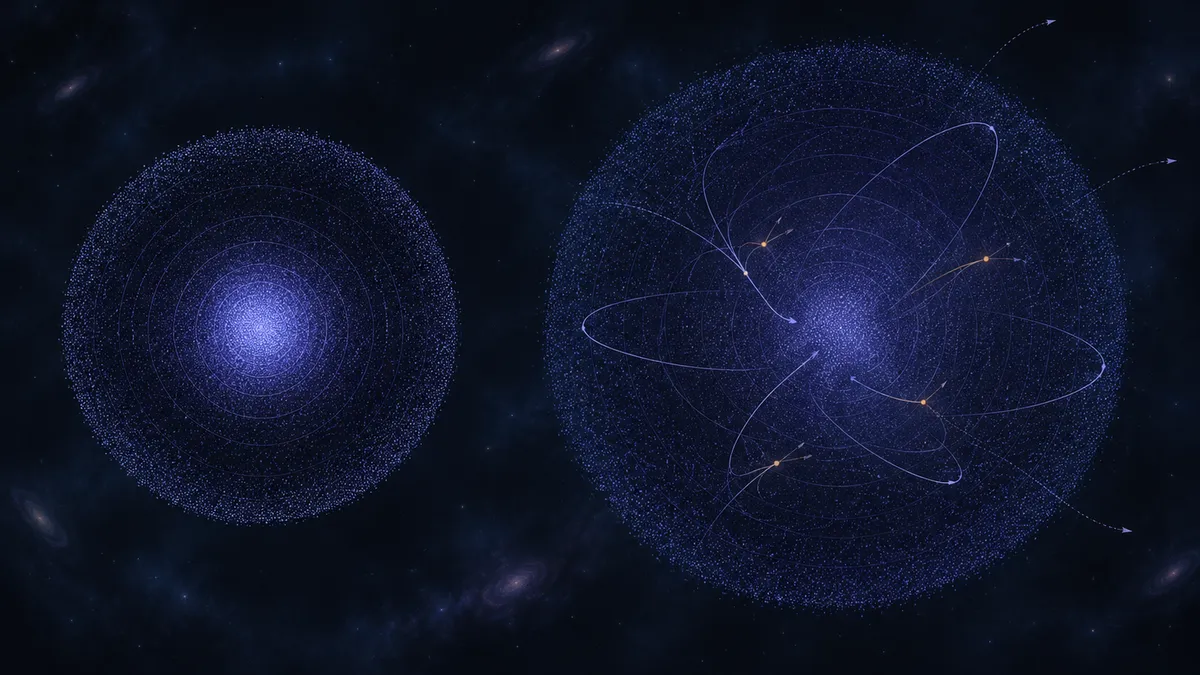
A tiny particle-level kick could reshape a galaxy’s invisible surroundings. Researchers are modeling how that possibility might leave a gravitational signature astronomers could eventually test.
Dark matter’s identity remains unknown, but its gravitational effects reveal extended halos around galaxies. What would happen to those halos if their constituent particles slowly decayed, giving their replacements a small shove?
Anna Bencke, Marc Kamionkowski, Annika H. G. Peter and Juniper Morales investigate that question in Dynamics of self-gravitating halos with decaying dark matter, an arXiv preprint submitted on November 3, 2026. Their evidence comes from computer simulations, not a detection of dark matter decay. The provided version does not establish peer-reviewed status.
The authors find that decay-induced kicks can expand a halo and reduce its central density. They also build a computational shortcut for predicting the resulting density profiles. Both results come with boundaries: the calculations assume spherical symmetry, use a particular starting profile and cannot reliably resolve the innermost region.
How a small kick changes a halo
The model starts with a dark matter particle that decays into two products: a slightly lighter massive particle and a massless, non-interacting particle. The massive daughter receives a recoil velocity in a random direction.
These kicks inject kinetic energy into the halo. A sufficiently large kick can send a particle beyond gravity’s hold; a smaller one can leave it bound but move it onto a more extended orbit. Across many particles, the halo can puff outward rather than simply disappear.
The important comparison is between the kick speed and the halo’s characteristic speed. The decay lifetime also matters because it determines how quickly the energy arrives. However, a halo can continue rearranging after the decays finish: particles launched onto long, stretched orbits take time to redistribute themselves.
Simulating the invisible structure
The team uses NSphere, a code that treats a spherical gravitational system as concentric shells. Spherical symmetry makes gravity much cheaper to calculate than in a general three-dimensional simulation, allowing the authors to explore many combinations of decay lifetime and kick speed.
Each simulation contains one million particles and begins with a Hernquist density profile, a mathematical description with a steep central rise and declining outer density. The main simulation grid and emulator runs last 200 characteristic time units—about 10 billion years for the authors’ illustrative Milky Way-scale halo.
Across their simulations, low kicks produce little structural change. Larger kicks produce shallower inner density profiles and steeper outer ones. The authors also report lower central radial velocity dispersions in the relaxed remnants. Injecting energy can therefore leave the final, expanded halo with a smaller spread of radial speeds near its center.
The team separately examines whether the particles’ initial orbital preferences matter. Some starting halos favor radial, plunging trajectories; others favor tangential motion. In a controlled comparison using a kick of one-quarter of the characteristic speed, the runs evolve for only 5 characteristic time units, with a decay lifetime of 1 characteristic time unit. At that shorter duration, the radially biased halo experiences the greatest inner-density reduction relative to its matched non-decaying control.
The authors interpret this as an angular-momentum effect: kicks can redirect plunging orbits so that they no longer reach as close to the center. Their calculations also show that the inner halo tends toward a common, mildly radial orbital distribution, while the outskirts retain more memory of their starting conditions.
A shortcut, with a specific accuracy claim
To make these simulations easier to use, the researchers train an emulator—a fast mathematical predictor—on a grid of 100 simulated halos. It compresses the density changes into four main patterns and interpolates how strongly each pattern contributes for a given kick and lifetime.
On 18 independent test simulations, the authors report a median fractional density error of about 1%, with a 90th-percentile error of about 2%, within the validated radial range. This measures agreement with their simulations, not accuracy against real galaxies.
They also find that the final mass inside a fixed aperture depends mainly on kick strength and only weakly on lifetime across the sampled range. That result has an important condition: the runs continue long enough for essentially all particles to decay. It should not be generalized to halos in which most decays have yet to occur.
Where the predictions stop
Numerical evolution can itself flatten a simulated halo’s center. The authors therefore compare decaying halos with an evolved non-decaying control, rather than attributing every change from the starting profile to new physics.
Even with that correction, their convergence check shows residual differences of a few percent typically, reaching roughly 10% within the validated region. Below about one-tenth of the scale radius, systematic numerical bias excludes reliable emulator predictions. The reported 1% interpolation error does not remove those underlying numerical uncertainties.
The emulator also applies only within its sampled decay parameters and uses initially isotropic Hernquist halos. Extending the approach to other profiles and connecting it quantitatively to galaxy observations remains future work. The contribution is a faster route from a hypothetical particle decay to a predicted halo structure—not evidence that dark matter actually decays.
- dark matter
- decaying dark matter
- galactic halos
- computational astrophysics
- NSphere
- orbital anisotropy
- density-profile emulator
- cosmology preprint
Related reading
Automatically matched by shared topic keywords. These links do not imply that the sources agree or establish a consensus.
Reading the Hidden Histories of Faint Galaxies Through Their Star Clusters
Source published
Shared keywords: dark matter
Radio galaxies masquerade as tiny gravitational lenses
Source published
Shared keywords: dark matter
A Sharper View of the Milky Way’s Hidden History
Source published
Shared keywords: dark matter
PrimordialPy connects inflation models to predictions of ancient black holes and cosmic ripples
Source published
Shared keywords: dark matter
Halo Stars Help Put the Milky Way’s Mass Near 1.3 Trillion Suns
Source published
Shared keywords: dark matter