TRANSMISSION // 2611.05467v1
When Cleaning the Sky Erases a Galaxy Cluster’s Faint Glow
Source published
A scale-based analysis warns that some survey background-subtraction settings can remove diffuse intracluster light along with the sky. The authors identify where measurements face greater risk, rather than measuring how much light is lost.
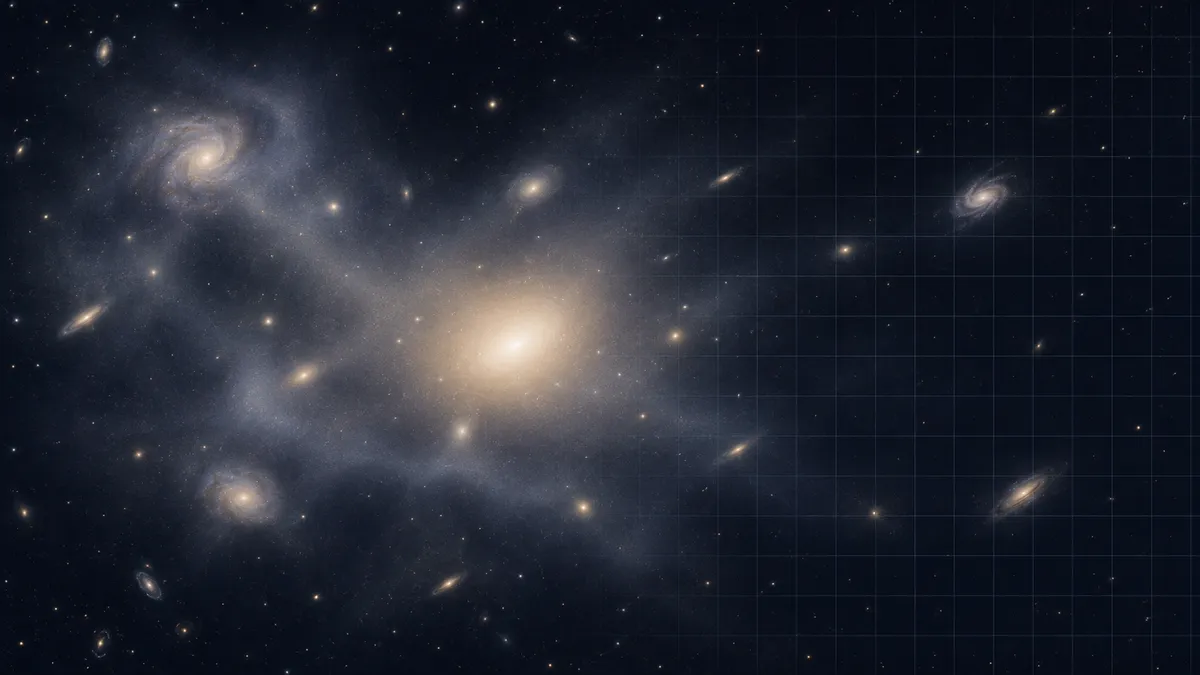
Finding a galaxy cluster’s faintest glow requires more than a deep exposure. Astronomers must also ensure that the processing used to clean an image does not erase the signal they want to study.
The faint, diffuse light spread through a galaxy cluster can help astronomers reconstruct its assembly and dynamical history. But before researchers can measure this intracluster light, they must separate it from the image’s sky background. A new analysis highlights a danger in that essential step: software can mistake extended astronomical emission for background and subtract it away.
Giulia Golini, Sarah Brough, Mireia Montes and Aaron Watkins examine this problem in How sky subtraction scales affect Intracluster light measurements. Their paper is available as the November 3, 2026 arXiv version-one preprint. The landing page reports acceptance for publication in RNNAS; that statement alone does not establish its peer-review history.
Why background removal can go too far
Survey images contain background variations associated with the atmosphere and instruments. Processing pipelines estimate and remove that background, often using a grid of local regions. According to the authors, standard survey processing is optimized for compact sources and primary cosmological goals, which can leave very extended, faint structures vulnerable.
The problem arises when diffuse emission is not adequately masked before the background is estimated. If the estimation regions are comparable in size to the astronomical structure, some of its light may be treated as sky. The authors describe possible consequences including underestimated galaxy outskirts and artificial dark depressions around bright galaxies.
Intracluster light is especially exposed because it extends across large areas. A deeper image therefore does not automatically guarantee a better measurement: processing must preserve the faint emission as well as detect it.
Comparing the size of the signal with the processing grid
The study is a comparison of characteristic scales, not a direct experiment measuring lost light in newly processed images.
The authors begin with halo mass, expressed as M500, and assume a Navarro–Frenk–White halo profile. They convert between halo-mass definitions, derive a characteristic halo radius, and use an existing relation to estimate the central galaxy’s effective radius. They then adopt six times that effective radius as a representative extent for intracluster light.
Next, they compare that modeled extent with survey background-estimation grid sizes across halo mass and redshift. Published cluster and group measurements are plotted for reference. Those reference systems help locate real astronomical targets within the comparison; they are not new measurements of sky-subtraction errors.
The grid sizes differ substantially. Hyper Suprime-Cam Public Data Release 2, or HSC-PDR2, uses regions approximately 2.8 arcminutes across. HSC-PDR3 uses much smaller regions, about 21.5 arcseconds across, while Rubin Observatory’s LSST Data Preview 2 uses about 25.6 arcseconds. Smaller background-estimation regions can put more extended emission at risk.
Where the authors identify greater risk
Under the study’s assumptions, Golini and colleagues find that the HSC-PDR3 and LSST Data Preview 2 scales can affect groups and clusters with M500 above roughly 25 trillion solar masses across the redshifts considered. This identifies susceptibility to oversubtraction, not a finding that every such system loses a particular fraction of its light.
The larger HSC-PDR2 scale leaves a broader range of systems less exposed in this comparison. The authors place its principal risk among nearby, massive clusters: redshifts below 0.1 and M500 above roughly 126 trillion solar masses.
For the full ten-year LSST survey, they discuss an anticipated background-modeling scale of approximately 13.6 arcminutes. Their comparison suggests that this larger scale would mitigate the bias, leaving mainly the nearest and most extended systems vulnerable. However, this setting is an expectation cited through private communication, not a demonstrated outcome from completed ten-year survey processing.
A warning map, not a correction formula
The paper explicitly describes its scale boundary as a threshold of increasing risk. Actual oversubtraction also depends on source properties, observing conditions and image analysis. Its assumed intracluster-light extent is another limitation: changing that extent by a factor of two shifts the boundaries, although the authors report that nearby, massive clusters remain the most susceptible.
The analysis does not supply object-by-object corrections or quantify the fraction of light removed. Its practical contribution is a framework for assessing whether standard survey products are suitable for a particular diffuse-light study. The central lesson is not that deep surveys cannot recover intracluster light, but that preserving it requires background modeling and masking designed with extended emission in mind.
- intracluster light
- sky subtraction
- low surface brightness
- galaxy clusters
- survey image processing
- Hyper Suprime-Cam
- LSST
- astronomy preprint
Related reading
Automatically matched by shared topic keywords. These links do not imply that the sources agree or establish a consensus.