TRANSMISSION // 2611.05461v1
Catching a Neutron Star Merger’s Light Before It Fades
Source published
Simulations suggest coordinated optical, space-based and radio observations could turn a handful of neutron star mergers each year into detailed studies of their ejecta and jets. The forecasts depend on merger rates, emission models and successfully finding the counterpart.
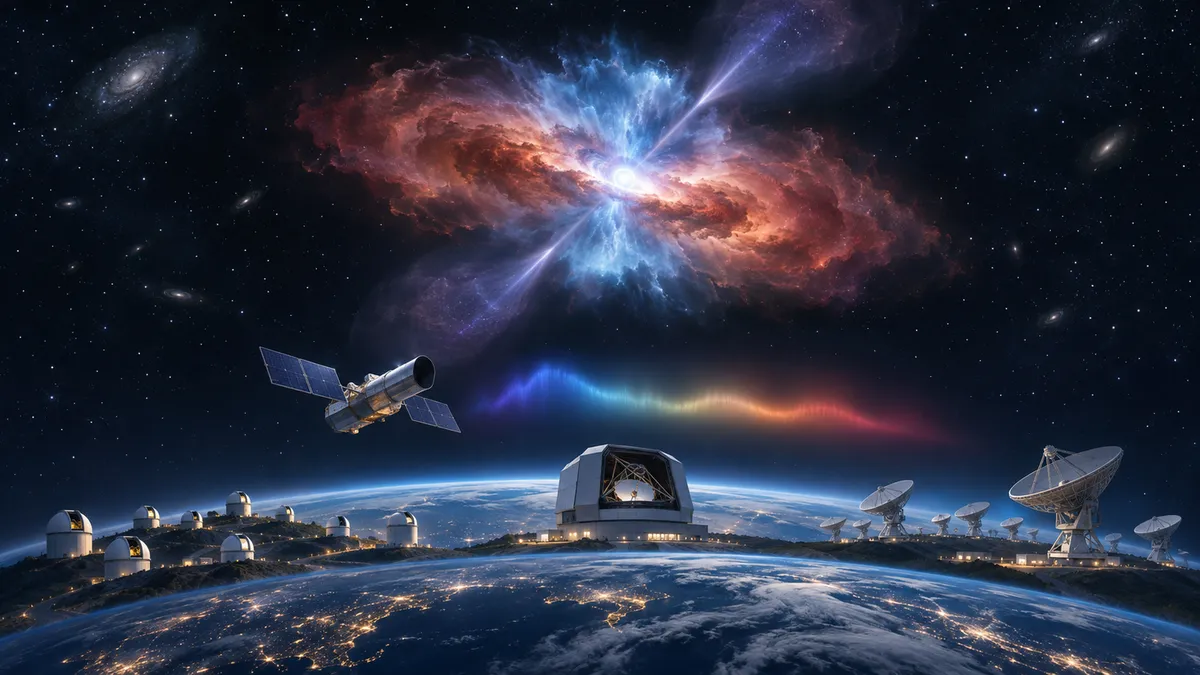
A gravitational-wave alert announces a collision, but its fading light carries different clues. A new preprint explores how observatories could work together to capture those clues over hours, days and years.
When neutron stars collide, the gravitational waves are only part of the story. Material thrown into space can produce a rapidly changing glow called a kilonova, while a successfully launched jet can generate a longer-lived afterglow. Together, these signals offer clues to the merger’s debris, heavy-element production and jet physics.
The difficulty is catching enough of them, quickly enough. More sensitive gravitational-wave detectors can reach farther into the universe, but the accompanying light becomes fainter with distance. Finding a transient across a large patch of sky is also a different task from measuring its spectrum before it fades.
In an arXiv preprint submitted on November 3, 2026, Keerthi Kunnumkai and colleagues investigate how the Schmidt Observatory System, working alongside the Vera C. Rubin Observatory, could tackle that problem. The manuscript says it was submitted to The Astrophysical Journal; the supplied version does not establish peer-reviewed acceptance. Its results are forecasts from simulations, not observations of a newly discovered merger population.
A relay between observatories
The proposed division of labour is straightforward. The Argus Array and Rubin would provide wide-field optical searches. Once a counterpart was identified, the planned Lazuli Space Observatory would collect images and spectra. The Deep Synoptic Array, or DSA, would look for radio afterglows from jets interacting with surrounding material.
Lazuli’s planned spectrograph would cover optical and near-infrared wavelengths simultaneously, from 0.4 to 1.7 micrometres. That matters because kilonovae cool and become redder as they evolve. Space-based observations would also avoid atmospheric absorption and weather losses.
The authors simulated binary neutron star and neutron star–black hole mergers at the anticipated sensitivity of the LIGO–Virgo–KAGRA network’s fifth observing run, O5. They drew merger properties from a population model informed by gravitational-wave observations, assumed a 70% duty cycle for each detector and adjusted the binary neutron star merger rate to account for the absence of such detections in O4.
They then assigned model kilonova emission to mergers producing sufficient ejecta, compared the resulting brightness with survey limits and estimated Lazuli exposure times. Separate calculations modeled jet afterglows.
A few events, followed closely
In the detailed results, the authors estimate annual binary neutron star kilonova detection rates of approximately 0.3–4.2 for Argus and 0.6–6.6 for Rubin. Their combined estimate is 0.7–8.2, rather than the sum, because the samples overlap. The abstract gives a slightly higher Rubin upper bound of 7.0; these are approximate, model-dependent forecasts.
Neutron star–black hole kilonovae are less promising in the adopted models. Only about 7% of the simulated mergers of that type produce a kilonova, and the combined optical detection forecast is roughly 0.2–0.8 per year.
For spectroscopy, the team used observations and spectral models of AT2017gfo, the kilonova associated with GW170817, as a reference. At a simulated distance of 521 megaparsecs, Lazuli could obtain a target signal-to-noise ratio of 20 with about 0.8 hours of exposure at 1.4 days after merger, increasing to about 5.6 hours at 6.4 days. Those signal-to-noise estimates concern the redder 0.7–1.7 micrometre range, not uniformly the entire instrument band.
An illustrative densely sampled sequence for another simulated event required about 28 hours of spectroscopy. The authors estimate an annual commitment of roughly 100 hours for a few binary neutron star kilonovae, while stressing its sensitivity to their distances.
Seeing features is not identifying elements
Spectra could reveal broad features as the ejecta evolve. They would not automatically provide an unambiguous inventory of heavy elements.
Rapid expansion blends atomic lines, and atomic data for many heavy elements remain incomplete or poorly calibrated. The authors explicitly distinguish detecting spectral features from securely identifying the ions responsible. Their population and exposure calculations use POSSIS models; their investigation of identifiable features instead uses AT2017gfo-like TARDIS spectral models, because the adopted POSSIS opacity treatment does not retain the necessary element-by-element information.
Radio observations add another timescale. DSA could detect about 35% of the simulated binary neutron star events that successfully launch jets with six-hour exposures—not 35% of all mergers. Off-axis afterglows can become detectable hundreds of days after the initial collision.
The central limitation comes before this observational relay even begins: the study assumes the correct counterpart has already been identified. It does not simulate separating it from unrelated transient alerts. Afterglow forecasts also omit sky-observability constraints, while the wider predictions depend on assumed merger populations, neutron star matter and emission models.
The study therefore offers a conditional observing plan, not a guaranteed discovery tally: find the light promptly, measure its changing spectrum, and return much later for the radio signal.
- gravitational waves
- kilonovae
- neutron star mergers
- Schmidt Observatory System
- Lazuli Space Observatory
- Argus Array
- Rubin Observatory
- Deep Synoptic Array
- multimessenger astronomy
- spectroscopy