TRANSMISSION // 2611.05455v1
A binary star in Sagittarius’s Teapot reveals its orbit—and a distance problem
Source published
A preprint combines telescope interferometry, archival spectra and century-old velocity measurements to characterize Nandou, also called Phi Sagittarii. The authors report a roughly 239-day binary orbit, but uncertain distance measurements limit the stellar masses. Their analysis also suggests that a later processing of Hipparcos observations suppressed part of the system’s orbital signal.
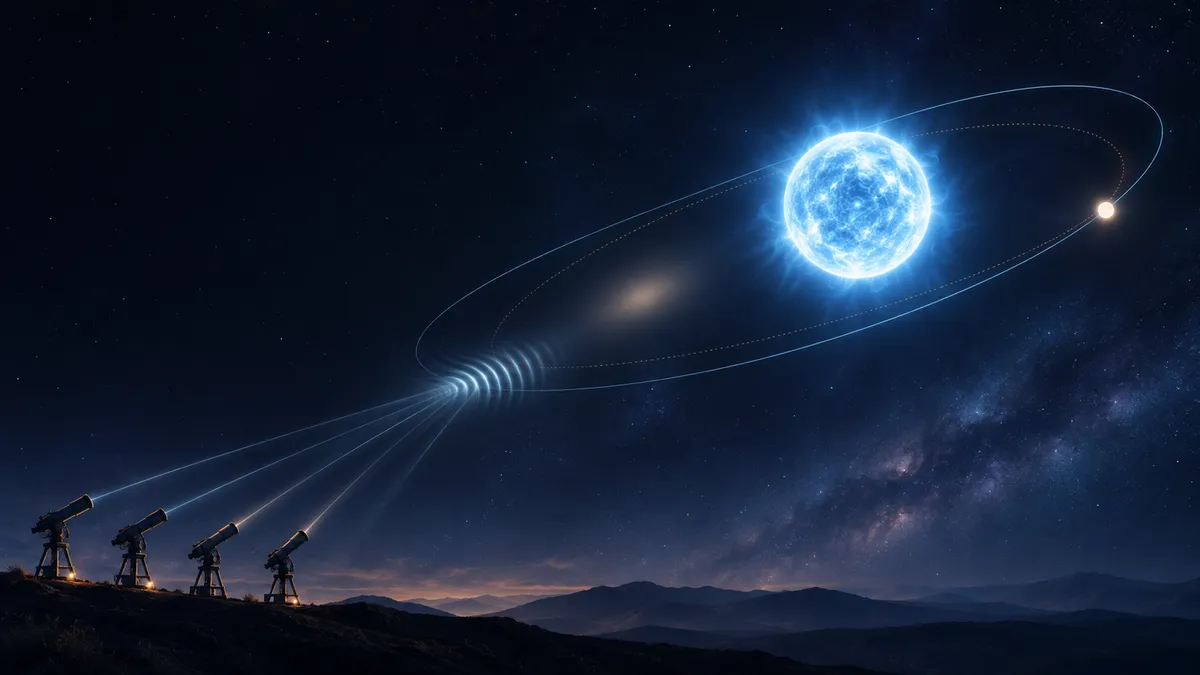
One of the stars outlining Sagittarius’s familiar Teapot is a closely spaced pair. A new analysis reconstructs their orbit while showing why precise-looking measurements do not always provide the most reliable picture of a moving stellar system.
Two stars behind one familiar point of light
Nandou, also known as Phi Sagittarii, belongs to the Teapot pattern in Sagittarius. Its companion had already been detected with the GRAVITY instrument at the Very Large Telescope Interferometer. In a November 2026 arXiv preprint, Idel Waisberg and Boaz Katz bring together several kinds of observations to determine the pair’s orbit and estimate the properties of its stars.
The authors report an orbital period of 238.844 ± 0.011 days and an eccentricity of 0.418 ± 0.004, indicating a distinctly noncircular orbit. They estimate the relative orbit’s semi-major axis—a measure of its size—at 1.32 ± 0.10 astronomical units. That physical scale, unlike the angular orbit measured on the sky, depends on the system’s distance.
Building an orbit across a century
The analysis uses five GRAVITY observations from 2024 alongside two earlier observations from 2017. Interferometry combines light collected by separated telescopes to distinguish structures too closely spaced for the individual telescopes to resolve. Here, it tracks the companion’s changing position relative to the brighter star.
The companion supplies about 6.5% as much light as the primary in the near-infrared K band. In the optical spectra, however, the primary dominates: the researchers find no identifiable spectral lines belonging to the secondary.
To measure the primary’s motion toward and away from Earth, they analyze five archival spectra obtained between 2011 and 2015. They also recover historical radial-velocity measurements reaching back to 1903. Together, the velocity observations span 112 years, helping constrain the repeating orbital cycle over a much longer interval than the interferometric observations alone.
The historical sources did not supply measurement uncertainties. The authors estimate a typical uncertainty of about three kilometres per second from their orbital fit. They also note that the combined fit suggests some observational errors may be underestimated by up to roughly 20%. These qualifications matter when interpreting the reported precision.
Why distance remains the weak point
The authors derive masses of 3.8 ± 0.9 times the Sun’s mass for the primary and 1.6 ± 0.4 for the secondary. Their main limitation is parallax, the apparent positional shift used to estimate distance.
For an unresolved binary, a position measurement follows the light-weighted centre, or photocentre, rather than either star individually. Its orbital movement can complicate the separation of parallax from other apparent motion. The paper argues that this helps explain discrepancies among published distance estimates for Nandou.
The researchers revisit observations from the Hipparcos satellite, comparing its original 1997 processing with a 2007 reprocessing. The original data are compatible with the photocentre orbit expected from their binary model. The later processing instead yields a substantially smaller orbital signal: a semi-major axis of 1.7 ± 0.3 milliarcseconds, rather than approximately five.
They interpret this mismatch as evidence that the later treatment of the satellite’s changing orientation fitted away some genuine stellar motion. Consequently, they decline to adopt its formally more precise parallax. Using the original data, they choose a conservative parallax of 12.5 ± 1.0 milliarcseconds, corresponding to about 80 parsecs. This is a warning about the particular dataset, not a demonstration that every reprocessed Hipparcos measurement is unreliable.
A probable evolutionary stage, not a direct measurement
Spectral modelling and measurements of brightness across ultraviolet, visible and infrared wavelengths support a primary temperature of about 12,000 kelvin. The inferred radius is 5.1 ± 0.4 times the Sun’s radius, with its uncertainty also dominated by distance.
Comparison with stellar-evolution models favours a roughly four-solar-mass primary near the end of its main-sequence lifetime, when hydrogen burning in the core is nearing completion. The preferred model interpretation gives an age near 150 million years. The secondary’s infrared brightness is consistent with a main-sequence star.
These evolutionary conclusions are model-dependent. The authors explicitly state that the present dynamical mass is not precise enough to test the evolutionary mass estimate.
A possible future partnership
The paper also sketches a likely future, rather than reporting an observed transformation. As the primary expands, tidal interactions should make the orbit more circular before substantial mass transfer begins. Later, unstable transfer could place both stars inside a shared gaseous envelope.
A rough energy comparison suggests that the pair could expel that envelope and survive as a closer white-dwarf–main-sequence binary. Much later, expansion of the secondary could produce a symbiotic system. This proposed sequence depends on assumptions about stellar evolution and envelope ejection.
A more immediate prospect is better astrometry. The authors identify a possible future Gaia orbital solution as a route to a more reliable parallax—and therefore much tighter stellar masses. For now, the preprint establishes a detailed orbital interpretation while leaving distance as the central uncertainty.
- Nandou
- Phi Sagittarii
- binary stars
- stellar interferometry
- VLTI/GRAVITY
- Hipparcos
- parallax
- stellar evolution
Related reading
Automatically matched by shared topic keywords. These links do not imply that the sources agree or establish a consensus.