TRANSMISSION // 2611.05448v1
Jev-AD tests whether looking two seconds ahead improves language-guided driving
Source published
A preprint pairs a fast language-based decision model with predictions of nearby traffic. Collisions fell sharply in simulated merging and replayed freeway traffic, but the results do not establish real-world driving safety.
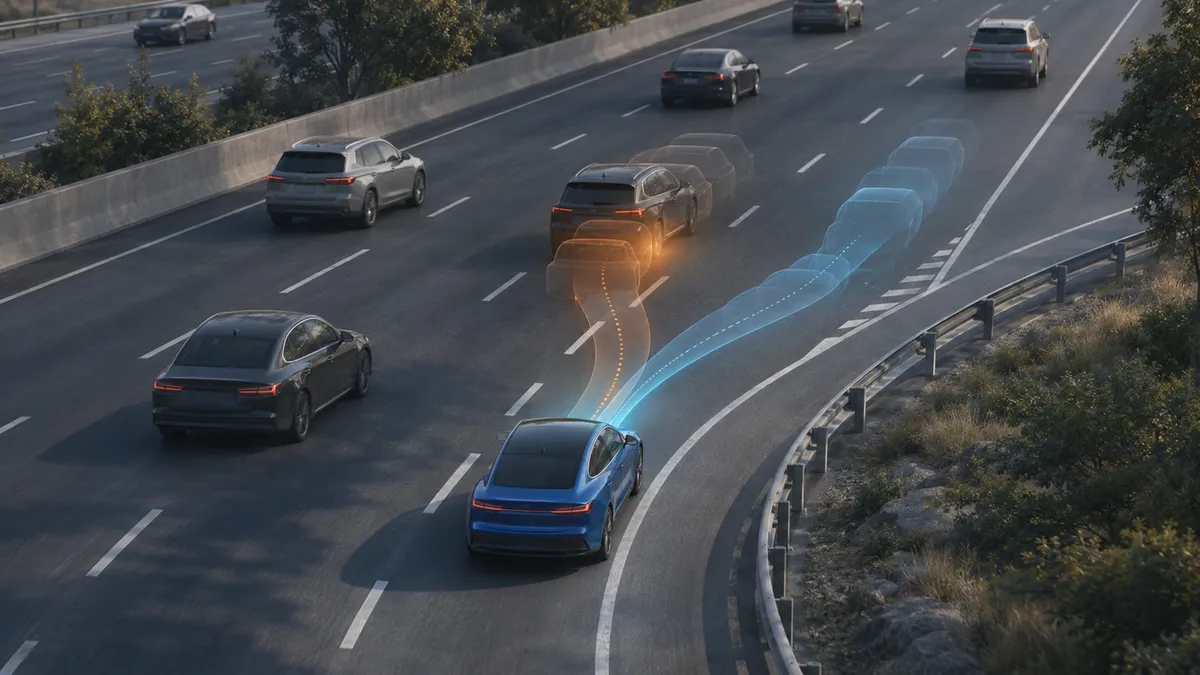
A passenger’s request to change lanes can be easy to understand and dangerous to execute immediately. Jev-AD separates interpreting that request from predicting its consequences, giving a decision model short descriptions of what each available action could lead to.
Understanding a request is not enough
“Please get me there quickly” tells a driving system something about a passenger’s priorities, but not whether accelerating is safe. In an arXiv preprint submitted on November 3, 2026, Purdue University researchers Yansong Qu, Jiancong Chen and Samuel Labi investigate whether explicit predictions can help a language-guided driving agent make that distinction.
Their system, Jev-AD, combines Jev, a proprietary typed decision model, with a smaller language world model that predicts traffic movements over two seconds. The central result is not that a language model can drive safely on public roads. It is that giving a fast decision model explicit forecasts substantially reduced collisions in the authors’ simulated and replay-based evaluations.
From passenger language to predicted consequences
Unlike a chatbot that generates an explanation before answering, Jev assigns probabilities to predefined answers. When a passenger speaks, it assesses whether the request is unsafe or unrelated to driving, how aggressively the passenger wants to travel, and whether a particular maneuver is requested. Depending on its unsafe-request score, the system can refuse a command or hold it for clarification.
Every half-second, the driving agent chooses among available actions: change left, change right, maintain its target lane and speed, accelerate, or slow down. The world model supplies predictions for those choices rather than leaving Jev to infer their consequences from vehicle coordinates.
The predictor uses a Qwen2.5-0.5B backbone adapted with LoRA. In the simulated multi-vehicle setting, it reads four recent scene snapshots and predicts acceleration and steering for the ego vehicle and up to eight nearby vehicles. A bicycle model converts these controls into trajectories. Code then calculates possible collisions, time to collision, and the vehicle’s final lane and speed, presenting the results as short verbal descriptions.
This division matters: numerical safety calculations are performed by code, while Jev compares the resulting descriptions against the passenger’s request. Avoiding actions labeled as dangerous is an instruction to the model, however, not an enforced safety filter.
Large reductions in simulated collisions
The main merging experiment comprised 500 car-episodes: 50 scenes, five command conditions and two autonomous vehicles. Using the same Jev decision model and command-grounding procedure, the researchers reported collisions in 26.0% of car-episodes with KoMA’s scene-description input, versus 2.4% with learned world-model foresight. Completion rose from 73.8% to 97.6%.
A simpler predictor that assumed surrounding vehicles maintained their current speed and heading also performed well, reducing collisions to 2.8%. That comparison supports the authors’ interpretation that making consequences explicit contributed more to the collision reduction than the particular learned prediction method.
The learned model nevertheless helped with some behaviors. Under stop requests, the constant-velocity version often predicted that braking would expose the car to a rear-end collision. It stopped successfully in 90 of 100 requests, compared with all 100 for the learned-model version.
A Jev-AD decision took about 0.25 seconds, including foresight, within the experiment’s half-second decision period. Importantly, the simulation waited for each decision: the reported driving outcomes therefore do not measure what happens when a controller misses a real-time deadline.
Commands and recorded traffic
In separate command-following tests, Jev-AD achieved the intended behavior in 92.9% of trials across 24 scored commands, including paraphrases, negations and Chinese requests. Two additional borderline commands were not scored for intent because the researchers assigned them no correct answer. This is a result on the study’s command set, not evidence of general language reliability.
The researchers also tested 500 episodes using NGSIM freeway recordings. These were not road trials. A simulated autonomous vehicle replaced a recorded driver, while other vehicles generally followed recorded trajectories. When specified following-gap conditions were met, an IDM car-following model controlled their reactions within their recorded lanes.
In that setting, collisions fell from 48.2% with Jev’s scene-text input to 2.8% with learned foresight. Constant-velocity foresight achieved a lower collision rate of 1.8%, so the learned predictor was not uniformly safer. Its advantage included faster stopping: 1.8 seconds on average after a stop request, versus 3.4 seconds with constant-velocity predictions.
What remains untested
No vehicle was tested. The agent received ground-truth state information rather than imperfect perception, used a small action menu, and left low-level control to the simulator. Separate world models were trained for simulation and NGSIM, without cross-setting testing.
The predictor also provides no uncertainty estimate or mechanism to recognize unfamiliar inputs. Together with the absence of a hard collision filter, these limits make the study evidence for a decision-making approach—not a demonstration of deployment-ready autonomous driving.
- autonomous driving
- Jev-AD
- language world models
- trajectory prediction
- natural-language commands
- traffic simulation
- NGSIM