TRANSMISSION // 2611.05447v1
Cleaner galaxy images are not enough: denoising must preserve the light
Source published
A PAU Survey preprint reports that a self-supervised image-denoising method can make faint galaxies look clearer while substantially underestimating their fluxes. Modifying the network and fine-tuning it with photometric objectives improves repeated-exposure consistency, but wavelength-dependent biases remain important for scientific interpretation.
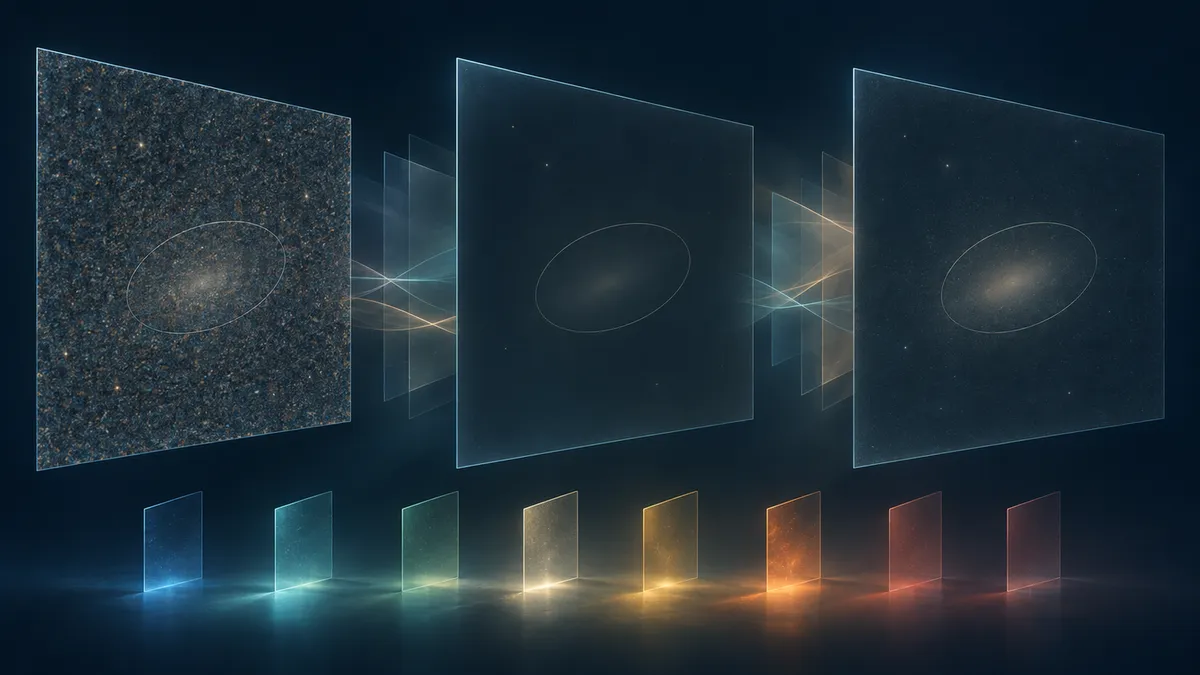
Astronomers need more than attractive images: they need reliable measurements of the light those images contain. J. Chen and colleagues test that distinction using PAU Survey observations, finding both promise and persistent limitations in machine-learning denoising.
When a better-looking image gives a worse measurement
Removing noise from an astronomical image sounds like an uncomplicated improvement. Yet an algorithm can suppress fluctuations while also suppressing the faint galaxy astronomers want to measure. A new preprint by J. Chen and colleagues makes this distinction central: visual clarity and reliable photometry—the measurement of light from a source—are different objectives.
The team studies Noise2Void, a self-supervised denoising method that learns from noisy images without requiring clean reference images. In simulations and observations from the Physics of the Accelerating Universe Survey, or PAUS, its standard implementation produces cleaner-looking images but systematically underestimates faint-galaxy fluxes. The researchers then introduce modifications intended to protect those measurements. These are reported preprint findings, not evidence of peer-reviewed validation.
Learning without a clean reference
Noise2Void hides selected pixels during training and predicts their values from surrounding pixels. The idea is that neighbouring pixels contain information about a coherent astronomical source, but should not reveal the particular noise fluctuation in the hidden pixel. This relies on assumptions about the noise, including independence between pixels.
The study uses calibrated PAUS observations of the COSMOS field and simulated galaxy images with known noiseless references. PAUS observes through 40 narrow-band filters, sampling light across many wavelength intervals. Such measurements can be especially noisy for faint sources.
The authors work with already reduced images, rather than raw detector exposures. This allows comparisons using the existing survey calibration, source positions and measurement apertures. However, processing can introduce weak correlations between neighbouring noise values. The team measures such correlations and reports background artefacts in tests of Probabilistic Noise2Void, a related method with an explicit noise model. Their final approach does not use that full probabilistic formulation.
Teaching the model to respect flux
The first modification limits large negative network outputs while still allowing some negative values. The authors find that this bounded-output model substantially reduces the downward flux bias affecting faint sources. Importantly, correcting the flux scale alone does not substantially improve agreement between repeated measurements.
A second stage therefore fine-tunes the model with low-rank adaptation, or LoRA. Most network weights remain fixed while a smaller set of added parameters is trained using two photometric objectives.
One encourages different exposures of the same galaxy, observed through the same filter, to yield consistent aperture fluxes. The other penalises changes relative to the original image’s aperture flux. Both are needed: simply shrinking every measurement could make repeated observations agree more closely without making them scientifically better.
What the reported improvement means
For the NB645 filter, the authors report a repeated-exposure difference width of 0.529 after LoRA fine-tuning, compared with approximately one for the original measurements. They interpret this as an effective reduction of roughly 47% in random flux scatter relative to the original PAUS uncertainty scale. For the faintest group, with i-band magnitudes from 22 to below 23, the reported width is 0.415.
These numbers require a qualification. The diagnostic divides differences between denoised measurements by the original catalogue uncertainties, not newly determined uncertainties for each denoised source. It measures repeatability relative to an existing reference scale; it does not independently establish absolute accuracy.
The median denoised-to-original flux ratio in the full NB645 sample is 1.031, suggesting preservation of the typical survey flux scale within a few percent. Nevertheless, very faint sources produce a long tail of large ratios because their original fluxes can be close to zero. A separate analysis across all 40 filters also reports improved repeated-exposure consistency, using evaluation pairs excluded from fine-tuning.
A downstream test exposes remaining bias
The researchers also examine D4000, an index comparing light on either side of a spectral break near 4000 angstroms. They present this as a consistency check, not a dedicated scientific analysis.
Denoising narrows the full-sample D4000 distributions and reduces their extreme high-value tails. But their central values also shift. The authors identify wavelength-dependent flux changes and explicitly treat the resulting shift as a residual systematic effect, not a physical change in the galaxies. Some galaxies consequently change classification under fixed thresholds.
Comparison with overlapping LEGA-C spectroscopy shows reduced scatter but a remaining offset. Different regions of galaxies contribute to the two surveys’ measurements, preventing this comparison from directly validating absolute calibration.
The broader limitation is equally important: original PAUS fluxes are noisy references, not ground truth, and the simulations simplify real backgrounds and noise. The work supports photometry-aware denoising as a promising approach within this setting. Transfer to other surveys remains future work. Its clearest lesson is methodological: judge restored images by the measurements they support, not merely by how clean they look.
- PAU Survey
- astronomical photometry
- self-supervised learning
- Noise2Void
- image denoising
- low-rank adaptation
- flux preservation
- measurement bias
Related reading
Automatically matched by shared topic keywords. These links do not imply that the sources agree or establish a consensus.